In late 2026, Warframe will take players to Tau, an entirely new solar system. But in what has become the norm for the long-running multiplayer game, creative director Rebecca Ford is looking backward and forward at the same time.
“The impossible task of anyone working on Warframe is choosing when to go new or choosing when to revisit,” Ford told Polygon on a recent call. The team is laying groundwork for Tau at a breakneck pace. Warframe’s fall update, The Iceblade of Narin will introduce a new Warframe and in-game hub on Sept. 23.
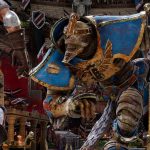
Then, on Oct. 15 a special event called Epoch Operation: Tau will launch, which is something that I will show to people who don’t know much about Warframe so that I can witness their bafflement (it involves piloting a skyscraper-sized spaceship that looks like a large nude humanoid).
As if that weren’t enough, the team is also launching a new six-player cooperative game mode called Glacial Defense, which is definitely not a raid.
“We had raids. They lived, they died, they’re gone,” said Ford. “We are auditioning for a role of six-player, slightly demanding gameplay. Do you show up?”
Warframe’s raids, officially known as Trials, were retired in 2018. At the time, design director Pablo Alonso explained that maintaining the game mode was a massive effort and timesink for the dev team — and that not enough players were actually engaging with it. Those who did though, seem to be diehards.
“There are players that know the old Warframe raids that stay around and talk about them to this day,” Ford said. Warframe has also become the de facto home for refugees from Destiny and Destiny 2. In Warframe they’re finding cool weapons, zippy gameplay, and probably less toxicity. But the challenge the Warframe devs face is, ironically, a lack of challenge. High-level players with a mind for synergy can sweep through missions in a matter of minutes, carrying lesser ones to the finish line on a wave of neon explosions.

Is this awesome? Absolutely. But there is presumably a growing contingent of people who want their dopamine rush served with a side of strategic teamwork.
“The selfish tangent to this, which is both incriminating and honest, is I have a group of friends I play Deadlock with and we lament that there’s nothing for us to do in Warframe because we have to leave two people out all the time,” Ford said. “So we’ll see — is there a social niche for this? Are there groups of six players that want to do some Warframe stuff together that can’t right now? And the answer to all those questions will be who knows, please be patient with us.”
In the two years that I’ve been playing Warframe, Digital Extremes has introduced multiple new Warframes, story quests, and now a solar system. In that same time, they have redone facial animations that date back to 2015, and periodically revamp older Warframes to bring their kits in line with the game’s modern, free-flowing gameplay. Not all the changes have been well-received in the moment: A horror mode called Follie’s Hunt proved destabilizing for a player community used to melting enemies with ease.

“I would say that was one of the low points of the year so far, which is great, which means we’ve only gone up since then,” said Ford.
Another adds more missions for the Railjack, a spaceship whose dogfight gameplay has been divisive. Revisiting it, said Ford, was “a dangerous thing for any Warframe dev to do.” Every change is a gamble — but a bold necessity — in a live-service game.
“The harshest reality check is when people disagree with your definition of fun for what I would call ‘our game,’ but the community would say, ‘No, no, this is actually our game, you make it for us,’” Ford said, laughing. “And we’re like, ‘Damn, they got us again!’ Any developer who accidentally or intentionally makes a live service game must experience the ritual or the witchcraft that separates the self from the service. You always wish you had more time. You always wish you had more resources, but you need to deliver something.”
Get Polygon’s Wishlister newsletter
A weekly cheat sheet to what you’ll eventually love to play. No buying, no
commitment — just saving for later.
Sign up free
Free. Unsubscribe anytime.
The reveal of Tau at TennoCon alleviated some of that pressure.
“I think people were like, ‘Oh, holy shit, this is what they’ve been working on,’” Ford said. “I think it’s what every publisher thinks they want, which is a live-service game that can just ‘print money,’ which is just not true because every dev team that is responsible for that lives in a very vicious world,” said Ford. “Our community has been gracious for those years, and we do not take that for granted. And all we can do is try our best to put out weird, fun things that we have fun making.”
Read Full Article At Source