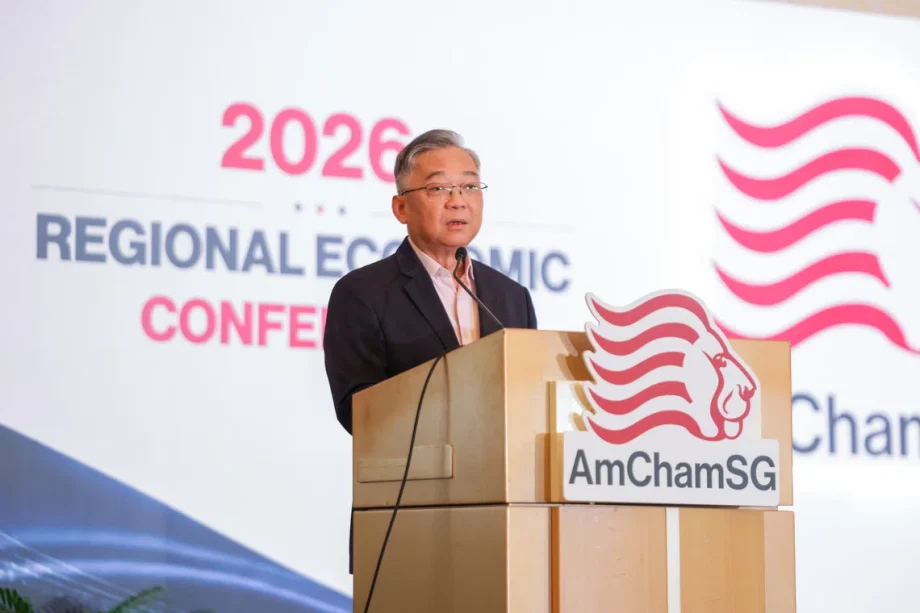
SINGAPORE – The longstanding economic relationship between Singapore and the US shows that trade and investment can support jobs in both economies, said Deputy Prime Minister Gan Kim Yong.
Speaking at the 2026 Regional Economic Conference organised by the American Chamber of Commerce in Singapore (AmChamSG) on Sept 8, DPM Gan said that since the US-Singapore Free Trade Agreement entered into force in 2004, bilateral trade has grown significantly, benefiting businesses and workers in both countries.
Today, bilateral trade and Singapore’s investments in the US support around 350,000 American jobs. Meanwhile, the US has maintained a substantial trade surplus with Singapore for more than two decades.
In 2025, that surplus exceeded US$33 billion (S$42 billion).
DPM Gan said that with around 6,600 American companies based here, the US is Singapore’s largest investor. And the Republic – despite its small size – is the third-largest Asian investor in the US, behind Japan and South Korea.
More than 250 Singapore companies operate across 45 US states, in sectors ranging from logistics and agribusiness to aerospace and shipbuilding.
“Our partnership shows that trade and investment can strengthen capabilities and support jobs in both economies,” he said.
And even as the US pursues today a renewed effort to rebuild its industrial capacity, strengthen strategic industries, and secure critical technologies and supply chains, DPM Gan said, strengthening capabilities at home and deepening engagement with trusted partners need not be competing objectives.
“American companies will be better placed to sustain growth and investment at home when they can also reach growing markets abroad, draw on reliable regional networks and deploy their technologies at scale.”
Hence, US economic renewal and more profound US engagement in South-east Asia can reinforce one another.
However, DPM Gan also noted that the US tariffs now in place, as well as the prospect of further measures, are weighing on business decisions and adding to uncertainty globally and in the region.
In July, Singapore became subject to a 12.5 per cent tariff, following a US Trade Representative investigation into 60 trading partners regarding their alleged failure to enforce prohibitions on imports made with forced labour.
Separately, US sectoral tariffs – with rates ranging from 25 per cent to 50 per cent – on steel, aluminium, copper and automotive parts also apply to some Singapore exports. Singapore is also on the list of countries that may face US tariffs aimed at excess manufacturing capacity in the future.
“We cannot remove every source of uncertainty. But by keeping channels open and working together, we can give businesses greater confidence to address these uncertainties and invest for the long term,” said DPM Gan, who is also the Minister for Trade and Industry (Trade).
Read Full Article At Source