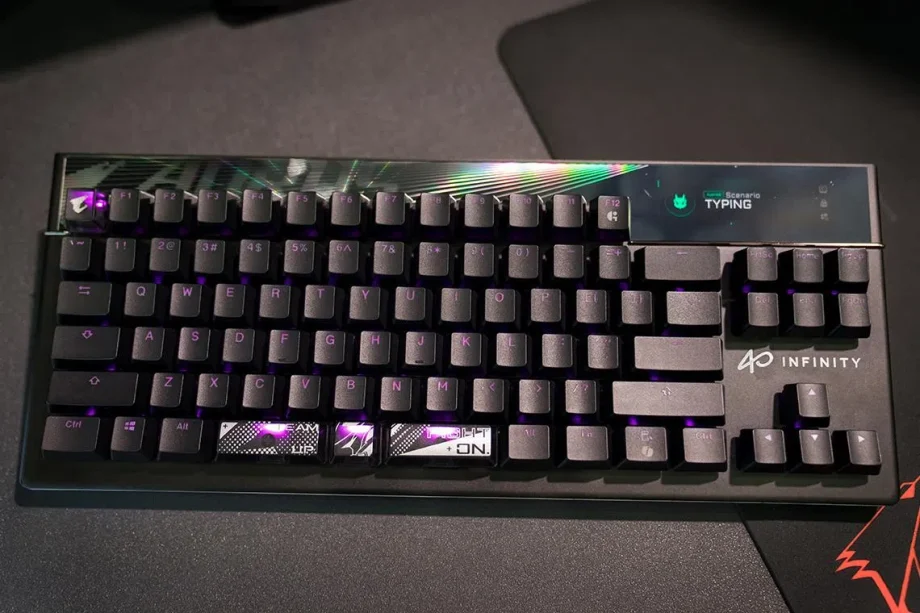
Gigabyte Aorus K10 Infinity gaming keyboard

Gigabyte Aorus K10 Infinity gaming keyboard


As part of their recently announced Infinity lineup for Computex 2026, which mostly consisted of PC components, Gigabyte also included a new peripheral that refreshes their line of mechanical keyboards, the Aorus K10 Infinity.

Gigabyte isn’t typically known for their keyboards; they do make them, yes, but the last release, the Aorus K1, was a full six years ago, and it’s certainly dated by today’s standards in terms of design and switches used (throwback to the days of Cherry MX dominance). 

The Aorus K10 Infinity can best be described as an ‘update’, then. The keyboard has an 8kHz polling rate with magnetic switches – Gigabyte calls them “tactical magnetic switches”, but the 0.1mm trigger sensitivity suggests something closer to hall effect than the newer TMR switches. That’s no dunk on the K10, though, as the board still features adjustable actuation and “multi-stage trigger settings”.
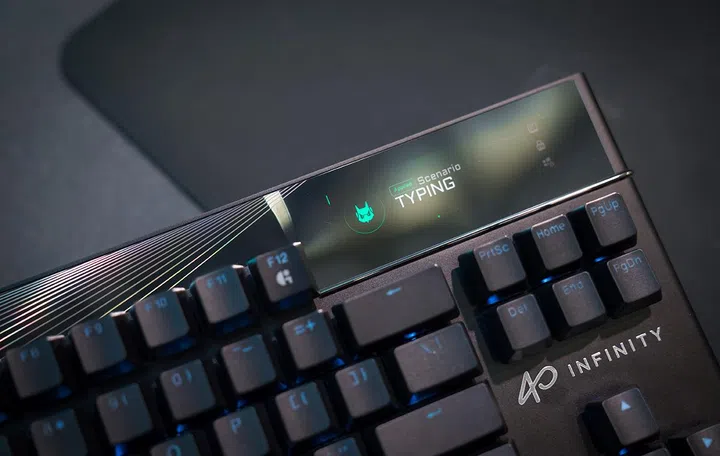
The Aorus K10 Infinity features a multi-function 3.1-inch OLED touchscreen.

The Aorus K10 Infinity features a multi-function 3.1-inch OLED touchscreen.

Image: Gigabyte.

But while the bread-and-butter specs aren’t too far from its contemporaries, the board has a showpiece of its own, that being the 3.1-inch OLED touchscreen. It has a pixel density of 311ppi, high for a display that you’re not looking at all the time.

That’s because Gigabyte intends for users to interact with the screen more often; it’s where you can adjust trigger settings, lighting, and other functions. The K10 includes what Gigabyte calls “Combat Power”, where the keyboard can measure “key mileage” (how much distance you’ve covered with your total keystrokes, according to promotional images), precision and error counts in real time.

This is all for “gameplay analytics”, Gigabyte says; it may be useful for getting post-game statistics for keystroke accuracy, though as a real-time tool, we’re not sure how many times you’d be looking down at your board when playing games.

Outside of the touchscreen, the keyboard can be customised and adjusted on GiMATE Web Edition. It’s a web-based programme, so any changes made to the keyboard via GiMATE will be stored on the K10’s onboard storage, no software installation necessary. If there’s anything big tech companies have taken from the enthusiast scene, I’m glad driver-free web apps are one of them.

The Aorus M10 Infinity mouse, which also features an aluminum-magnesium alloy base.

The Aorus M10 Infinity mouse, which also features an aluminum-magnesium alloy base.

Screenshot: Gigabyte

To complete the peripherals announcement, Gigabyte have also launched the Aorus M10 Infinity, a mouse that also features an 8kHz polling rate, alongside optical switches and native Nvidia Reflex 2 support. The base uses an aluminum-magnesium alloy, though Gigabyte didn’t state what the shell was made out of, only that it uses an excimer finish for its matte surface.

Like the K10, it too has onboard storage and can be customised via GiMATE Web Edition.

Pricing and Availability

Neither the K10 or M10 Infinity have been given local pricing or availability details just yet, seeing as they’re fresh out of Computex. With hall effect being more mainstream, one hopes that the K10 doesn’t end up being too expensive, but maybe that OLED touchscreen would beg to differ.


Read Full Article At Source

Share. Save. Don't Miss The Buzz: XFacebookRedditLINETelegramWhatsAppGmail