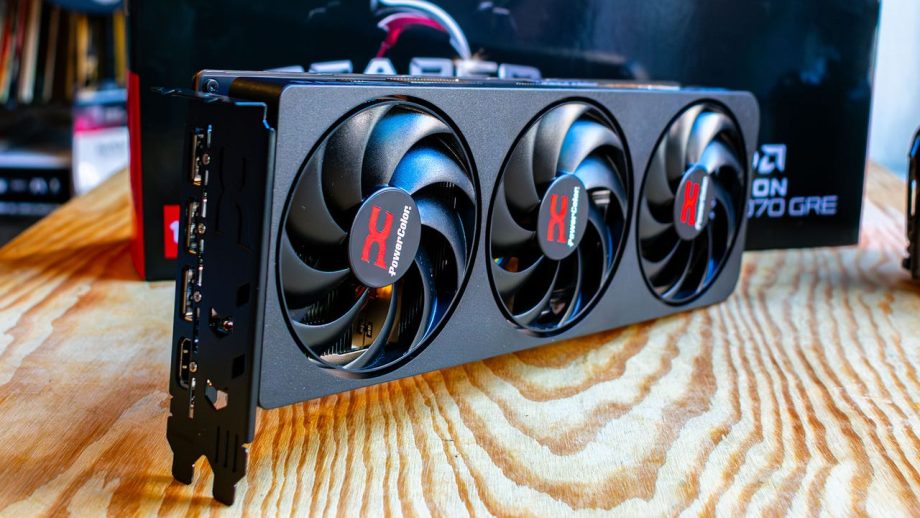
AMD Radeon RX 9070 GRE Review

AMD Radeon RX 9070 GRE Review


When the AMD Radeon RX 7900 GRE came out back in 2024, it offered some of the best bang-for-your-buck performance to be found in a graphics card, especially at 1440p. The new Radeon RX 9070 GRE is trying to follow in those footsteps, even launching at the same $549 price tag. But the PC gaming landscape has changed a lot in the last few years.

In any other time, the RX 9070 GRE would have a lower price tag than the original 9070; it’s slower and has 12GB of VRAM, rather than 16GB. However, due to the ongoing RAM shortage, the $549 9070 GRE is the same price as the original 9070 was at launch, although the latter has since ballooned in price.

If AMD’s $549 launch price actually holds this time around, the 9070 GRE is just as much a 1440p all-star as the 7900 GRE before it, even if there isn’t much of a generational performance uplift this time around.

Welcome to the New Normal

The main reason the 7900 GRE was such a great graphics card when it launched in the US was that it was so much cheaper than the 7900 XT, while also being an extremely strong 1440p graphics card. It launched for $549, compared to the 7900 XT’s launch price of $899, even though the latter had a few price cuts under its belt by then. But this generation is a little bit different.

With AMD’s RDNA 4 graphics cards, Team Red basically ignored the high-end, launching the 9070 XT as its most powerful card and leaving the Nvidia RTX 5080 and 5090 to just own the high-end. That’s why, when I saw the 9070 GRE’s $549 price tag I had to do a double take. This is a mid-generation budget play that, at least at first glance, seems just as expensive as the original 9070, but with a smaller GPU and less VRAM. But the 9070, just like every other GPU under the sun, has only gone up in price since it launched.

At the time of writing, the Radeon RX 9070 will set you back around $620, which is around 12% more expensive than the $549 9070 GRE. With that $70 price difference, the 9070 GRE shaves off 8 Compute Units (CUs) and 8GB of VRAM. And I suspect that the latter is largely the reason why the 9070 GRE isn’t a much more affordable card right now, even though it really should be.

As I’ll get into a little further down, that 12% price cut doesn’t exactly come with just 12% worse performance. Instead, the 9070 GRE is anywhere between 15% and 32% slower than the original 9070. If prices carry on the way they are right now – and there’s no guarantee that’ll happen, the 9070 will remain the better value. But with the way RAM and VRAM prices have been trending basically all of 2026, there will likely come a time where the 9070 GRE’s lower 12GB capacity will likely save it from the worst of the price increases.

Performance

According to current prices, the Radeon RX 9070 GRE is smack dab in the middle of the 9060 XT and the 9070. And, unsurprisingly, that’s exactly how it performs. The 9070 GRE is a great little 1440p graphics card, although it can struggle to max settings out in some of the most demanding games.

To test the Radeon RX 9070 GRE, I ran it through an updated suite of games to see how it would perform across a variety of different engines. I also retested all the older GPUs that I’m using to compare the 9070 GRE, because it’s been about a year since any consumer GPU has actually come out. I tested all Nvidia drivers on Game Ready driver 596.49, and all non-9070 GRE AMD cards on Adrenalin 26.5.2. The 9070 GRE was tested on a pre-release driver provided by AMD.

The first thing I test on any new graphics card is 3DMark. While these synthetic benchmarks don’t correlate exactly with real-world gaming performance, they give a good picture of the potential a graphics card has. In Speed Way, which tests DirectX 12 performance with ray tracing, the 9070 GRE gets 4,274 points compared to 5897 points from the 9070 and 3009 points from the 9060 XT, placing it right in the middle. However, AMD gets uncomfortably close to the RTX 5060 Ti on the low-end here, with Nvidia’s card getting 4,227 points in the same test.

In Steel Nomad, though, which tests non ray tracing DX12 performance, the 9070 GRE fares a lot better. Here, the 9070 GRE gets 5160 points, compared to 3690 points from the RTX 5060 Ti. That’s a huge lead for AMD here, but what’s more impressive is that the RTX 5070, which usually gives the 9070 a run for its money, only gets 5222 points in this test. That’s only a 1.19% lead for Nvidia, despite the 5070’s typical $640 price tag these days – 15% more expensive than the 9070 GRE.

In actual games, the 9070 GRE continues to live between the 9060 XT and 9070. For instance, in Call of Duty Black Ops 7, with no ray tracing or FSR and on the Extreme preset at 1440p, the new AMD card gets 136 fps, compared to 167 from the 9070 and 112 from the 9060 XT. This is a game that has always favored AMD hardware, too, so it shouldn’t be too surprising that it leads both the 5070’s 124 fps and the 5060 Ti’s 92 fps.

AMD’s giant lead doesn’t last long, though. In Cyberpunk 2077 on the Ray Tracing Ultra preset and FSR 4 set to Balanced at 1440p, the 9070 GRE gets 78 fps, compared to 91 fps from the 9070 and 61 from the 9060 XT. The RTX 5070 gets its lead back here, getting 88 fps with the equivalent DLSS settings and 67 fps for the RTX 5060 Ti.

Crimson Desert is another game that I’m testing at native resolution, mostly due to its strong performance on every GPU I’ve ever tested it on. In that game, the 9070 GRE gets an average of 65 fps at 1440p with the ā€˜Cinematic’ preset, compared to 77 fps from the 9070 and 53 from the 9060 XT. Nvidia’s cards have a stronger showing here, but not by much, with the 5070 getting 75 fps and the 5060 Ti getting 59 fps with the same settings.

Total War: Warhammer 3 is a game that hammers both the CPU and the GPU, and doesn’t even offer upscaling features to lighten the load. In that game, the RX 9070 GRE gets 109 fps with the Ultra preset at 1440p, compared to 120 fps from the RTX 5070 and 87 from the RTX 5060 Ti. The 9070 GRE might not quite match the 5070 here, but it does get a massive 22% lead over the 5060 Ti, even though it’s at that same $550-$560 price point.

In Assassin’s Creed Shadows, I max the game out with the Ultra preset and also crank the ray tracing settings, then turn on FSR or DLSS to ā€˜Balanced’. Here, the 9070 GRE falls just short of the 60 fps sweet spot, averaging 56 fps. While that’s disappointing at first, it actually matches the 5070 at the same frame rate, and absolutely dominates the 5060 Ti’s 47 fps. But, just like Call of Duty, this is a game that has favored AMD hardware in all the testing I’ve done.

Forza Horizon 6 is an odd one, though. In that benchmark, the 9070 GRE gets just 60 fps at 1440p with the Extreme preset. I repeated this test several times, and yes, made sure that V-Sync was disabled. That’s still super playable, but it falls short of the 9070 at 101 fps and the 9060 XT at 68 fps. However, given how new Forza Horizon 6 is, and the fact that I was testing on pre-release drivers, I don’t think this is quite indicative of how the GPU will perform after a few driver updates.

There are some games where the Radeon RX 9070 GRE falls behind, but just like the 9070 and 9070 XT before it, this new AMD card punches way above its weight class. If the 9070 GRE’s price holds at around $549, it’s hard to recommend anything else for 1440p gaming. But, as soon as the price starts creeping up towards $600, it’s probably worth spending a bit extra on the Radeon 9070, just for the extra VRAM.

Jackie Thomas is the Hardware and Buying Guides Editor at IGN and the PC components queen. You can follow her @Jackiecobra


Read Full Article At Source

Share. Save. Don't Miss The Buzz: XFacebookRedditLINETelegramWhatsAppGmail