AMD releases FSR Redstone, bringing AI upscaling tech to Radeon RX 9000 GPUs

AMD releases FSR Redstone, bringing AI upscaling tech to Radeon RX 9000 GPUs


If you’re an owner of a Radeon RX 9000 Series GPU, you may have noticed a new driver update for your graphics card on AMD’s Adrenalin app. That’s because the company has released FSR Redstone, a suite of AI upscaling technologies that complement the existing FSR 4 tech. And like FSR 4, it only supports RDNA 4 cards.
FSR is AMD’s answer to the video game upscaling race, competing directly with Nvidia’s DLSS and Intel’s XeSS. First announced at Computex 2025, FSR Redstone doesn’t necessarily replace FSR 4 (we’ll get to that in a bit), but it does expand its feature set with three new technologies centred around machine learning:

  • FSR Radiance Caching: A system that, in real time, learns how light is transmitted in a scene and predicts how it will travel;
  • FSR Ray Regeneration: A denoiser that fixes a current problem with ray tracing – a high amount of noise on surfaces with ray traced lighting – by analysing low-sample frames and cleaning them in real time; and
  • FSR Frame Generation (ML): This is pitched as an upgrade to Frame-Gen technologies present on existing FSR standards, utilising a neural network that takes two consecutive frames and generates intermediate frames between them to compensate for motion-related effects like ghosting.

Alongside these three new features is FSR Upscaling (ML), which is what FSR 4 has been re-branded to following Redstone’s launch. 

AMD is touting some pretty ambitious performance gains with FSR Redstone. This includes a quadruple the frames in games like Call of Duty: Black Ops 7 and Cyberpunk 2077, and three times as much in F1 25, when you’re playing on a Radeon RX 9070 XT.
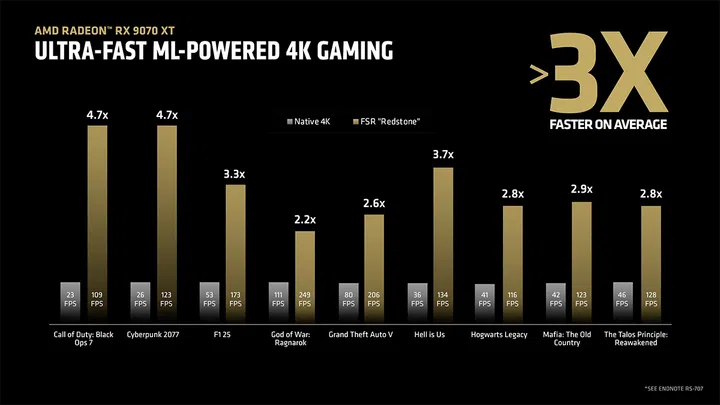
Purported performance gains from FSR Redstone. Take note, though, games tested utilised only FSR Frame Generation (and Ray Regeneration for Black Ops 7).
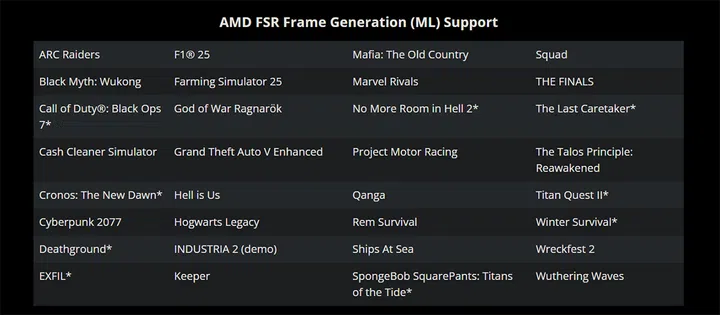
FSR Redstone Support

But what about games? AMD states that FSR Redstone will be supported on over 200 titles by the end of this year. You can find the full list on AMD’s website here, but some notable titles include Arc Raiders, Battlefield 6, Black Myth: Wukong, GTA V Enhanced and Silent Hill f, among others.

If you read the fine print, though, the more accurate claim would be that over 200 titles would support at least one FSR Redstone feature by end-2025. For instance, only 32 of those 200 games will see FSR Frame Generation (ML) support in the coming month. Some games are also in the list by virtue of already supporting FSR 4/FSR Upscaling (ML) natively.

These are the list of games that will support FSR Frame Generation (ML).

Screenshot: amd.com.

The two newest technologies, FSR Ray Regeneration and Radiance Caching, are currently the least supported features. The latter is currently not available in any game, and although AMD did show it working on one title, Warhammer 40,000 Darktide, its developer Fatshark clarified that its implementation is still in development.

As for Ray Regeneration, the only game so far that supports it is Call of Duty: Black Ops 7, which, incidentally, soft-launched FSR Redstone by including Ray Regeneration when it released.

Finally, as mentioned, FSR Redstone only supports RDNA 4 cards. This probably isn’t the best news for those still hoping that AMD would bring FSR 4 to older Radeon cards. It’s also a bit puzzling when compared to the competition, as certain features in Nvidia’s DLSS 4 are available on cards as old as the RTX 20 Series.

As of now, though, the area where FSR Redstone has DLSS 4 beat, or is at least matched, is adoption; Nvidia claims that over 175 games support DLSS 4, coming close to AMD’s number of over 200. However, AMD will still have to play a lot of catching up if it wants to come close to Nvidia’s total DLSS adoption rate, which numbers at over 800. By contrast, prior to Redstone’s launch, only around 300 games supported FSR, according to Tom’s Hardware.


Read Full Article At Source