SINGAPORE – On paper, it was the perfect match.
Charlie, a 48-year-old resident of the Singapore Zoo, and the girl next door, Chomel, granddaughter of beloved icon Ah Meng.
The offspring of these two unrelated Sumatran orang utans would add vital diversity to the gene pool of their species, which is critically endangered. And while 29-year-old Chomel was already the mother of two, it would be Charlie’s first progeny, and would help to preserve his genetic legacy.
They were thus paired up, as recommended under a regional breeding programme for orang utans.
But when their romance failed to blossom after four years, the zoo’s animal care team turned to medical technology for help.
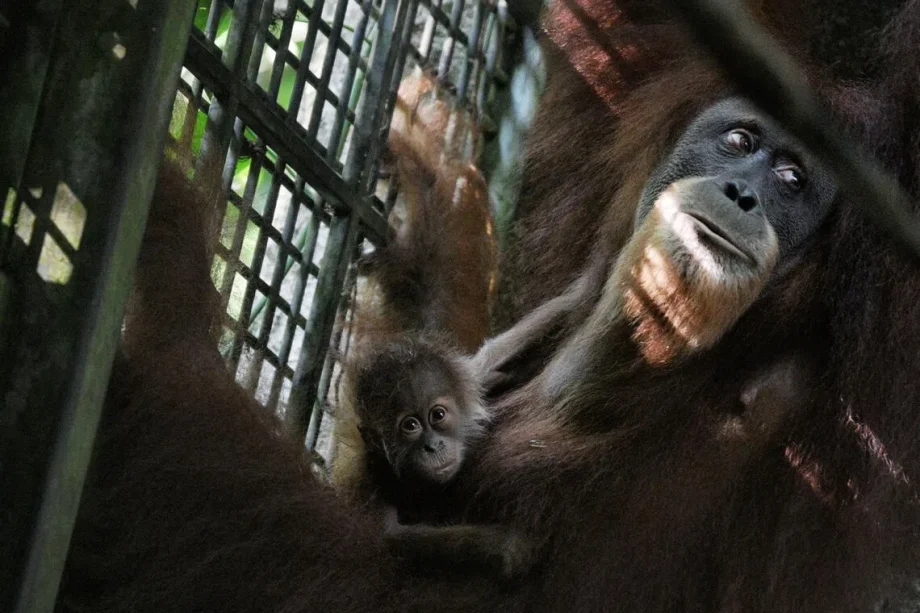
On March 18, following a dramatic birth by caesarean section, Mandai Wildlife Group welcomed Charlie and Chomel’s son and its first orang utan baby – and the first among its primates – conceived through assisted reproduction.
The caesarean birth, also a first for the Mandai primates, was necessitated after Chomel developed placenta praevia, a condition that could complicate delivery.
The baby was named Ayaan, which means blessing in Arabic.
Mandai Wildlife Group’s deputy vice-president of veterinary healthcare and scientific programmes Heng Yirui said on May 21: “To our knowledge, this is the first documented case of an orang utan birth spanning artificial insemination, placenta praevia and a successful caesarean delivery.”
Visitors may be able to glimpse mother and son, and another baby that Chomel is fostering, at the orang utan exhibit at the Singapore Zoo from May 21. They will be present from Thursdays to Sundays and on public holidays.
Native to Malaysia and Indonesia, orang utans are under threat from deforestation and hunting, among other things. There are three species: Bornean, Sumatran, and Tapanuli.
The World Wildlife Fund estimates that there are currently around 13,800 Sumatran orang utans in the wild.
The zoo tries to ensure genetic diversity through regional breeding programmes with other zoos.
Ensuring that Charlie’s unique genes were preserved was critical, as a diverse collective gene pool helps keep primate populations in human care healthy and resilient, Mandai Wildlife Group’s curator of animal care (operations) Wendy Chua told The Straits Times.
“Charlie didn’t have any progeny at all, which is why he is ranked amongst the most important to breed,” she said. “If he were to pass on with no offspring, there’s nobody else left to carry his genes.”
Under the SEAZA breeding programmes coordinated regionally, the animal care team could look for a suitable partner in Singapore or abroad to match with Charlie.
In 2018, the animal care team determined that Charlie and Chomel, being genetically distant, would make a good match.
“Their offspring (would be) stronger, healthier and survive to be much better individuals,” said Ms Chua.
Since they were at the same zoo, there was no need to transport a suitable orang utan from another country.
Ms Chua said Charlie was also getting close to the upper end of his lifespan, making breeding more urgent. Orang utans can live up to 60 years under human care and between 35 and 45 years in the wild.
But when Charlie showed no interest in mating with Chomel, the animal care team decided to try artificial insemination, which had been successfully used at Mandai for the giant pandas and African lions.
The team began trying from May 2022 and succeeded on the third attempt.