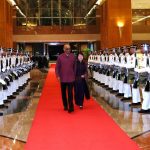
NANNING – While trade is no longer always seen as a mutually beneficial exercise in today’s unsettled and troubled world, countries have to work to make it a “win-win”, Senior Minister Lee Hsien Loong said on May 19 during a visit to Guangxi autonomous region in south-western China.
In a meeting with Guangxi’s party secretary Chen Gang in the capital, Nanning, SM Lee noted that trade has become mixed up with considerations about security, resilience and rivalry, as well as worries about vulnerability.
“If we are honest, we have to say that it is not always win-win, but we have to work to make it win-win,” he said, highlighting the considerable potential for economic cooperation in trade, investment and many other areas between Singapore and China, and between China and the wider ASEAN region.
“We would like to build on what we have done, to do more of this, and to enhance not just the economic well-being of our countries, but also the human well-being of our populations. Because, ultimately, the purpose of trade economics is to make the lives of our people better.”
Guangxi, which has an ethnically diverse population of more than 50 million people, acts as a gateway to western China, with its direct access to the sea via the Gulf of Tonkin.
Also known in China as Beibu Gulf, the waterway off the coast of northern Vietnam connects provinces like Yunnan, Guizhou and Sichuan with South-east Asia.
In his meeting on May 19, SM Lee pointed to the New International Land-Sea Trade Corridor (ILSTC) as one example of how commerce has resulted in mutual benefit.
The trade corridor, which allows goods to be moved from western China to ASEAN by road, rail, sea and, soon, river, is part of a wider bilateral connectivity initiative centred around Chongqing that SM Lee had a hand in starting when he was prime minister in 2015.