
We booked a taxi from Singapore to JB via Grab. Here’s what happened

We booked a taxi from Singapore to JB via Grab. Here’s what happened


Two hours. Multiple transfers. Long queues. That used to be the reality I and many others faced on day trips to Johor Bahru on public transport.

For years, the only real (and legal) alternative – short of owning your own vehicle – was to head to Ban San Street Terminal to hail a cross-border taxi.

But it could drop you off only at Larkin Sentral Terminal, which meant it wasn’t particularly convenient.

So, when Grab began making cross-border taxis available through its app on May 4, my colleagues and I jumped at the chance to test this option immediately.

Or rather, I booked one for the next day, since such rides must be booked at least 12 hours ahead.

Such taxis are licensed to pick passengers up from anywhere in Singapore, and drop them off anywhere within fixed operating areas in Johor.

If they are Singapore-registered, they can pick passengers up only at Toppen Shopping Centre, Angsana Mall, The Mall at Mid Valley Southkey or Larkin Sentral Terminal for the return trip to Singapore.

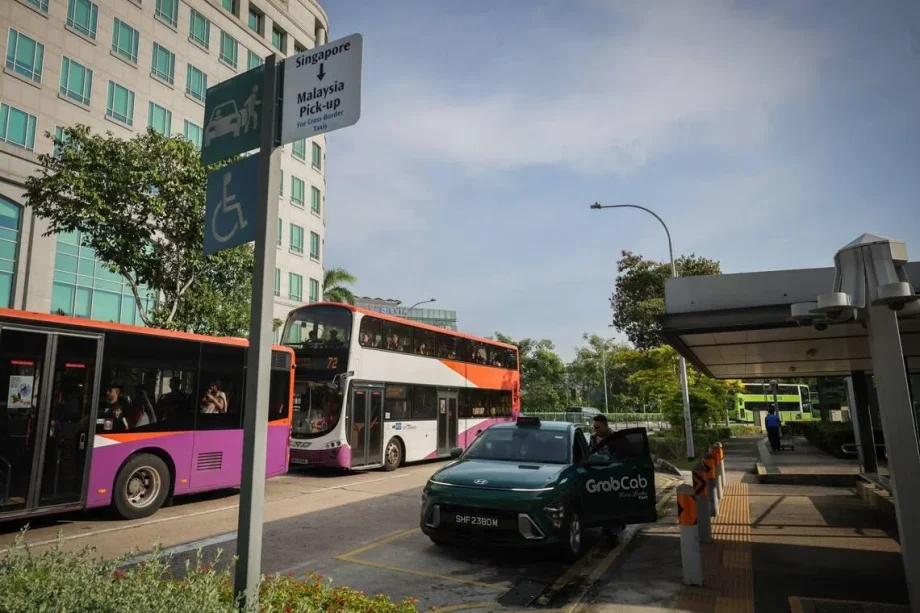
The plan was simple. We decided to meet at the pick-up point for Malaysia-registered cross-border taxis near Century Square in Tampines, just outside Tampines MRT station on the Downtown Line.

As only one pick-up point is allowed for these cross-border trips, we figured the location would improve our chances of getting a ride because of the larger pool available.

We’d then have our booked taxi head straight to The Mall at Mid Valley Southkey in Johor Bahru.

We also booked a 2pm ride back to our office in Toa Payoh North.

Costing $111.20 to get there and RM333.72 (S$107.65) to get back, the journeys were pricier than taking a street-hail taxi from Ban San Street Terminal or Larkin Sentral Terminal, where fares start at $80 and RM240 respectively.

For that kind of premium, we were expecting a completely seamless experience – and that was what we got, for the most part.

At about 8.30am on May 5, 15 minutes before the scheduled pick-up time, I received a notification that the driver ferrying us across the Causeway was en route to my location.

Behind the wheel of the dark-green Hyundai Kona Hybrid GrabCab was Mr Mohamed Kabirshan Majid, and we were his first passengers as a cross-border taxi driver.

Mr Mohamed Kabirshan Majid, 44, had two passengers for cross-border taxi rides on May 5, with the trips making up about half of his daily earnings.


Our journey was smooth, until a slight hold-up at Woodlands Checkpoint that lasted about 30 minutes. While stuck in traffic, Mr Kabirshan told us that he had another Singapore-JB trip to make later in the day, at about 6.45pm.

These two rides alone would net him about half his average daily earnings, which ranges between $300 and $500. The 44-year-old drives seven days a week.

He said: “I usually drive about 14 to 16 hours a day in Singapore to earn my usual amount. These cross-border trips give me the opportunity to earn more.

“I can cut back on my working hours because of this.”

Mr Kabirshan started out as a cabbie with ComfortDelGro in 2016, but never opted to do cross-border rides before this as he thought the regulations were too restrictive.

“Last time, it was very troublesome. You can only pick up at one place and drop off at one place, and drivers still had to queue for passengers,” he said.

As we drove past Customs, we were met with many curious stares from officers, possibly puzzled by the “cross-border taxi” livery on both sides of the car.

Once we were in Johor Bahru, however, we hit our first minor hiccup.

The GPS navigation had given the wrong instructions that would have sent us to Skudai instead, but thankfully, Mr Kabirshan noticed it quickly enough to course-correct.

Once we arrived at our destination, the navigation system bugged out again, sending us on a loop before we could finally alight at The Mall at Mid Valley Southkey.

In all, it took us slightly less than two hours to get to our destination.

Unlike in Singapore, where there is a clear sign next to the Tampines pick-up point stating that cross-border pick-ups could be done there, the Malaysian mall had none.

From 10.45am to 11.45am, we did not spot any other cross-border taxis at our drop-off point.

When asked, the mall’s concierge said he did not receive any notice from his management about the building serving as a designated pick-up point for Singapore-registered cross-border taxis.

He had read about it on social media, however, and noted that while there was no specific location, passengers could likely board such vehicles anywhere in the vicinity.

So when our driver for the return trip contacted me at about 1pm, I told him I would meet him at the eastern entrance.

Pulling up in a red Proton Exora at 2pm sharp, Mr Chai Chon Meng also said we were his first cross-border trip of the day.

The 52-year-old has been a cross-border taxi driver since 2004, usually taking passengers from Senai International Airport in Johor Bahru to Ban San Street Terminal in Bugis, Singapore.

He said: “Being able to book these rides on an app is a good thing, since it’s easier for passengers.

“But it’s still very early days. Who knows, once the Rapid Transit System Link is up, maybe people will just choose that, since it’ll be a faster and cheaper option.”

The 4km rail link between Singapore and Johor Bahru is targeted to start operations in December.

Mr Chai Chon Meng, 52, has been a cross-border taxi driver since 2004. Our booking was his first outside his usual route from Woodlands Checkpoint to Ban San Street in Bugis.

ST PHOTO: GIN TAY

Confessing that he had never driven outside his usual route from Woodlands Checkpoint to Ban San Street, Mr Chai relied heavily on his voice navigation system.

But as we travelled along the Bukit Timah Expressway, network connectivity issues cropped up and the system went dead silent.

As he reset his mobile phone, he asked me which exit to take, but I was equally unfamiliar with the route. Thankfully, he took the right one.

Immediately after dropping us off, he said he was going to drive back to Johor Bahru because waiting for passengers near one of the designated pick-up spots for Malaysia-registered taxis was a gamble, especially since there were no advance bookings being shown.

“Singapore taxis will probably get more business in Singapore, while Malaysia ones will get more business there because you can only pick up anywhere in your home territory.

“Why would anyone go out of their way when they can just wait at home and go downstairs when the car’s there?”

While he wouldn’t say much when he was asked if he was able to earn more under the enhanced cross-border taxi scheme, his small smile as he clicked “drop-off” on the app said it all.


Read Full Article At Source