SINGAPORE – When night falls, a relentless thwacking begins against the lights of Tampines Changkat, as droves of cicadas dive into lit corridors and flats to the fear and fascination of residents.
The seasonal emergence of the orange-winged cicada (Asianopleura fulvigera) is just another day in the neighbourhood, where complaints about annual swarms of adult cicadas have mounted since late 2018.
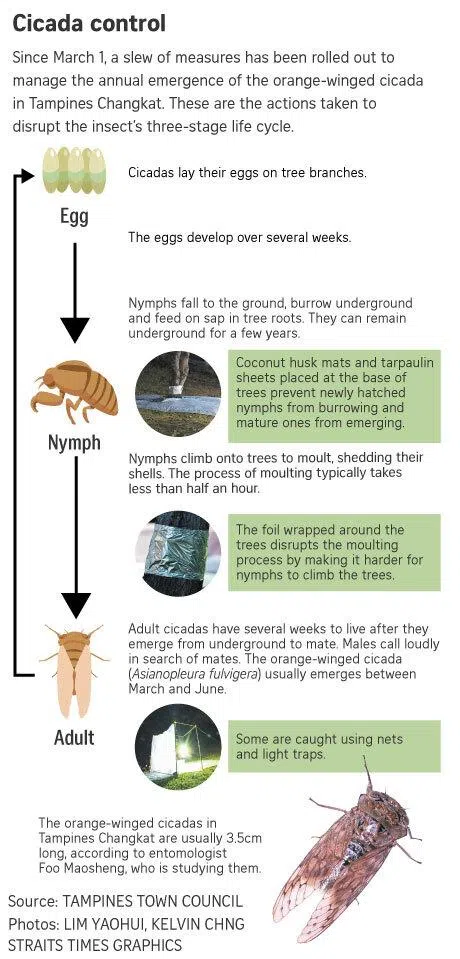
While cicadas spend most of their lives underground, they emerge as winged adults for a few weeks to mate. Some species can end up in buildings at night as they rely on light to navigate.
In a bid to divert some cicadas away from homes, the recently formed cicada task force – led by Tampines Changkat MP Desmond Choo – has resorted to setting up light traps on an almost nightly basis since April 10.
As at April 23, the task force has caught more than 7,000 orange-winged cicadas, which are native to South-east Asia, but possibly foreign to Singapore.

A collage of an orange-winged cicada emerging as an adult with wings from its nymphal shell on a tree next to Block 321 Tampines Street 33 on April 23.
ST PHOTOS: LIM YAOHUI
These figures were provided to The Straits Times by members of the group, a collaboration between the Tampines Town Council, insect scientists, and the volunteer-run Tampines Changkat Nature Kakis Chapter to study and address the neighbourhood’s cicada woes.
For a start, the task force launched on March 1 is trialling measures that disrupt the orange-winged cicada’s three-stage life cycle over a five-month period to put a dent in their numbers.

Cicadas floating in a container of soapy water at a light trap to attract the creatures.
ST PHOTO: LIM YAOHUI
Entomologist Foo Maosheng, who leads the task force’s research, said the sheer volume of orange-winged cicadas caught by the traps suggests a possible ecological imbalance arising from the absence of natural enemies that help control the population. These include predators and parasitoids – organisms that develop on or inside hosts and eventually kill them – which are not well understood.

Researcher Foo Maosheng showing the cicadas his team has caught so far in Tampines Changkat. They have been preserved in a lab at the National University of Singapore’s Lee Kong Chian Natural History Museum.
ST PHOTO: AZMI ATHNI
“Light traps are typically meant to survey an area’s insect diversity, especially nocturnal ones, so you will get all sorts of insects, like moths, ants and some leaf bugs,” said Mr Foo, insect curator of the National University of Singapore’s Lee Kong Chian Natural History Museum.
“However, when I set up my traps, I realised only adult cicadas were flying in. Very few insects from other species were attracted.”

Contractors of Tampines Town Council setting up a light trap to catch cicadas next to Block 321 Tampines Street 33 on April 23.
ST PHOTO: LIM YAOHUI
One possible explanation is that the swarms of cicadas, which feed on plant sap using their straw-like mouths, have crowded out other insects that occupy the same niches on the trees, he added.
The extent of this interaction will need to be studied in detail, said Mr Foo, who has collected more than 1,300 cicadas so far for research and education.
This is but a fraction of the cicadas emerging in the neighbourhood. On just two nights, some 2,000 cicadas were caught at the same hot spot, members of the task force told ST during an April 23 trapping operation near the HDB blocks in Tampines Street 22 and 33.

Cicadas in a container of soapy water at a light trap next to Block 321 Tampines Street 33.