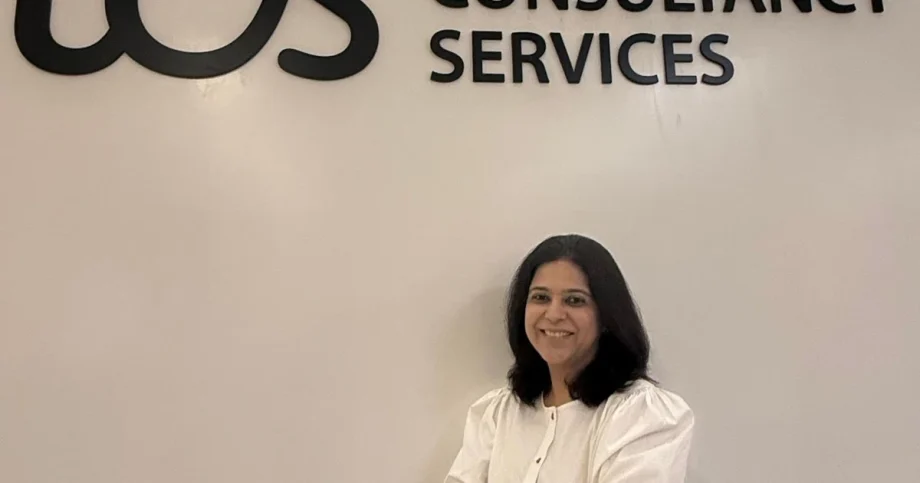
Companies face the challenge of how to translate their climate pledges into measurable outcomes, says Shveta Bhardwaj
[SINGAPORE] Many companies large and small in Singapore and globally now have climate ambitions, but face the pressure when it comes to demonstrating tangible progress towards net-zero commitments rather than just set targets.
This is the view of Shveta Bhardwaj, head of sustainability services (Asia-Pacific) at Tata Consultancy Services (TCS), who believes that a key challenge that companies face is how to translate their ambition into measurable outcomes.
“This can be done through data, operating models, technology and architecture, behavioural change and accountability,” she said in a recent interview with The Business Times.
TCS, which is part of India’s Tata Group, is a global IT services, consulting, and business solutions organisation.
Bhardwaj, who is based in Singapore, works with companies across 11 Asia-Pacific markets on sustainability transformation initiatives spanning energy, infrastructure, manufacturing, financial services and the public sector.
There is a growing demand from companies for stronger ESG (environmental, social and governance) and carbon data foundations, as well as artificial intelligence-enabled sustainability intelligence and climate-risk capabilities, she added.

Working with industry
Bhardwaj, who has been in her current role for two years, noted that Singapore and Australia are among the mature markets in Asia-Pacific that have made strong progress on the sustainability front, with a lot of push and focus from the government.
Among the initiatives that she spearheads at TCS is the TCS GoZero Hub, a research and innovation platform that was developed in partnership with the Nanyang Technological University’s Energy Research Institute in Singapore, and Australia’s Macquarie University.
This hub – which was established as an Asean Centre of Excellence for research, innovation and collaboration – brings together academia, technology and industry to accelerate sustainability innovation and energy transition efforts.
She also spoke of another major project – a virtual power plant regulatory sandbox – that TCS is involved in with other industry partners for Singapore’s Energy Market Authority (EMA).
At the Singapore International Energy Week in 2025, EMA announced a pilot of this sandbox to aggregate distributed energy resources such as solar PV systems and energy storage to participate in Singapore’s wholesale energy market.
“(This sandbox) is really a testbed to see how virtual power plants can work in the context of Singapore,” said Bhardwaj.
She pointed out that with the ongoing energy transition – a structural shift in how a society produces, supplies and consumes energy – there is a greater focus on various sources such as cleaner energy and renewables.
“There’s the grid being at one end of this, which was very uni-directional as it was just electricity flowing from the grid to all of the consumers,” she said.
“But with renewable energy coming into play, things are now much more bi-directional and these different sources (of energy) also interact with one another. For example, with solar energy, should we store it or turn it into hydrogen?”
Bhardwaj pointed out the integration of these resources mean that more enterprises are also approaching their long-term power purchase agreements differently as they evaluate the many sources available to them and the cost.
“The questions being asked are, what should I do with this? Should I consume it or store it? Should I be selling it back to the market, or use it?” she said.
“And if it’s a larger enterprise where there are different demand profiles, can I shift it from a place where there is lower demand to somewhere else where the demand is higher?”
Continuing the momentum
While sustainability may have lost some of its buzz around the world of late as other topics and concerns such as AI dominate conversations, Bhardwaj maintained that it should still remain a core part of a company’s operating model, no matter the industry.
“What’s key now is how to ensure companies can execute their sustainability strategies effectively and make sure that momentum is there. This isn’t a project where you can say ‘I’ll do this for a few years and that’s it’,” she said.
“On our part, we see that sustainability is certainly now more embedded into the organisations we work with. It’s not a separate agenda that sits outside, it’s now part of overall business decisions and operations.”
Read Full Article At Source