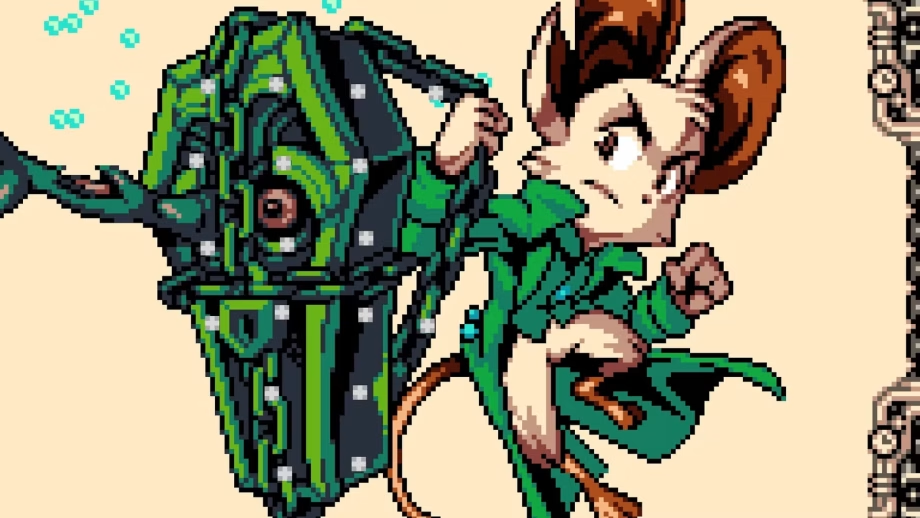
“Craft” in gaming can easily become synonymous with specular reflection — you know a team worked hard if the puddles in their AAA fantasy simulator glimmer like they would in real life. But if I’ve learned anything from talking to the team at Yacht Club Games this year, it’s that blood, sweat, tears, and the risk of financial ruin in the name of making cool-ass shit can often go overlooked in the context of, say, a Game Boy Color homage. But if we heralded Elden Ring for a synthesis of complex combat, rich lore, and demanding system work, then maybe we owe it to the folks at Yacht Club Games to recognize everything they pulled off in Mina the Hollower.
As GOTY talk ramps up and The Game Awards nominations draw near, I asked the folks at Yacht Club to answer a few variants of one basic question: How the hell did you think of this and stuff and how the hell did you pull it off? They kindly responded.
Responses have been edited and condensed for clarity.
1
Mina the Hollower’s best mechanic was invented to solve a problem with Castlevania

David D’Angelo, programmer at Yacht Club Games: Mina actually started with, Alec, the director, as a side project. He wanted to get better at doing art stuff. He said, “I’m gonna make a little game where I could make Game Boy Color art.
But when it came to us actually wanting to make the game, it started way more out of the mechanics perspective because we were interested in making a top-down game. And we were excited about the Castlevania-style gameplay in a top-down space. No one’s done that before. We could tackle that and make it really exciting and interesting.
Alec Faulkner, designer at Yacht Club Games: The burrowing in Mina was fully cooked, I would say, by the time I was pitching it to everyone else. You jumped up in the ground, you held the button to go under. I think the timing is essentially identical, three quarters of a second or something, you can stay under there. And then you gotta pop right out.
That classic Castlevania, like 1-2-3 in Rondo of Blood, that combat has such incredible, fun tension to it. [With Mina], I wanted to stand exactly three-and-a-half feet in front of the enemy, but not four feet and not three feet. And doing that little dance on a single axis, because those are all platformers, is a ton of fun. What if you had another axis and you could move around even more?
Quickly I realized a limitation of that. In something like a platformer, there’s infinite space, more or less, on which you can move back and forth. You can think of it like you’re playing football and the enemies are pushing you this way, but you came from one direction. You can’t be cornered necessarily in that level design.
In top-down perspective though, you can corner yourself quite easily. So we needed a way to get out of a corner, right? There had to be some sort of defensive mechanic. It shouldn’t be a game where if you’re cornered, you’re screwed and you wail on the attack button and hope for the best. That wouldn’t be very fun. So naturally I think my brain went to: you should jump. We make a lot of platformers, I love platformers, so why not jump over the enemy? But that camera perspective makes that tricky to feel good and to be readable. Your shadow position is here, but your sprite is up here. Where will you actually land?
So the thought then is, what if instead of jumping above the ground you jumped under the ground. Then I could represent your position with a shadow (or the burrow mound that’s in the actual game). And then it’s crystal clear exactly where I am, and where I will be when I am done with this action. From there it goes, what kind of character would burrow? I guess a mole or a mouse.
There was a desire to make mechanics that were simple and intuitive but have a lot of depth. I don’t like giving the player a whole bunch of buttons that do little things. I would rather give you a few buttons that do a lot of things. If this is gonna be a game about fighting things, if it’s gonna be a game about platforming, jumping over pits and whatnot, and if it’s gonna be a game about exploring, then I would hope that if it were giving you two main buttons you’re pressing, then one of these buttons is going to play with those things in a lot of ways.
Certainly in terms of action, it allows you to reposition yourself when you’re fighting other enemies. That immediately provides a ton of depth to the combat. When it comes to the exploration elements of the game, very quickly we can start brainstorming, “OK a little mouse hole that you go into that hides a secret room.” Maybe you could burrow down into other rooms entirely when you see that little X on the ground. Finally, platforming: “Well, she can jump one tile — what if when you were burrowing and moving faster, you could go two?” I think that’s just how you design fun characters and fun games.
2
Yacht Club made you wait to dodge (and that’s why its combat is so good)

D’Angelo: We are doing things that are, I would say, objectively not appealing. So in Mina, you whip in four directions, you can’t whip diagonally, you can’t control it with the joystick. It is really restricted in how it controls.
When you press the jump button and go into the burrow, there’s almost half a second before you get into the ground and you’re actually invulnerable from most attacks. Every single game that comes out is a game where you press a button and immediately have a dodge. If any other company was looking at it, they’d be like, “look what people like.” And it’s true, what people like is to be able to dodge immediately. They don’t like having to wait half a second to dodge. So it would just be like, no, why would we make that?
Sean Velasco, director of Mina the Hollower: It’s easy to get lost in the sauce when you’re doing very small, minute details. How long the enemy would time out when you whip them. They flash for a certain amount of time. And if you just keep whipping them over and over again, you could just stun-lock them and there would be very little time in between.
Well, that was not the kind of Souls-y type of experience, the Castlevania kind of combat, that we were looking for. And so we ended up adding in a lot more attacks where the enemy could just jump through, even while they’re flashing, even when you hit them, they don’t get stun-locked and their attack can go through.
It used to be that at the end of your burrow, if you were at an edge, you would automatically jump when you got to the end of the burrow. And so it was almost like an Ocarina of Time thing where you’d auto-jump at the end of the ledge.
After the game was in development for a long time, we thought to ourselves, this is not creating the kind of action that we want. We need to let the player do this on their own and to release the button at the time that they want. We ended up making that as a modifier in the game that you could turn on, but we thought that was taking a little bit — it just made it too automatic.
We wanted the game to have a very manual, deliberate feel where you’re having to really learn and accomplish everything.
3
Mina the Hollower’s trippiest level wasn’t even supposed to exist

Faulkner: “I look fondly on the [mystical plane of] Astral Orrery. When I look back on that level, my thought often is, I can’t believe that David said yes to all of these ideas. There are so many insane things. I don’t even know how to program some of the stuff that is in there. And we really went all out. There were no compromises kind of level.
It’s structured with four kind of legs from a central area that you go out onto. And so it feels to me like we’re showing off a little bit. It’s just a constant variety show of, okay, now try this. Here’s a completely different set of ideas.”
4
The game’s scariest enemy has Resident Evil DNA

Velasco: When we are designing the story for a game like Mina, we always plant flags of where the story is going to have to happen and where the major turns are going to happen and where there’s gonna be a cutscene.
For Mina, we really designed the game to be both thematically and gameplay-wise cohesive. For instance, in September, the town that’s a perpetual autumn, we knew that we wanted to have a kind of mythical, Sleepy Hollow-style character that was gonna be pursuing you throughout the course of the game.
Faulkner: The Carving Man was our Resident Evil Nemesis-style stalker enemy that chases you through September. I think that’s emblematic of something that we do consistently pretty well, which is bring in influences from all sorts of games, retro or modern or indie and unknown. Influences from everything everywhere. And not just adapt it into a different format, but iterate on it and push those ideas further.
Velasco: And the idea of him being this invincible wraith and then the actual gameplay beat of when you’re whipping him you can’t kill him and you have to save the children from him, all of this stuff is working in conjunction with one another to try and make both the gameplay reinforce the thematics and the thematics reinforce the gameplay.”
Faulkner: The Carving Man is a highlight for people as a result. It’s an unexpected thing to see a stalker enemy. It’s a fun feeling to walk through that first screen transition and then to go, crap. He is the one guy that goes through screen transitions. God.
And all of our fun, interesting design ideas that we have to cram into everything, I think they shine with that guy a lot in particular. He can grab you and pick you and he throws you. How far does he throw you? Until you hit collision. I’m now gonna give you a really long room where he might chuck you all the way down and you’ve really got to watch that camera scroll.
Finding those opportunities to create new cool feelings from gameplay that still has some juice left in it, that’s just sitting there, and squeezing that juice out of it, makes more fun.
5
The team built its own engine because every pixel mattered

D’Angelo: We had an engine we built for Shovel Knight, but we decided we are gonna make a new engine for it.
Mina is very bizarre in terms of what it actually is trying to achieve. Not many games are doing retro palette swapping effects and cycling effects that they did in the ’90s. You can’t get that off the shelf anywhere. In Unity or Unreal, you’d have to build that into the engine.
To some degree, it’s like if you’re building so much into it, why not make it yourself, especially when it’s something like a 2D game? So there’s that. There’s a big component of that. We’re doing things that are actually different, even if the game doesn’t look that much different than something you might have played in the past.
Then there’s a second component of: we enjoy doing it. We like having our own engine. It’s agonizing to be stuck with something that’s hard to change. You don’t want the gameplay of the game to suffer because you’re trying to get around something that was handed to you and you’re not able to control it.
And then I think there’s a third component, that those engines are limited in a way that it’s hard to fix them. For example, if you want to get your input latency in Mina, I don’t know, it’s like a .01 millisecond. That’s insanely low. And if you go to Unity or Unreal, you’re living with like three frames of latency for a 60 frames-per-second game. And we’re just like, we don’t want to accept that. We just don’t want to accept that kind of thing.
Those ideas may work for lots of other games. If you have an Assassin’s Creed where it’s more about pressing the direction and your character moves into that direction in a really animated, fluid, nice way, that latency doesn’t matter that much. But in our game where a pixel makes a huge difference because there’s only 192 high pixels, if there’s only that few pixels, that latency becomes extremely meaningful.
So there are lots of decisions that are laid into the engine that make it so our style of game will work better. And I think it’s part of our company ethos too, where it’s just like, we like being involved in every single part of it and building it our way and doing it the best way for our company.”
6
Mina the Hollower’s toughest enemies have more than one way to beat them

Faulkner: The Astral Orrery has an enemy, Saturn Head. He’s just a Castlevania Axe Armor. He throws a thing high, he throws a thing low. You wanna be close so that you can hit him, but not too close because you’re gonna have less time to react to the thing that he’s throwing at you. And it’s a pop quiz every time, high or low. Look at that anticipation animation: What’s he gonna do? To me that is classic Castlevania personified. And so I love that enemy in our game so much because we didn’t make top-down Castlevania exactly.
There are a lot of similarities there. You operate at different heights, and you are more or less vulnerable to certain attacks at certain heights. But the way the mechanics all shake out, it feels totally different. You can’t duck instantly. You need a little bit more preparation to know whether you need to burrow, which means you would need to jump entirely first and then get into the ground.
And unlike Castlevania, maybe you have a holy water, maybe you got a sidearm that can allow you to do something a little bit more creative, another way of tackling a frustratingly fun enemy. But in Mina there are a billion ways of doing everything. And one of those first rooms with Saturnhead, I put him on some little platforms that you can enable and disable. And it’s quite easy to just bait him out, hit the platform again and watch him drop into the pit.
And so when I see players do that, when I see them say, “I HATE THIS ENEMY, HE REMINDS ME OF AN AXE ARMOR SCREW THIS, I’M NOT GONNA FIGHT HIM AT ALL — WATCH THIS!!!” Yeah, that’s the game we made. That’s the fun of it, and I’m so glad that so many players can either engage with that fun core gameplay or ignore it entirely and feel clever for their own solution.
7
60 “trinkets” were a balancing nightmare

Velasco: Difficulty balancing was a challenge. When you’re in the middle of it and you’re playing the game every day, day in, day out, you end up getting very good at the game, which I’m sure a lot of developers can probably commiserate with or at least agree with. So when you show the game to outside people, they could just get thrashed by it. That ends up becoming a big point of contention. Where does that difficulty lie? And how do you know where the correct balance is?
We had the level-up system which could help you with that. And we had all of these trinkets, 60 trinkets, none of which are mutually exclusive. You could use any of them all in conjunction with one another, and you could have six equipped at once.
So making sure that you could design all of that in a way that let it work was very tough. But also those things can really help the player as well. Mina’s sidearms, were also created with the idea of augmenting the gameplay skill that you may be weak at. So if you’re too afraid to approach an enemy, then you could have a long-range weapon that attacks from far away. If you are having trouble with your health, then you could have a trinket or a sidearm that helps you heal up a little bit. If you need more mobility or you want to get around more easily, there are trinkets and sidearms that also accommodate for that.
Faulkner: You have to learn how to make every game you make, unless you’re making the same game, in which case why are you doing that? Make a new game!
And on this one, there sure were a lot of spreadsheets. It turns out when you gotta balance the game for any player at any stat leveling with any equipment loadout, when you can do any area in any order, you gotta look at those numbers a lot and really make sure that no matter what we are invisibly guiding you into a good time.
Game development is all magic tricks. So I think you succeed at that when you provide room for big moments of, My gosh, I leveled up a lot. I feel overpowered now. And those contrasts and those dynamics are oftentimes what makes that scaling fun. Now I’m in trouble. I don’t think I can do this area.
But no, it was all meticulously designed for you. We made sure you will not have a bad time.
8
Mina the Hollower’s developers didn’t connect the world until the end

Faulkner: Hooking up a large and interconnected world without cheating it too much, without any non-Euclidean spaces that hide distances, those things tend to confuse the player, even if you don’t really notice it. I expect that when I go through a hallway, the distance from one door at the start to the end is indeed reflective of that distance. You need all those things to be consistent if you want it to be a world that you can intuit naturally.
And right from the start, our goals in terms of the exploration of it all were to deliver on. The fun of those early Zelda games. Which is to say that you shouldn’t be able to just fast travel around wherever you want. Navigating and exploring and understanding the world is part of the fun of it. So we need to meticulously craft everything in a way that all just flows naturally and works out.
We did it in a kind of insane way, I think, and this shocks other devs when I tell them this: We didn’t hook up most of that world until very late in development. It was always kind of like, you’re in production and you’re just trying to work on the next area and now we need to get the next area ready, so we gotta start working on that and get all the enemies and objects and the boss and all that ready.
So you keep barreling ahead, but for years and years and years we weren’t creating our perfect little vertical slice. We kind of just assumed it would all work and be fun if we just think about everything and plan for everything. And thank God, because the first time we all kind of hooked it all up, it worked great. And there weren’t too many calibrations that we had to make after that.
But for the most part, we were just flying by the seat of our pants and utilizing and trusting our confidence in ourselves.
9
Yacht Club almost bankrupted itself making their dream game

D’Angelo: We’re financially independent [at Yacht Club Games], so it’s a huge risk making the game. No one’s backing us. It’s all our own money. This time it was off the Kickstarter and our funds from Shovel Knight, so if the game doesn’t make money, we’re out of business.
But because it is our money and we are not financially tied to anyone, it’s 100% our creative decisions and control. How we make it and every part of how we get to a finished product is just of our own design.
Faulkner: After all the obligations with Shovel Knight Treasure Trove were wrapped up, we decided to kick off not one but two exciting new games. One of those is Mina the Hollower, the other is unannounced and what I’m working on now.
For years and years, we struggled to split the teams into and maintain the same commitment to a level of quality and to get everyone’s input on every decision, which tends to be pretty necessary for the way that we do things. We tend to require ourselves to be a little unanimous. But when you split your attention, turns out that you don’t work twice as fast and make twice as many games. Both just struggle and they go half as fast.
So after enough years of that, we were looking in the bank account and going: We really gotta finish one of these games or else we’re gonna be in trouble.
Velasco: Mina was a very maximalist game. And our game before this, Shovel Knight: King of Cards, was also a very maximalist game where we thought, we gotta shove in all of the Shovel Knight ideas because this is gonna be the last one in the main series. We’re gonna have to shove them all in there. So anything that we thought of, we gotta put it in.
We wrote a lot of checks and then we ended up having to cash them all. And that’s where it all came in. And we really decided not to make any major cuts, especially because since the game was such a cohesive thing, I would have cut stuff, but we couldn’t because everything depended on something else. And so making a cut would often be more time consuming or more annoying than just going through with it and finishing it all.
Faulkner: If we had to start working on Mina 2 tomorrow, I think all of us have a pretty clear idea of what we would do with it and what we would want to challenge ourselves with and how we make it. But man, [Mina] was brutal. Morale was pretty low as well, especially toward the end of development as we’re looking at the bank account and stressing.
We’ve learned that lesson the hard way. Not once, not twice, but I think three times now.
Read Full Article At Source

