SAF tests mobile anti-drone system and airborne 5G network.

SAF tests mobile anti-drone system and airborne 5G network.


ROCKHAMPTON – If the calling card of the modern battlefield is a swarm of cheap but lethal drones, its lifeblood is spectrum: the invisible, radio frequency waves that carry data, such as flight instructions and reconnaissance footage.

At Exercise Wallaby 2026, the Singapore Armed Forces is experimenting with two key systems that will enable it to prevail in today’s congested and networked battle space.

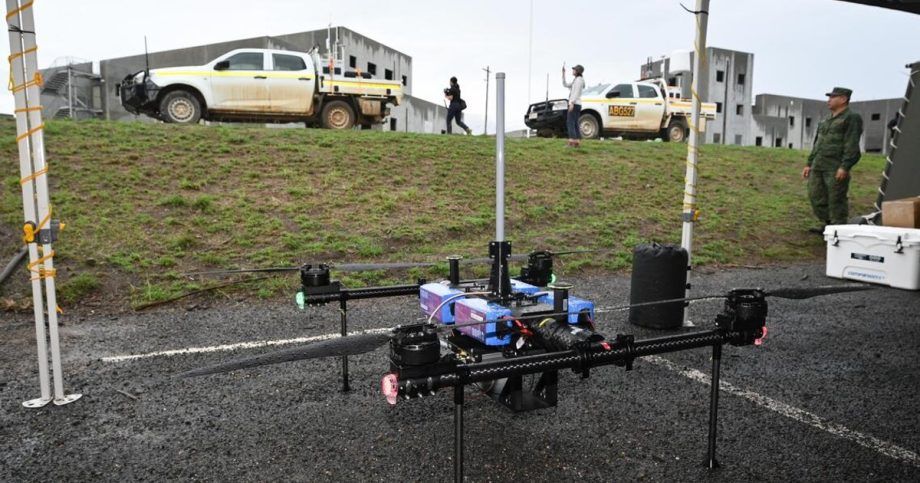
The first is an improved aerial communications node (ACN), a 5G base station in the air that will provide forward-deployed units with a data link back to headquarters, even if they are in a zone with no friendly signal coverage.

The second is a mobile counter-unmanned aerial system (C-UAS), which can be rapidly moved around the battlefield to detect and bring down enemy drones.

Together, the two systems seek to secure the airwaves for the SAF while degrading the enemy’s ability to do so in today’s battlefield, where soldiers are dispersed and vast volumes of information need to be processed, said the Chief Signal Officer, Colonel Dean Chua.

“When you see unmanned systems flying around, what they need to fly and use to fly is spectrum, and spectrum is also the one resource that allows our soldiers to stay connected,” he said.

Dominating the spectrum space, therefore, defends the SAF against unmanned threats while also protecting its communications, Chua added.

When the ACN was first tested at Exercise Wallaby 2025, the drone was tethered to the ground.

This year, the SAF and the Defence Science and Technology Agency (DSTA) have cut the cord, enhancing its mobility and effective range.

The counter-unmanned aerial system takes down enemy drones.

The counter-unmanned aerial system takes down enemy drones.

ST PHOTO: LIM YAOHUI

The ACN works by extending 5G coverage from a base station up to 2km away, said Captain Jerome Chua from the 10th Command, Control, Communications, Computers and Intelligence Battalion (10 C4I), not unlike a Wi-Fi repeater.

Where it hovers, it provides network coverage in a 400m radius. This is useful for soldiers on the front line who require high data throughput, said Chua.

DSTA’s technology development director Ho Cheeng Tse said the tethering rope had limited where the drone could be deployed. But operating in such a wide environment with troops distributed all over called for a more flexible and mobile solution.

The Shoalwater Bay Training Area, where Exercise Wallaby is being carried out, is roughly five times the size of Singapore.

“When we remove the rope, that helps the soldiers to be able to receive the videos and the communication that they need, based on where operations require them to be at right now,” said Ho.

Meanwhile, the C-UAS is a suite of drone detection sensors and countermeasures. Sensors such as radar detect aerial objects and use algorithms to differentiate enemy drones from other flying objects such as birds or big aircraft.

DSTA’s technology development director Ho Cheeng Tse in front of a counter-unmanned aerial system on Oct 23.

DSTA technology development director Ho Cheeng Tse in front of a counter-unmanned aerial system on Oct 23.

ST PHOTO: LIM YAOHUI

When a threat is located, effectors are then deployed to neutralise it by jamming communications signals back to its pilot, thereby forcing the drone to land, said Ho.

This year, different configurations of the C-UAS system were mounted on pickups to test their effectiveness for different operational needs, she added.

“We can detect and jam while (the vehicle) is on the move, and that’s what we have experimented with at this exercise,” she said.

These tests in the vast Australian landscape help the SAF to stretch the limits of these systems and identify areas for improvement.

For instance, Ho said, soldiers had given feedback to DSTA that under certain scenarios the C-UAS could not provide the required detection on time. In others, the detection proved difficult to follow up on consistently due to the terrain and other factors.

Such feedback prompts the agency to find better solutions, such that the existing C-UAS suite can be made more robust for different operational scenarios, she said.

“Because of modern conflicts, the field of C-UAS is evolving rapidly, we are always keeping track of the latest developments and thinking about how that would actually change (our) tactics,” she said. “And then we work closely with the Singapore Armed Forces to discuss what possible tactics that could be.”

Colonel Dean Chua, the Chief Signal Officer, said the technology will help soldiers who may be dispersed in the fast-paced battlefield of today.

Colonel Dean Chua, the Chief Signal Officer, said the technology will help soldiers who may be dispersed in the fast-paced battlefield of today.

ST PHOTO: LIM YAOHUI

Singapore’s quest to build its drone capabilities while simultaneously defending against the emerging threat was ramped up in 2025.

At the debate on MINDEF’s budget in 2025, then Defence Minister Ng Eng Hen announced that the SAF would form a Counter-UAS Development and Operations group that would work with other government agencies to guard Singapore against UAS threats.

Ng also announced that the air force and army had set up specialised centres to scale up UAS warfare and integration within their units.

Colonel Chua said the ACN and C-UAS trials are part of the SAF’s continuous efforts to respond to evolving threats.

He said: “The C-UAS (platform) is one effort for the SAF to really protect our soldiers and protect our units when we have to go to the battlefield.”


Read Full Article At Source

Share. Save. Don't Miss The Buzz: XFacebookRedditLINETelegramWhatsAppGmail

Leave a Reply

Your email address will not be published. Required fields are marked *