In the heart of Brooklyn, there is now a devastatingly gorgeous manga panel from Jiro Taniguchi’s Ice Age: Chronicle of the Earth hung on a gallery wall. I can’t tell you what it says–I fear my scant familiarity with Japanese doesn’t extend to literacy in kanji–but I can tell you what it portrays: a cityscape consumed by nature. A lush tangle of vines and trees reclaiming the Earth from its disastrous, mettlesome inheritors.
While I doubt this panel and manga are the first time this kind of image has cropped up, it certainly feels like a progenitor to many similar visuals across the years. Your mind might jump to I Am Legend, the Will Smith-led feature film about a post-apocalyptic New York City, for example. My mind jumped straight to Nier Automata’s city that’s been lost to time, as well as The Last of Us’ many dilapidated small towns and US metropolises. Though I went into the Brooklyn Museum’s new Art of Manga exhibit already curious about what connections the form might have to games, it became quickly apparent that manga has always been in conversation with other mediums, influencing everything from anime to gaming.
The Brooklyn Museum, located right near Prospect Park in New York City, is currently home to the Art of Manga exhibit. Curated by Nicole Coolidge Rousmaniere–whose love of manga stems from early exposure to French graphic novels and reading Astro Boy at a seminal age–the gallery features a beautiful selection of Taniguchi’s work, as well as select other notable mangaka (manga artists and authors) of outsized influence. This includes Rumiko Takahashi, best known for her work on Ranma ½ and Inuyasha, Eiichiro Oda, the renowned creator of One Piece, and Hirohiko Araki, whose gorgeously styled illustrations from Jojo’s Bizarre Adventure are among the exhibits crown jewels.

In total, the exhibit draws from the work of 10 mangaka, evenly split between male and female authors of varying popularity and prefectures of Japan, and explores different kinds of subject matter including inner-city living and queer life. This was essential to Rousmaniere, As she explained, “If I had featured fewer artists, the exhibition would not have been as powerful; We might not have gotten across the incredible range of these artists and the power of the line that they employ.” The Art of Manga exhibit, evidently, needed to be big.
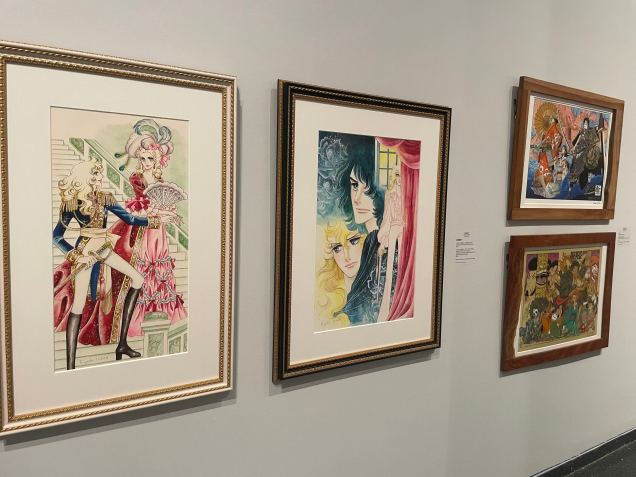
And big it is. At its center, there is a reading room with bookshelves full of manga related to the artists spotlighted in the exhibit. Whole walls are adorned with iconic illustrations of some of the manga (a particularly poignant scene from One Piece comes to mind near the exhibit’s end), but some of the highlighted art is also quite grand. Jojo’s Bizarre Adventure, for example, is the subject of what Rousmaniere calls “the heart of the exhibition:” a 12-panel composition called “There is always a Traitor.” The work consists of a series of life-sized panels of Jojo’s Bizarre Adventure’s Stand users assembled in tableau, with each panel towering over the average visitor and making the cast out to be even larger than life than they typically are. Or as Rousmaniere puts it, Araki’s “2D figures are in fact 3D, and jump from the page into our imagination.”

“What I adore about Araki Hirohiko is his versatility and his ability to embrace new challenges, be it life-size painting or lithography, fashion, or music. He has no bounds on his imagination and I think this is what makes him and his work so vital,” Rousmaniere extolled.
A little ways away from that massive installation is a smaller piece from Araki that might look strikingly similar to many gamers. In it, many characters from Jojo’s Bizarre Adventure stand huddled up on what appears to be a bus. The distinct juxtaposition of the cast’s bright colors and exotic patterns against the drab gray of the bus interior cuts an imposing image. To the eye of your average RPG player, like me, the ensemble might look eerily close to that of a Persona game.