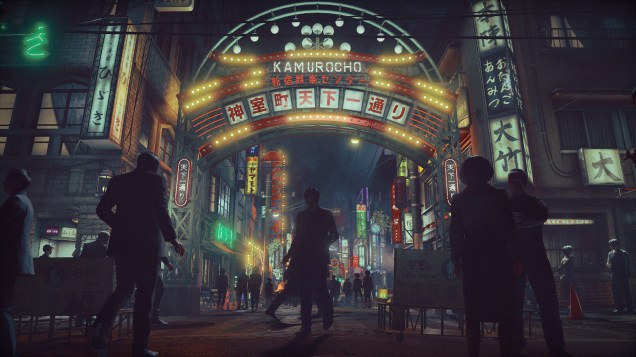
New York Comic Con can be a strange place sometimes, but this year, Sega gave select media the opportunity to make it stranger (than heaven). We went hands-on with developer Ryu ga Gotoku’s next major project, and while our extended look offered glimpses into the decades-spanning adventure, there’s clearly still a lot more to see.
The three-hour demo was broken up into five parts. The first three were all set in 1915, first on a ship headed to Japan, and then in the harbor town of Kokura. These three sections introduced key characters, a major conflict in protagonist Makoto’s early life, and a climactic battle in an ironworks factory.
The later two sections highlighted two other cities and eras: 1929’s Kure and 1943’s Osaka. Both sections were centered around the multiple open-world activities we’ll find in each of Stranger Than Heaven’s time periods, from minigames and short missions to the side content involving Showbiz show-planning.
There was a lot to take in during the demo, which reinforced the massive scope that director Minikobu Abe and the RGG Studio team are going for in the full game. After we played the game, we sat down with Abe to learn more about feedback received from previous demos, the inspiration behind Stranger Than Heaven’s story, and more.
Stranger Than Heaven seems to be shaping up to be a massive game, with an emotional story at its core. Based on what I played, it should be capable of standing out, rather than being lost in the shadow of RGG Studio’s Like A Dragon series.
A fish out of water
Stranger Than Heaven tells the story of Makoto Daito, a half-American, half-Japanese man who finds himself torn between two cultures. In the prologue, he’s chased by American policemen in San Francisco who use words like “oriental;” while in Japan, he’s greeted with “keto,” a derogatory slang word for non-Japanese people that literally translates to “hairy foreigner.”
While these moments are set over 100 years ago in 1915, Abe says that the overarching themes are very much still relevant today. “Questioning your identity is one big theme for a lot of people around the world, especially with the internet, and I think it really resonates with people,” Abe said. “We thought making a character who’s mixed race could spark a huge interest and a strong message, like it could give the courage for people to live their lives.”

Abe also mentioned that he knows firsthand the feeling of being considered an outsider, even in his home country. “I have a personal experience living abroad and then coming back to Japan; I’m not of mixed heritage, and yet people still treated me like a gaijin, which is a foreign outsider,” Abe said. “[Telling this story] really resonated with me; I really wanted to tell this story as a director, and that was the entire starting point on how we got to this concept.”