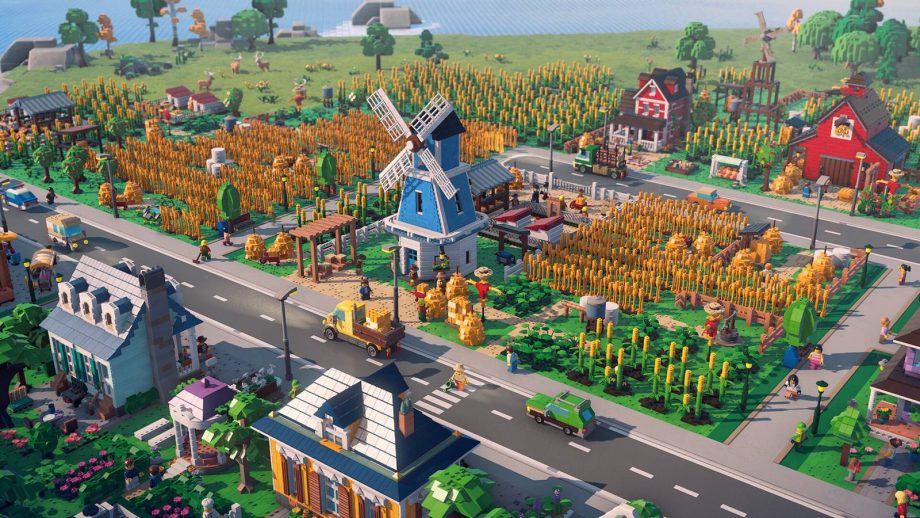
Hot on the heels of Paradox and Iceflake Studio’s Lego Skylines reveal, Polygon got the chance to spend several hours with a preview build of the upcoming city builder. It included an early-game and late-game scenario, enough to get a feel for the campaign mode, how more complex simulations play out and, just as important, how customization works. Despite some late-game balance concerns, the smaller-scale building and deeper focus on decorating make Lego Skylines a promising spinoff indeed.
Iceflake said elsewhere after Lego Skylines‘ reveal that it’ll have a hefty campaign mode, and the early scenario picks up at the start of your career as a master builder. I’m on an island with a family that moved here thinking they were getting a piece of rural bliss, and what they’ve found is absolutely nothing. So I build them a home, decorate the exterior, drop down some shopping options and a place to work, and now life in the sticks can move ahead smoothly.
If you’ve played Cities: Skylines or any builder like it, that paragraph already gives you a solid idea how Lego Skylines wants to distinguish itself. Individual households matter more in Lego than vast swathes of commercial and residential districts. You do need to think about the bigger city layout, eventually, but citizen needs are a big part of what shapes that. Campaign mode tasks you with completing multiple requests from various citizens and local bigwigs, which gives your town a loose, basic shape to help get you started. It’s a welcome introduction to city building compared to how Cities: Skylines punctures your floaties and throws you into the deep end.
Every household has a set of basic needs you have to meet, like making sure everyone has somewhere to work (would that real life were the same), and those needs evolve over time in the usual Skylines way. Families with kids need daycare, the old folks should have somewhere to go: All that works, from what I can tell, largely the same as in the mainline games.
Houses also have an “appeal” needs category, which is where Lego Skylines‘ potential really gets me excited and where it deviates the most from the other Skylines games. Decoration items are how you fulfill appeal needs, and they come in several categories, like cozy, nature, formal, industrial, and so on. You’ve got flower patches and ponds for nature, garden features for cozy, statues and benches for formal — you get the idea.

Initially, I dropped whatever they wanted without thinking too much about it, just to make people happy. Unsurprisingly, my first neighborhood was a rank patchwork of mismatched items that looked appalling. Then I started thinking more deeply about it, figuring out ways to make thematically coherent neighborhoods despite using different elements. It’s pretty amazing what you can make just by rotating a few props and getting a bit creative with placement, though I admit I looked to the late-game save file’s neighborhoods for some inspiration on that front.
In addition to coordinated yards and shared spaces, you also get multiple home variations for each size. Fancy a classic Tudor-style neighborhood? Or Victorian — sorry, “Bricktorian” —suburbs for the finer folk? Beach homes? Condos? Townhouse apartments? Cabins? None of that, but several other styles instead? Well, you’re in luck, and every style category has several variations. I had to drag myself away from fine-tuning neighborhood decorations to do quests.
You can also customize each plot with prop items. These don’t appear to affect needs, and the selection is rather limited. I didn’t bother with them much, though I suspect it’s one of the first areas modders will probably focus on.
Even with the heavier emphasis on customization, the simulation elements are still here. You need power, water, garbage disposal, education, and all the other services, and you have several options for how to provide them. Upgrades, like in Cities, increase a service building’s range, usually at the expense of higher running costs or adding pollution. Policies, taxes, and general budget planning are here as well, though I didn’t get to dig into those much.
The simulation balance is a bit wonky, though. The late-game file had a larger city with 2,000 people (the scale is much smaller than in Cities), and despite hosting several schools and about a dozen garbage disposal centers, trash was piling up and only 50% of the educated population was “highly educated.” I really didn’t want to drop half a dozen more garbage centers down, even if they are unobtrusive. (It’s just 2,000 people! How much filth can you really produce!?) The education situation seemed a bit excessive, too. Maybe I just didn’t wait long enough for the new university to fill up and do its job, but the enrollment numbers were annoyingly low, despite the apparent need for the institution. But, these are balance issues that adjustments can improve.

Leisure and happiness unique, too, but in a good way. In Lego Skylines, the more leisure locations you build, the more you unlock. For example, you might start out with a handful of little sports venues or a mini-golf course, but as you sprinkle them around the city so everyone can have bouts of dinky sports fun, you get better venues and eventually really nice ones like stadiums. The bigger venues host events that make everyone happy, and they just look neat too. These also have distinct appearances, and you can combine them to make unofficial districts, like putting a music venue near some graffiti walls and other bohemian items in the downtown area or making an uptown district with fancy theatres and higher-end restaurants.
Speaking of restaurants, Lego Skylines handles its industries differently, too. In Cities: Skylines’ Industries DLC, you produce multiple product types in a given field (farm goods, lumber, whatever), and use various combinations of them to make different kinds of consumer goods. Lego Skylines‘ industries produce color-coded goods, and local shops need those goods to function, or else they import goods and become less profitable. I’m not sure yet how complex that may become. But aesthetically at least, I do like the idea of designating specific areas for certain goods and industries, a feat made possible by how much less room you need for industries to thrive compared to Cities: Skylines. My Lego farm district had four functioning farms, and I needed a fraction of the space a single farm uses in Cities.
As time spent with city builders goes, my Lego Skylines preview was comparatively short. However, the glimpse it showed me of Iceflake’s vision made me eager to see a whole lot more. I’ll have to wait a while longer, though, as Lego Skylines has no release date yet.
Read Full Article At Source