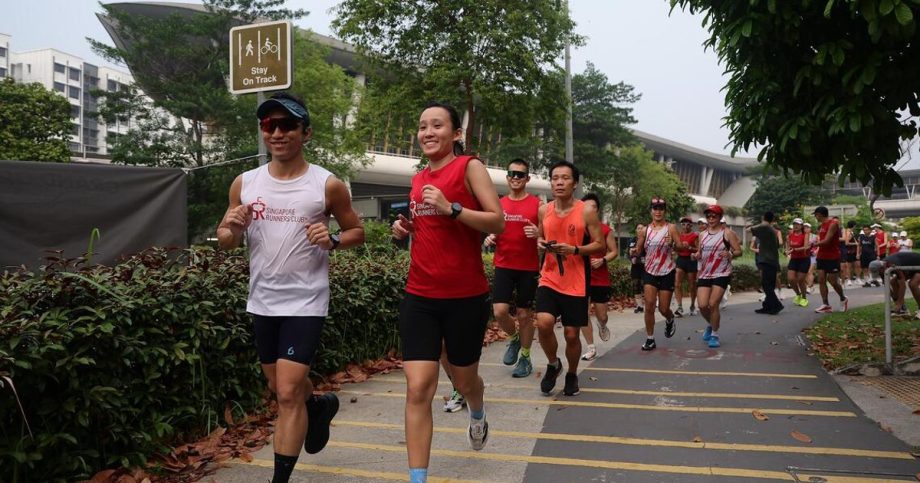
SINGAPORE – Jileen Tan is training for a personal best race time, but has had to cancel outdoor runs over the past two weeks because of poor air quality.
Singapore recorded unhealthy 24-hour Pollutant Standards Index (PSI) readings daily from Oct 5 to 17. Hourly readings of fine particulate matter of 2.5 microns or less in diameter (PM2.5) in size were elevated or high.
Tan, a 62-year-old secretary, now wonders whether she will be able to complete the 21.1km half-marathon in under two hours at the Standard Chartered Hong Kong Marathon in January 2027.
She had hired a personal trainer to help her achieve this goal, but can no longer adhere to her original training plan, which includes outdoor runs of 14km to 16km.
“I love to run outdoors and I miss it,” she says. “But I have to accept the situation.”
Many avid runners and those training for upcoming races have found their outdoor exercise hobbled by the haze.
Running when outdoor air quality is poor can irritate the airways and cause lung inflammation, as well as potentially trigger cardiac arrest, doctors say. Increased thirst and watering eyes can also make running more difficult.
Yet, some runners are still trying to get their outdoor fix by wearing masks, running at a slower pace or over shorter distances, and by tracking the hourly PM2.5 readings across the island and shifting their runs to areas where the air quality is better.
Not all these hacks help, say doctors. Here is what outdoor runners should keep in mind.
Haze can inflame airways, trigger cardiac arrest
Adrian Poh, medical director of the HMI OneCare Clinic chain, says people should postpone or cancel their usual outdoor exercise when air quality is unhealthy, as PM2.5 can penetrate the lungs and affect the airways.
Respiratory irritation and inflammation cause throat irritation, coughing, wheezing or chest tightness.
Increases in PM2.5 readings were associated with higher chances of out-of-hospital cardiac arrest in the first two days after exposure, according to data from emergency doctors and public health specialists in Singapore published in 2018 and again in 2022.
PM2.5 particles are retained in the lungs and not cleared by the usual mechanisms, Poh adds. This triggers oxidative stress and can lead to airway and lung injury. The airways and lungs become more susceptible to infection, and over time, lung function may be impaired.
“If your usual running pace feels harder, don’t push through,” he says. “The haze could be contributing to extra strain.”
Jill Lim, 33, has found it harder to breathe during her usual runs. The public servant is a pacer for the Singapore Runners Club (SGRC), a social running club whose members train and run together several times a week.
The club tracks hourly PM2.5 readings before deciding whether or not to hold a scheduled run. Lim says that even when the readings are just above 55, in the elevated but not yet unhealthy range, she finds it harder to breathe during intense training like interval runs.
“I feel a difference, compared with my usual sessions,” she says. “My breathing is definitely heavier.”


Read Full Article At Source