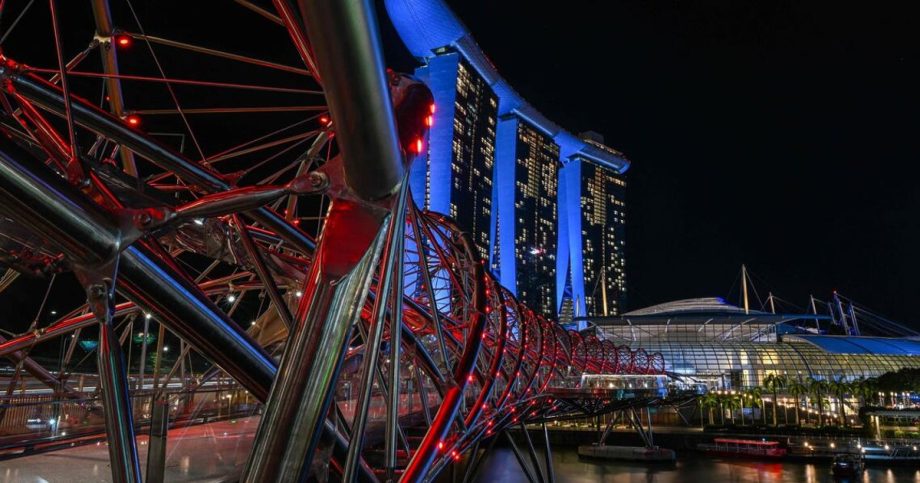
SINGAPORE – The iconic Helix Bridge in Marina Bay, an eye-catching tourist attraction and Singapore’s longest pedestrian bridge, was inspired by the double helix of DNA.
Less well known is that it is left-handed by design (the two twisted strands spiral in an anti-clockwise direction), unlike the familiar form of DNA found in living organisms, which twists to the right.
Most of the essential molecules of life, including the building blocks of DNA and RNA, most amino acids, sugars, and even some lipids, exhibit “handedness”. This property – first demonstrated by the father of modern immunology Louis Pasteur in 1848 – is known as chirality.
An object is chiral if it cannot be superimposed on its mirror image, much like our left and right hands.
Life on Earth overwhelmingly favours one configuration over the other – a phenomenon termed homochirality. Proteins are built almost entirely from “left-handed” amino acids, while most of life’s key sugars are “right-handed”. Why life settled on this specific dominant configuration remains a great scientific puzzle.
But the consequences are far-reaching: The enzymes that bind and break down molecules, the receptors on our cells, and even key facets of our immune system are highly shape-specific. They often cannot recognise or act on mirror-image molecules. We humans cannot metabolise “left-handed” glucose, although curiously, we can taste it just fine.
The case against creating mirror life
Scientists have worked on mirror-image biological molecules for decades, creating many useful products and drugs.
They show promise in creating drugs or biomaterials that do not break down, and because the immune system does not recognise them, they do not prompt immune reactions and could work in the body for much longer.
However, in December 2024, a group of prominent scientists published a Policy Forum article in the journal Science warning about the risks of creating “mirror life” – mirror-image organisms capable of reproduction and expansion – accompanied by a 299-page technical report examining the evidence and possible consequences.
The group included many who work at the frontiers of synthetic biology and mirror-image biological molecules, as well as experts in immunology, ecology and biosecurity. Several had previously regarded creating mirror-image organisms as a long-term scientific goal, but their own analysis persuaded them of the danger.
The scientists estimated then that the capability to create “mirror life” – a mirror-image bacterium being the most plausible first such construct – was “at least a decade away” and would require major technical advancements as well as large-scale investment.
For policymakers and the scientific community, this lead time is valuable: It creates an opportunity to develop proportionate safeguards alongside scientific progress, rather than trying to impose them retrospectively.
It also offers an opportunity to better understand and pre-empt the risk, rather than kick the can down the road while dealing with more exigent challenges.
The scientists’ case, built largely on existing experimental evidence and established principles of biology, laid out why a sufficiently robust mirror-image bacterium, once created, might survive and even thrive in our world if it was accidentally (or deliberately) released from the laboratory.
Although it would start with a metabolic disadvantage – there being fewer nutrients that it could use – the constraints that keep natural bacteria in check, such as viruses that could infect and predators that could prey on them, might have limited effect, because the reverse chirality could result in the bacterium not being recognised and targeted.
More concerning is what might happen should the bacterium invade living organisms. The likely inability of life’s immune systems – in plants, animals and humans alike – to recognise and react effectively against such a bacterium would mean that it could have a broad host range, plausibly resulting in severe or lethal infections across many species.
Most of the antibiotics we use to treat bacterial infections today are also chiral, and they are expected to have limited or no effect on a mirror-image bacterium. Even if we were to synthesise mirror-image antibiotics – a far less difficult challenge compared with creating mirror life – the lack of an adequate immune response would dramatically reduce the efficacy of these drugs.
The science has not stood still
Progress has continued on several fronts since the Science article. Chemical synthesis of large mirror enzymes and proteins has become more efficient, while parallel advances in synthetic biology have demonstrated increasingly sophisticated production and assembly of the components of the cellular machinery that make proteins.

Read Full Article At Source