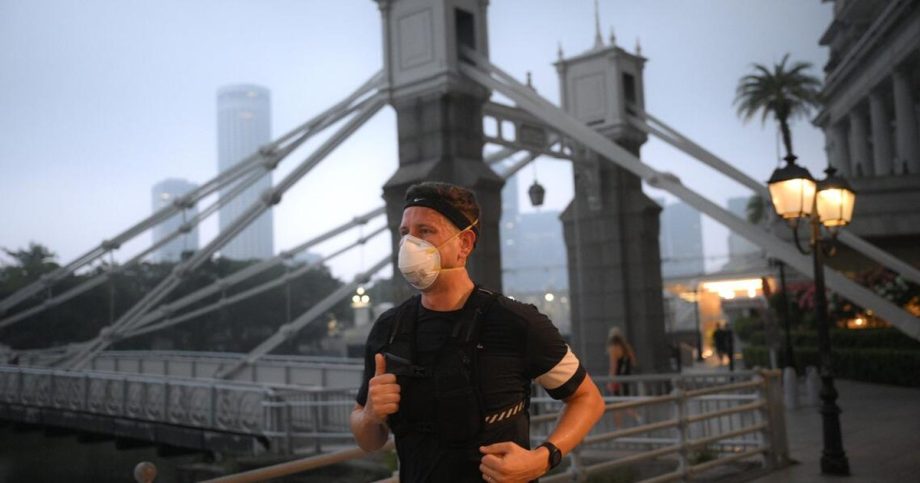
SINGAPORE – When Pollutant Standards Index (PSI) levels in Singapore hit the unhealthy and very unhealthy levels in mid-October, the authorities started distributing free N95 masks for vulnerable people, such as the elderly, expectant mothers, younger children and people with medical conditions such as asthma.
From Oct 14, each eligible person could collect a pack of two N95 masks at community clubs as well as via vending machines at locations such as selected public transport hubs and social service offices.
But with the bad haze conditions possibly extending into early December – with PSI possibly exceeding 300 – how long can a pack of two N95 masks last?
Can these masks be reused and when should they be replaced?
What are N95 masks, and how do they protect you against the haze?
An N95 mask is one that forms a tight seal around the face, and can filter out 95% of fine particles between 0.1 and 0.3 micrometres in size.
It is exposure to such particles that can cause irritation of the eyes, nose and throat in otherwise healthy people.
Continuous exposure to haze particles at unhealthy PSI levels – of 101 and above – over several days can affect the heart and lungs, especially in those with chronic heart or lung disease.
N95 masks also meets standards set by the United States’ National Institute for Occupational Safety and Health.
Are KN95 and KF94 masks the same as N95 masks?
KN95, FFP2 and KF94 masks are just as effective as N95 masks in reducing a person’s exposure to haze particles, the Ministry of Health (MOH) has noted.
The different names simply indicate their respective national standards.
KN95 indicates the mask meets standards in China, blocking at least 95% of airborne particles.
KF94 is a South Korean standard indicating the masks filter at least 94% of such particles, while FFP2 is a European standard similar to the N95.

Read Full Article At Source