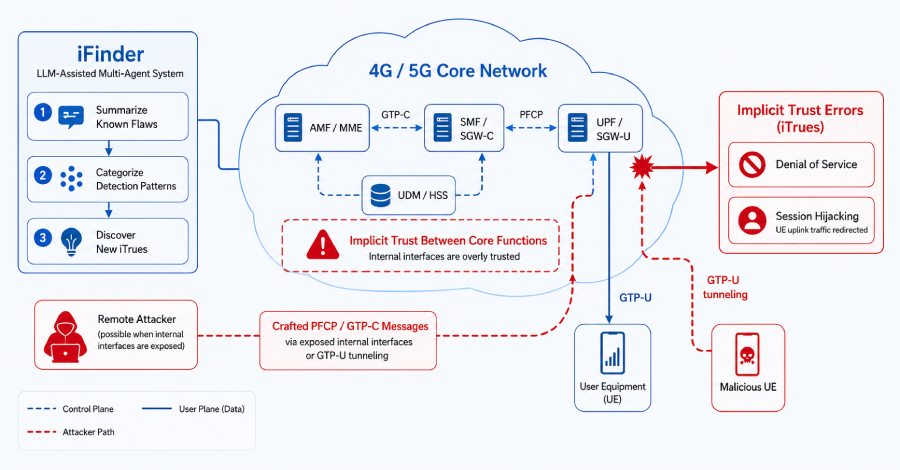

An academic study has disclosed a “widespread class” of security vulnerabilities impacting 4G and 5G core networks that, if successfully exploited, could trigger denial-of-service (DoS) attacks and even session hijacking, allowing an attacker to seize control of a user’s network session.
The findings have been released by a group of researchers from Singapore’s Nanyang Technological University in a paper titled “Understanding Implicit Trust Errors in Core Carrier Networks through Multi-Agent Flaw Discovery and Analysis.”
The study has uncovered dozens of vulnerabilities in the signaling interfaces of LTE/5G core networks, and specifically covers two LTE implementations (Open5GS and OpenAirInterface) and five 5G implementations (Open5GS, free5GC, OpenAirInterface, SD-Core, and eUPF) across two core signaling protocols, GPRS Tunnelling Protocol Control Plane (GTP-C) and Packet Forwarding Control Protocol (PFCP).
“Our research finds these vulnerabilities share a single recurring root cause, implicit trust between core network functions, and are present in widely used open-source LTE/5G cores that back research testbeds and commercial deployments alike,” the researchers said.
While cellular core networks (CNs) have historically incorporated physical isolation as a means to ensure interfaces between core network functions operate within a trust zone, the transition to cloud-native deployments has made the trust model “fragile” and expanded the attack surface, allowing adversaries to potentially reach previously internal interfaces.
The researchers said they found a pattern of blind trust among CN components, which, coupled with weaknesses in those interfaces, can be exploited by an external actor for conducting malicious activities, including DoS and session hijacking, when they become reachable over the internet. These errors have been codenamed implicit trust errors (iTrue).


Read Full Article At Source