A good puzzle game needs to constantly find new ways to challenge you, to walk you through skills and reward your observations, and to contain answers that make logical sense without being too obvious, or too obtuse.
Order of the Sinking Star, the latest puzzler from developer Thekla Interactive and director Jonathan Blow, mostly hits those marks with impressive, cunning, and devious puzzle design. But even when it misses and gets frustrating, the game takes so many swings that it’s easy to head to another level and find another opportunity to bend your brain and stretch your smarts.
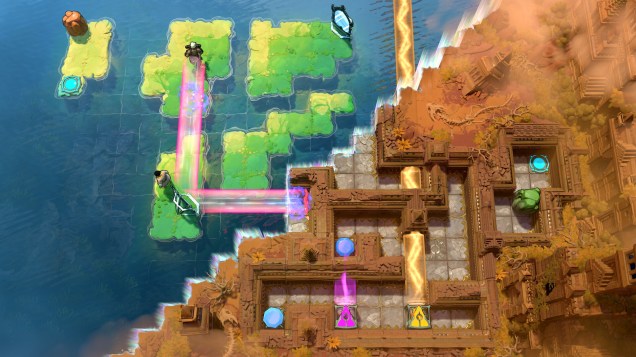
In fact, the best and worst part of Order of the Sinking Star is how expansive it is. Thekla touts over 1,000 puzzles to solve spread across an expansive overworld map that’s full of discreet dungeon-like levels, mimicking the formula of 1987’s The Legend of Zelda. And like the original Zelda, all of those puzzles involve pushing blocks around a grid, seen from a top-down perspective. Finding ways to keep the act of pushing blocks challenging, compelling, and unpredictable for hundreds of puzzles is Sinking Star’s greatest feat, but that ingenuity can also make the game a little too sprawling and, at times, unwieldy.
All those puzzles are born of the many smart and intricate mechanics Order of the Sinking Star brings to bear on its simple underlying concept. The game finds you in what appears to be some kind of strange artificial garden facility, and you start by controlling a character who, after being plucked from some kind of battle, at first wonders if she’s died and is now in the afterlife. But one assumes Valhalla or whatever would have more drinking and fewer brain teasers. As she sets about exploring, she discovers audio logs left behind by some other person who explored the place ahead of her and recorded his many findings.
Soon after, you enter a massive open overworld, where you can set out in four different directions, each representing a different set of mechanics. Those areas are each inspired by other, smaller puzzle games, and here those games’ creators serve as level designers for their specific areas. From the overworld, you can enter different puzzle levels, activated from points on the ground like spaces on a game board. Completing those puzzles opens pathways forward to keep exploring the overworld.
What you soon discover is that each of these sections of the map, with its unique mechanics, represents a specific world in the multiverse sense. Each world has its own characters, whom you control within individual puzzle levels. The idea of different worlds and their denizens being pulled into this strange, ethereal place provides a story reason to include a ton of different mechanics, and then gives Order of the Sinking Star a handy excuse to combine them in fascinating and novel ways as the different worlds collide.