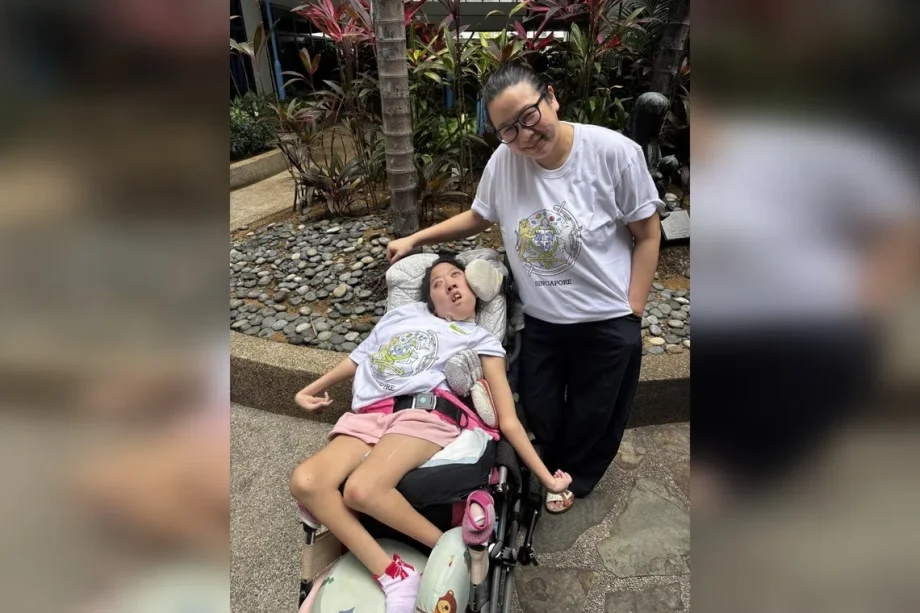
SINGAPORE – When Sarah Swee was born after 38 weeks’ gestation, she made a high-pitched, wheezing sound caused by disrupted airflow through a narrowed upper airway – called stridor – and she was not able to swallow.
She also suffered from facial palsy, a loss of movement in the facial muscles on her left side.
“She was not growing normally, so she was delivered by caesarean. It was then that the doctors noticed she has a receded chin and was not moving the left side of her face. This made it difficult for her to latch on for breastfeeding or even bottle-feeding, so she had to be tube-fed,” said her mother Jasmine Lee. Sarah, now 14, is non-verbal and non-mobile. Doctors still do not know what her condition is.
“(They) could only tell me about her symptoms and physical characteristics, but none could come up with a diagnosis,” said Lee, whose efforts all these years to get a diagnosis for Sarah have not borne fruit.
What Koh Ai Ling, a geneticist with KK Women’s and Children’s Hospital (KKH), can say is this: Sarah has a complex medical history of brain stem disorder, congenital (facial nerve) palsy and severe global developmental delay.
Even after Sarah underwent various genetic tests, no genetic cause explaining her symptoms could be found.
“Rare diseases can be difficult to diagnose because the symptoms do not always point neatly to one particular condition. A person may have several symptoms affecting different parts of the body. While each individual symptom may look relatively familiar to doctors, the challenge is recognising that the combination (of symptoms) may be the result of one underlying disorder,” Koh said.
Koh said doctors cannot test for every possible rare disease as there are thousands of known genetic disorders “and many are individually so uncommon that a particular doctor may never encounter one during his or her career”.
“Doctors may need to work through a long list of possibilities, review investigations that have already been performed, look for patterns that may have been missed and, increasingly, use genomic data to search for genetic explanations,” she added.
For someone like Sarah, Koh said the first important breakthrough may therefore not be a treatment or cure, “but simply finding out what is causing the illness”.
“A diagnosis can provide an explanation for years of symptoms, help doctors determine what should be monitored, prevent unnecessary tests or treatments, and in some cases identify a treatment that would not otherwise have been considered,” she added.
Around 7,600 genetic diseases have been identified throughout the world, and more are being discovered every year.
To increase the chances of finding the root cause of their conditions, persons living with undiagnosed diseases (PLWUD) can participate in an intensive 48-hour hands-on diagnostic sprint called The Undiagnosed Hackathon.
This event gathers families of PLWUDs and multidisciplinary experts from around the world to work side by side on rare, complex cases that have remained unsolved despite extensive medical testing.
The first South-east Asian edition of the hackathon, and the fifth overall, was held at KKH from Sept 19 to 20, organised by the hospital and the Wilhelm Foundation in Sweden.

Read Full Article At Source