Dive into the ArtScience Museum’s new ocean exhibition

Dive into the ArtScience Museum’s new ocean exhibition


SINGAPORE – Silver helium balloons in the shape of fish drift in the air, fitted with sensors and a tail to “swim” through the room while avoiding visitors and other fish. 

The art installation mimicking the schooling behaviour of fish is one of the highlights of ArtScience Museum’s latest exhibition, Into The Ocean: Journey Beneath.

Presented by the museum in collaboration with OceanX, an ocean exploration non-profit organisation, the immersive exhibition will be launched on June 6, allowing visitors to explore the different zones of the ocean, reaching depths where few humans have ventured. 

Guests taking whiffs of oceanic smells from the Caribbean and Pacific coasts of Costa Rica in Norwegian artist Sissel Tolaas’ Invisible Ocean artwork.

Visitors taking whiffs of smells from the Caribbean and Pacific coasts of Costa Rica in Norwegian artist Sissel Tolaas’ Invisible Ocean artwork.

ST PHOTO: NG SOR LUAN

The exhibition has five zones, featuring installations by artists from around the world to create a multi-sensory experience. These include colourful visualisations of how whales perceive their surroundings through echoes and vibrations and oceanic “smellscapes” featuring smells collected from coasts in the Caribbean and Costa Rica.

Visitors can also learn more about scientific concepts such as environmental DNA (eDNA) through games like eDNA Detectives, in which a player uses eDNA samples to find out which creatures have passed through the waters.

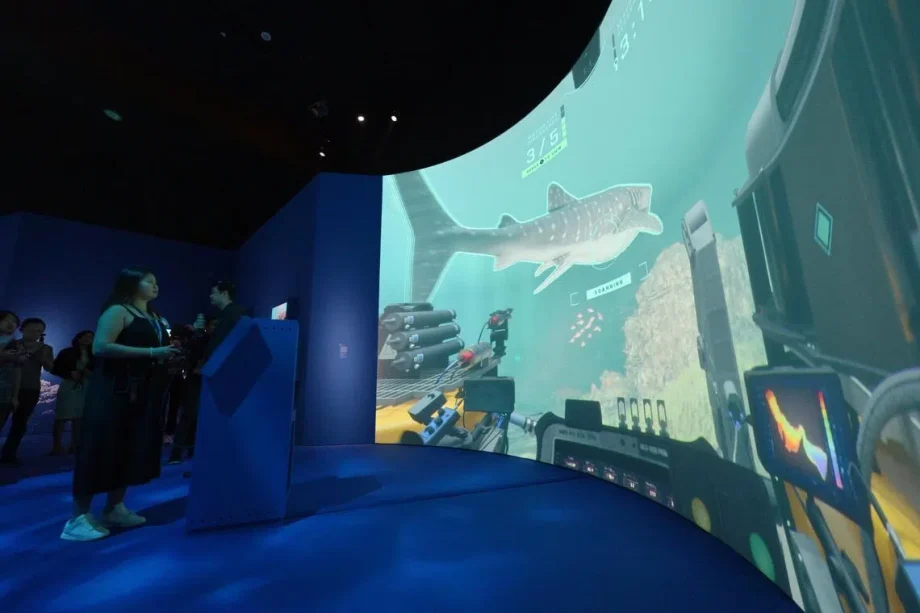
The large-scale installation Seeing Echoes in the Mind of the Whale allows visitors to experience how whales perceive their surroundings.

At the installation Seeing Echoes In The Mind Of The Whale, visitors experience how whales perceive their surroundings.

ST PHOTO: NG SOR LUAN

The exhibition also showcases footage captured during OceanX expeditions, and deep sea specimens from the National University of Singapore’s Lee Kong Chian Natural History Museum.

Visitors begin their journey in the first zone Descent, where they witness a live deep-sea expedition aboard OceanX’s research vessel before entering the Photic Zone, which explores the sunlit upper layer of the ocean where most marine life is visible.

The Photic Zone of the exhibition, which features reef core samples from local sites.

The Photic Zone of the exhibition, which features reef core samples from local sites.

ST PHOTO: NG SOR LUAN

The zone, which extends roughly 200m from the water’s surface, showcases footage of corals from the Red Sea. Reef core samples from local sites such as Cyrene Reef and Pulau Hantu also give visitors insight into how reef systems have adapted to Singapore’s changing environments over 8,000 years.

The next section of the gallery is the Twilight Zone. Here, visitors encounter the darker, cold ocean environment 200m to 1,000m below the surface, and learn about deep-sea currents in the ocean through a touch-responsive interactive installation.

Next comes the Aphotic Zone, the inky depths below 1,000m where visitors can observe specimens and footage of deep sea creatures such as the headless chicken monster, a genus of sea cucumbers found in the deep sea.

The zone also features cinematic footage of deep sea environments such as brine pools, which are rare bodies of extremely salty and dense water. 

In the final zone Resurface, visitors return to coastal waters, where they learn about seagrass meadows which act as nurseries for marine species and carbon stores. 

Visitors can learn about seagrass restoration in an interactive activity in the final zone of the exhibition.

In the final zone Resurface, visitors learn about seagrass meadows, which act as nurseries for marine species and carbon stores.

ST PHOTO: NG SOR LUAN

Adrian George, ArtScience Museum’s director of programmes, exhibitions and museum services, hopes visitors will “catch the virus of being curious about the ocean” and encourage them to reflect on their relationship with it. 

“We know that sometimes scientific principles and ideas can be difficult to understand, so we find that working with artists to try and articulate those ideas can help,” he said. 

“We have different installations which may appeal to people’s various interests, be it music or gaming, and they can also learn something about their region here.”

Kay Vasey, director of immersive and digital experiences at OceanX, said she balanced both entertainment and education to pique people’s interest, and expressed hope that visitors will leave with a greater sense of awe and empathy for the ocean. 

She said: “Once people feel something and actually care, then they ask themselves, ‘What can I do?’ That’s what I want people to walk away with.”

The exhibition runs until Nov 1.

  • For Singapore residents, tickets cost $19.50 (adults) and $16.50 (concession). For others, tickets cost $22 (adults) and $18 (concession). They can be purchased online or at Marina Bay Sands box offices.


Read Full Article At Source

Share. Save. Don't Miss The Buzz: XFacebookRedditLINETelegramWhatsAppGmail