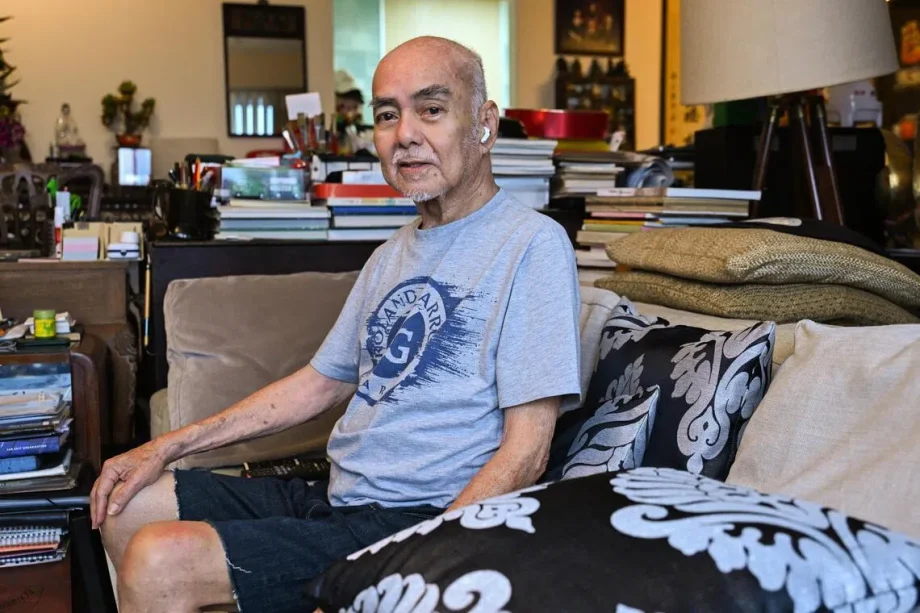
SINGAPORE – For years, Winston Wong’s family knew him only as a former captain in the army who is calm and reserved.
Until his retirement in 2018, Wong, now 79, had kept his roles as a pioneering member of the SAF’s bomb disposal and naval diving units largely under wraps.
His was an illustrious career, from sweeping for war relics and explosives to leading a mission to dispose of a heavy, active bomb in Bangladesh.
After graduating from the Singapore Armed Forces Training Institute in 1968 and bomb disposal and mine clearance diving courses in the UK in 1970, the combat engineer’s first missions involved neutralising hidden sea-mines and bombs from World War II.
“When Singapore developed with a lot of excavation and building of houses, they discovered a lot (of unexploded devices).
“There were sea-mines also laid during the war. Some were not very active, but still very dangerous because we have international sea lanes,” added Wong.
In the 1970s, remnants of sea-mines were uncovered across the sea channel to the Keppel Harbour area, he said.

Winston Wong’s diving belt (top, in black), among other tools he used when he was in the naval diving unit.
ST PHOTO: AZMI ATHNI
Wong spoke to The Straits Times on Sept 11, two days before he was to speak to the public about a critical Bangladesh mission that he led in 1978 to safely get rid of an unexploded bomb near an industrial estate in Joydebpur, north of Dhaka. On Sept 13, the military veteran will present on one of the SAF’s earliest overseas missions at the Military Hobby Fest at SAFRA Toa Payoh.
In April 1978, the Bangladesh government wrote to Singapore’s Ministry of Defence, seeking assistance to remove a 272kg aerial bomb. The explosive was probably dropped during the Indo-Pakistan war, but it did not detonate, said Wong.
The following month, Wong, already a captain, led a team of four to neutralise the bomb over a gruelling three days.
“For some reason, there was maybe a dent somewhere which caused the explosive chain to not align, so the firing process was not complete. But it could still be dangerous because any jarring movement could align it back,” he explained.
The explosive was buried inside a 2m-deep crater that was submerged in water because of monsoon rains.
Three weeks before the Singapore team arrived, protective sandbag walls were set up to shield a factory from the bomb, while water was pumped out before a tent was set up over the bomb to prevent further flooding.


Read Full Article At Source