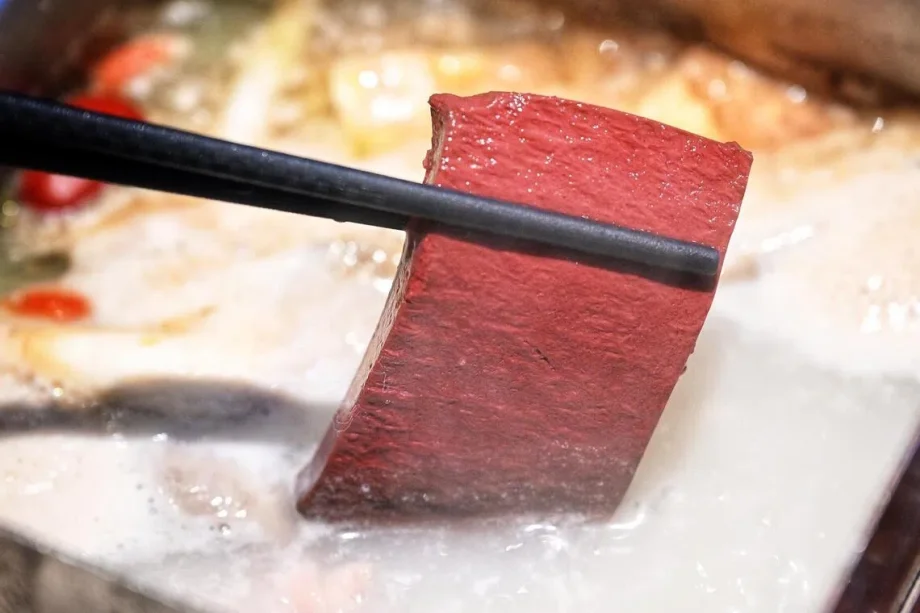
Thomas Koh was 11 years old in 1999 when he watched his grandfather’s world collapse. Since the 1950s, the Koh family has run Koh Brother Pig’s Organ Soup stall at Tiong Bahru Market. Its signature dish was a clear Teochew-style broth simmered with pork bones, offal and salted greens. At its centre were dark, jelly-like cubes of pig’s blood.
Koh remembers the routine. Every morning, buckets of fresh blood would arrive at the stall.
Left to set, the blood became soft, curd-like blocks. When customers ordered, the blocks were sliced, blanched and added to the soup.

Thomas Koh, a third-generation hawker at Koh Brother Pig’s Organ Soup. He was 11 years old when pig’s blood consumption was banned in Singapore in 1999.
ST PHOTO: MARK CHEONG
“It’s rich, and full of umami. The texture is similar to tofu,” recalls the 38-year-old, who took over his parents’ stall in 2018.
For him, pig’s blood was not an exotic ingredient. It was comfort food, and his family’s legacy.
Then, almost overnight in 1999, it disappeared.
Across the Causeway, the Nipah virus, which spread from infected pigs to humans, caused severe neurological illness, and in the worst cases, even led to paralysis and death.
On March 13, 1999, Singapore recorded its first patient with Nipah virus. Over the week that followed, more people here developed high fevers and severe neurological symptoms. Investigators quickly discovered that every single patient worked in the pig industry, and they traced the outbreak directly to sick pigs imported from Malaysia.
That same month, the then Primary Production Department suspended all imports of live pigs into Singapore. A serious blow, since Singapore had relied entirely on imported pork after its last local pig farms closed in 1989.
According to a 1999 article in the Singapore Medical Journal, this total ban appears to have been the decisive step that brought the outbreak to an end.
Pig imports resumed at the end of April 1999, but only from a single accredited farm in Indonesia that had tested negative for the virus.
Even though experts emphasised that the virus could not spread from human to human, or through eating pork, panic spread anyway. According to reports in The Straits Times at the time, pork consumption in Singapore fell by 40 per cent.
Animal blood products became a particular concern. When an animal is infected, viruses like Nipah – along with bacteria – can be present in the bloodstream.
Traditional blood curd posed an added risk as raw blood was left to set at room temperature, then only lightly heated, not always enough to kill harmful pathogens. This also made it vulnerable to contamination during preparation.
As a precaution, Singapore also halted the supply and consumption of blood from locally slaughtered pigs.
For grandfather Koh, this meant the removal of a defining ingredient from the family recipe. He closed the stall for three months to rework it.
“He added meatball, stomach, pig’s heart into the soup,” the younger Koh recalls.

For almost three decades, one key traditional ingredient has been missing from Koh Brother Pig’s Organ Soup’s bowl – pig’s blood curd.
ST PHOTO: MARK CHEONG
Customers reacted warily, not least because offal was seen as high in cholesterol and unhealthy. But the hawker persevered. The business survived, and to this day, long queues still form at the stall. What vanished from the bowl was the pig’s blood.
Nearly three decades later, that ingredient is making a comeback.
A Singapore Food Agency (SFA) spokesman tells ST: “Following this cessation, there was periodic interest from industry stakeholders to resume pig’s blood product supply through imports.”
Risk assessments were also conducted in 2018, leading to new requirements for the safe collection and processing of blood for food purposes.
In April 2026, the SFA approved heat-treated pig’s blood imports from Thailand’s Bangkhla Pig Slaughterhouse, the first application received and approved since the new requirements were introduced.
The approval does not revive the old system the younger Koh remembers. It authorises a very different product: one made under controlled industrial conditions and subject to approval, export documentation and health certification.
At the slaughterhouse, blood is collected through a closed pipeline immediately after slaughter, filtered, poured into trays and steamed for 45 minutes to kill pathogens. The finished curds are then chilled and packaged for export. Bangkhla Pig Slaughterhouse produces CP Foods’ pasteurised pig’s blood curd.
Unlike the buckets of raw blood Koh remembers from his childhood, this updated product arrives neatly packaged like boxed tofu.

Packs of CP Foods’ Pig Blood Curd on display at FairPrice Xtra in Ang Mo Kio Hub on June 4.
ST PHOTO: GIN TAY
“CP has been selling pig’s blood in Thailand for six years, and we are confident our technology and processes meet SFA requirements,” says Joyce Yap, director of CP Foods Singapore.
The pasteurised blood curd is now available in Singapore in supermarkets, hawker stalls and popular hotpot chains, including Haidilao. Whether Singaporeans still have an appetite for it remains uncertain.
The state and the palate
Pig’s blood became unavailable during a public-health crisis. Its long disappearance also raises a broader question: How do food-safety rules shape what a society comes to regard as normal, clean or edible?
Food historian Nicole Tarulevicz traces the roots of Singapore’s food-safety laws to the late 19th and early 20th centuries.
In a 2025 study published in the Journal Of Social History, she argues that these laws were never simply about protecting public health. They also served colonial interests, regulating trade, commercial practices and local food cultures.
“The British Empire was preoccupied with specific kinds of hygiene,” Tarulevicz explains.
But “hygiene”, she says, was not a neutral concept. It often carried racial and ideological assumptions that gave the colonial authorities a rationale for intervening in local practices.
The 1894 municipal abattoir offers a telling example. The authorities regulated the slaughter of cattle and pigs but largely ignored poultry, despite its importance to the local diet.
Cattle received careful inspection to ensure a reliable supply of fresh beef for British elites, who associated it with strength and status.
Pork proved more contentious. When the authorities tried to force Chinese butchers to slaughter pigs at the state facility, the butchers responded with a boycott.
The Government retaliated with fines and prison sentences. In one instance, officials even seized a dead pig hidden inside a rickshaw.
The rules were enforced most heavily against non-white residents, even as serious public health problems such as dysentery among coolies received far less attention.
Part of the reason was cost. Improving sanitation meant investing in public infrastructure. Policing food sellers, punishing adulteration and controlling who could handle food were cheaper and gave the colonial state greater control over commerce and everyday life.
Food safety, in other words, became a way to decide not only what was “clean”, but who was allowed to participate in the food economy.
Singapore inherited this regulatory logic at independence. Tarulevicz notes that its colonial-era framework reflected “specific British Empire ways” of defining and regulating food.
The food historian adds: “It is more complex than drawing a straight line from colonial legislation to post-independence bans on specific foods.”
Still, that history offers useful context. Food regulation is not only about protecting public health – it also shapes which practices are considered acceptable, manageable and compatible with the society a government wants to build.
Singapore’s modern food-control system evolved in response to its own circumstances: land scarcity, heavy reliance on imports, dense urban living and the need to prevent disease outbreaks. Yet older ideas about hygiene, inspection and control remained embedded in the regulatory landscape.
By 1999, when the Nipah virus outbreak prompted Singaporeans to give up pig’s blood, a broader transformation was already well under way.
The country was burnishing its image as a clean, modern First World destination for investors and tourists. In June 1997, the Government introduced a public grading system for hawker stalls based on cleanliness and hygiene.


Read Full Article At Source