Summary
-
Singapore residents are projected to spend an extra S$1.05 billion yearly in Johor Bahru after the RTS Link opens in January 2027.
-
Johor Bahru visitors are expected to spend S$756 million more in Singapore each year, resulting in a projected net outflow of S$290 million.
-
Grocery, drugstore, food and beauty businesses are expected to face the strongest pressure from increased cross-border spending.
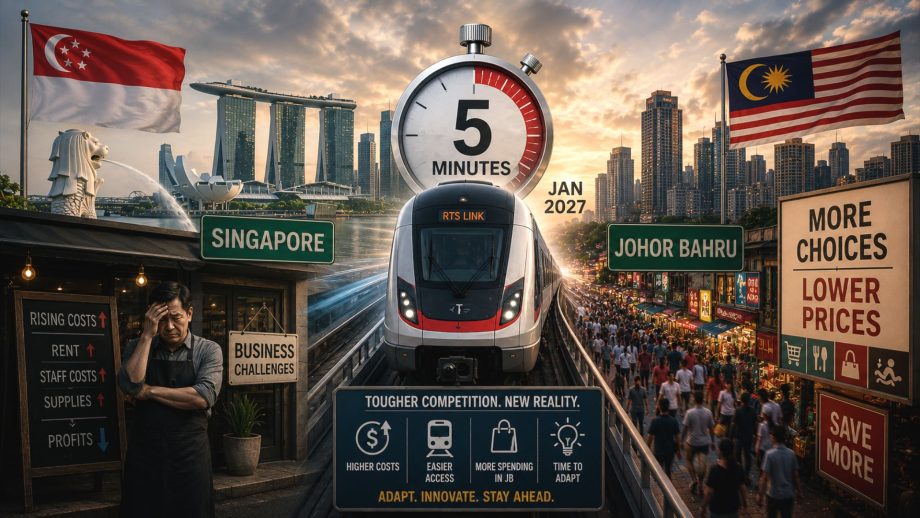
SINGAPORE: A five-minute train ride to Johor Bahru could change how Singaporeans shop, eat, and spend really soon. This is the concern facing many local merchants as the JB-SG Rapid Transit System (RTS) Link prepares to open in January 2027.
The warning is strongest among businesses already feeling the pull of lower prices across the Causeway. Some shoppers are already making regular trips to Johor Bahru for groceries, meals and personal services. And the upcoming new rail link could make those trips far easier.
A study commissioned by the Singapore Business Federation, the Restaurant Association of Singapore, and the Singapore Retailers Association shows that Singapore residents will spend an additional S$1.05 billion each year in Johor Bahru.
Johor Bahru visitors are also expected to spend more in Singapore, but the projected amount is smaller at S$756 million. This leaves Singapore with a projected increase in net outbound spending of S$290 million each year.
It sounds like a large number. However, against Singapore’s total retail and food-and-beverage sales in 2025, it represents 0.4 per cent. The number may be manageable at the national level, but the picture looks different for a small shop trying to hold onto its customers, Channel NewsAsia (CNA) reported (Aug 7).
Lower prices in Malaysia are already sending Singapore shoppers up north
Ruth Lee, a 55-year-old financial adviser, already drives to Johor Bahru every week or two. She visits for breakfast and groceries, saying she can save between 30 and 50 per cent compared with spending in Singapore.
Driving there can be troublesome because of traffic and the need to coordinate the family car. The RTS Link could soon remove much of that friction.
A five-minute train journey between Woodlands and Bukit Chagar would make spontaneous trips much easier. A customer who once needed to plan a cross-border trip around traffic may soon be able to make the journey with much less effort.
Kacey Lin, 50, owns Dawn Beauty at 888 Plaza in Woodlands. Her salon provides nail services, facials, and massages. She said her business has already lost customers to Malaysian competitors because of rising costs in Singapore.
The RTS Link makes future business growth harder to predict. Wong Toh Onn, 70, who works at a minimart in Bukit Batok East, said his business has fallen by about 20 per cent over the past two years.
Customers have told Mr Wong that they are buying groceries in Johor Bahru more frequently due to higher living costs and the favourable exchange rate.
The business owner’s reaction to the coming-soon rail link captured his deepest worries: “When the train opens, we’re doomed.”
Mr Wong’s problem is similar to many other small retailers. Keeping prices low becomes harder when rent, manpower and supply costs rise, leaving merchants squeezed between higher costs at home and cheaper alternatives across the Causeway.
Small businesses could feel the impact first
The commissioned study found that groceries and food products could see the largest net increase in outbound spending. Drugstores, F&B businesses, and beauty services are also expected to face strong pressure.
Northern Singapore could feel the effect more sharply because of its proximity to the RTS Woodlands North station. The study found that the northern region already had stronger outbound spending before the RTS Link opens.
That gives the rail link a very direct local impact. The concern extends beyond individual shops. Singapore has about 24,500 retail enterprises, with 98 per cent classified as micro or small businesses, according to the report.
Ang Yuit, president of the Association of Small and Medium Enterprises, said shop closures could affect suppliers, logistics firms and workers connected to these businesses. This is where a retail problem can become a wider business problem.
Read Full Article At Source