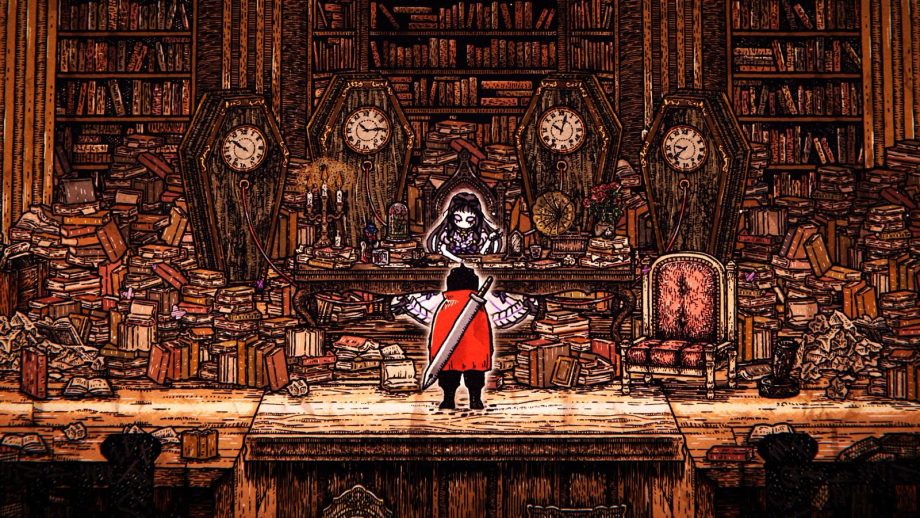
What to do when you’re a writer incapable of finishing a story? Simple: you kidnap an editor. Optionally, you may use your vampire powers to trap said editor inside your manuscript and have him fight demonic creatures until he’s cleared up your work. But should the editor really complain about his fate, when the manuscript looks as gorgeous as it does in Chronoscript: The Endless End? I got the chance to find out during a 20-minute online presentation followed by an exclusive hands-on demo.
In Chronoscript: The Endless End, an exploration-based action-adventure game developed by DeskWorks, you take on the role of Frederick G. Muller, a famous editor who just received a new assignment. All seems well until the job leads him to a creepy, remote mansion, where the resident vampire lady, Viola S. Chambers, teleports him into her unfinished story. As an immortal being (vampire perk), Viola has been working on her story for literal ages, clearly unable to wrap it up without editorial assistance. Poor Frederick is forced to walk his way through Viola’s manuscript in the most literal sense — let us hope he’s paid by the hour.
Upon seeing Chronoscript: The Endless End for the first time, I was deeply in awe of its visual style. The moody darkness, the hand-drawn charm (yes, everything’s hand-drawn), and the abundance of detail in the 2D illustrations create a unique, inky look. On top of that, Chronoscript: The Endless End uses a variety of 3D elements. As you steer a 2D Frederick through the 2D Metroidvania-style chambers, you’ll see 3D pens, ink bottles, and feathers on the side of your screen. Zoom out, and you see a 3D Viola hunched over her unfinished draft.
Though I was afraid that the 3D effects would feel redundant or clash with the highly detailed 2D ink drawings, the result felt surprisingly cohesive. The pages themselves are treated as objects, which means you’ll experience a slight shift when you move from one page to another — you’re literally walking from page to page, a feeling that would not have been possible without the use of 3D. The small golden page numbers, which took me a while to notice, are a lovely detail that’ll help you navigate this 2D-inside-3D world.
If you inspect the 2D drawings closely, though, you may notice duplicate elements; every bookshelf, chandelier, ladder, pillar, and parchment roll has a few twins in its near vicinity. While this makes sense, as drawing thousands of detailed and unique books would take far too much time (unless you’re an immortal vampire), it comes with a risk of repetitiveness if it follows an obvious pattern. In Chronoscript: The Endless End, though, the elements are arranged in a way that feels entirely natural; the same bookshelf may be found at the front, in the back, obscured by shadow, hidden behind other objects, or mirrored. Every page thus becomes a unique collage.

Read Full Article At Source