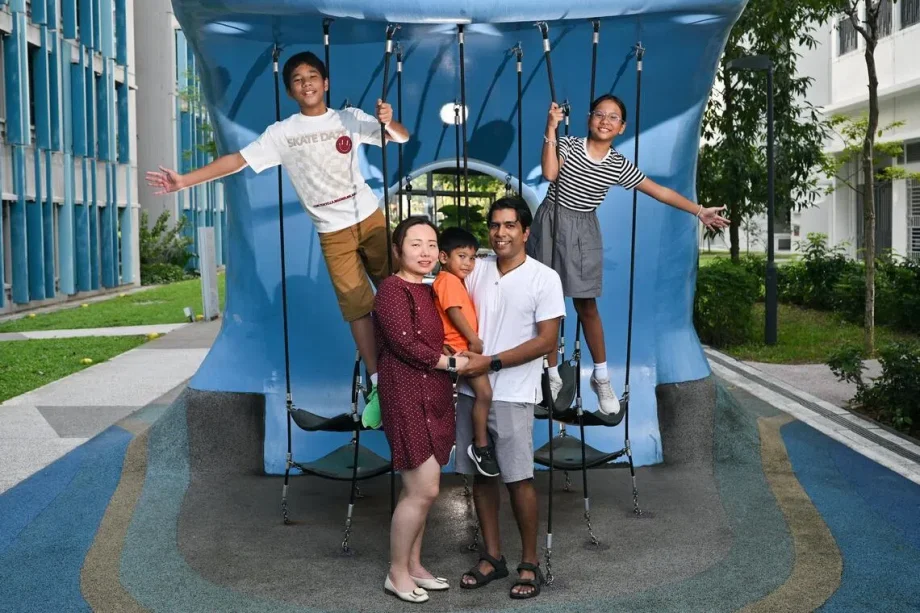
SINGAPORE – When Thinesh Edward Balasingam saw his wife Xiao Hui come out of the bedroom in June 2022, he stopped in his tracks. She looked drowsy and deathly pale.
Her Apple Watch sounded an alarm as her pulse had dropped to about 37 beats a minute, below the normal range of 60 to 100.
Two days earlier, she had been discharged after delivering their son, Skanda, through an emergency C-section after 48 hours of labour.
As Xiao rushed back to KK Women’s and Children’s Hospital (KKH), her place of delivery, in a taxi, Thinesh stayed home with their newborn and two older children, then aged nine and seven.
As it turned out, Xiao had post-partum preeclampsia, a rare condition in which a mother has high blood pressure and excess protein in her urine soon after childbirth, which can cause seizures and serious complications if left untreated.
Thinesh, who was on two weeks’ paternity leave, held the fort while Xiao was hospitalised for about seven days.
In addition to training the helper they had hired, he collected the breast milk that his wife pumped every day and fed it to their newborn.
“I still don’t know how I managed it, but my wife guided me on how to do some things. Her friends and mine also supported me through that tough period,” says Thinesh, 46, an advanced practice nurse from Singapore General Hospital. Xiao, 43, also a nurse, works at a polyclinic.


Read Full Article At Source