[The content of this article has been produced by our advertising partner.]
Norman Foster’s visit to Hong Kong this April has drawn renewed attention to the fourth-generation HSBC Main Building, the project that secured his place in the city’s architectural history. Forty years after its opening, the HSBC Main Building at 1 Queen’s Road Central still feels ahead of its time, bold yet open, monumental yet woven into everyday life, and immediately recognisable even to those unfamiliar with the building.
For many Hongkongers, the building became familiar long before they knew how it worked. It was the Lion Bank. It was the place guarded by Stephen and Stitt. It was the image on banknotes, the backdrop in postcards and films, the building that seemed to belong as much to the city as to the institution itself. That familiarity can make it easy to forget how startling it looked when it opened in 1986.
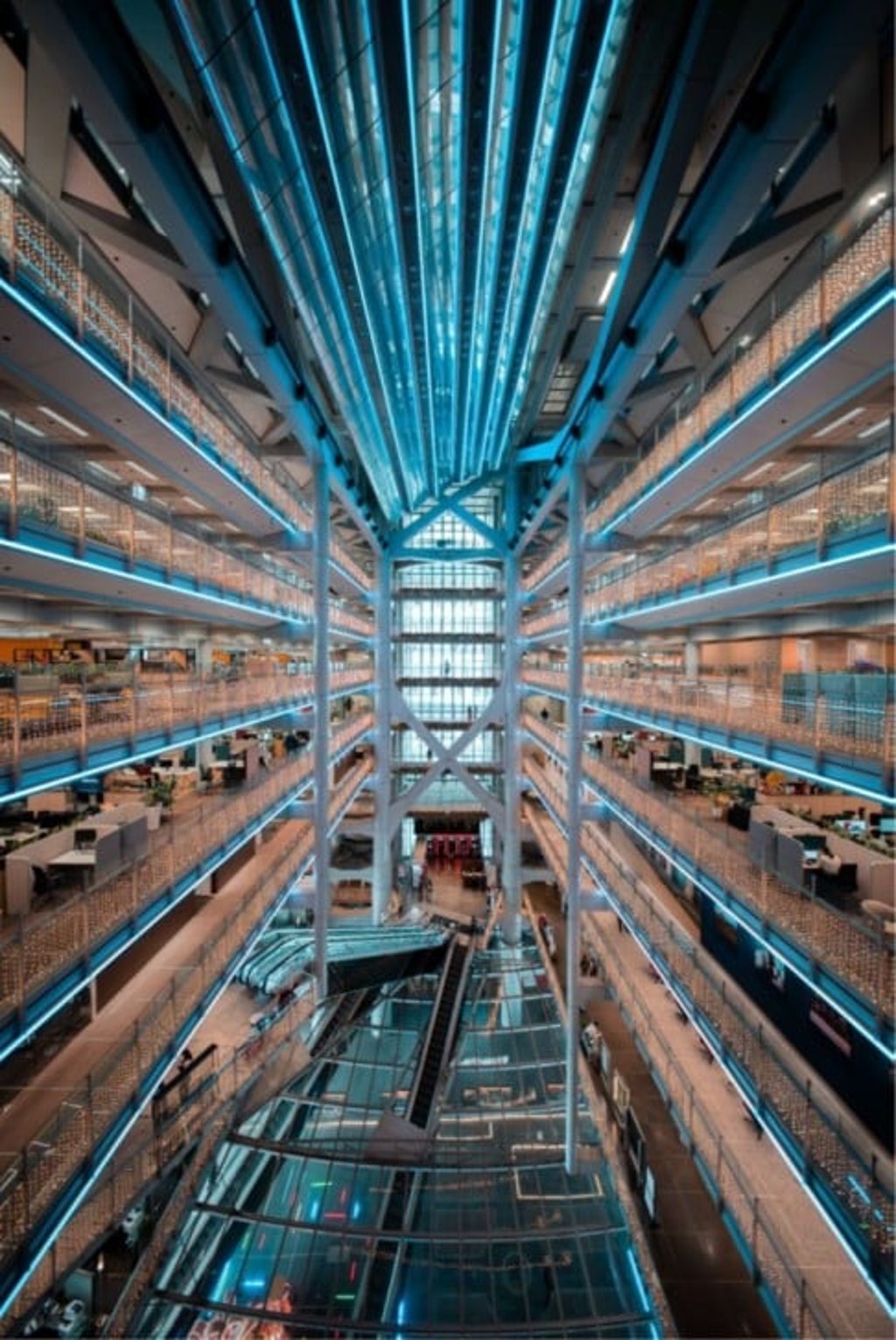
What appeared on the site was no ordinary office tower. Foster’s design lifted much of the structure above the ground, moved key structural elements to the exterior and created an open public space below. Floors were suspended rather than stacked in the usual manner. Sunlight was drawn into the interior through glasses. Services were shifted to the perimeter so the office floors could remain open and adaptable. The result was an office building that looked engineered, not wrapped in decoration, and public facing, instead of being sealed off.
.jpg?itok=ZcrfBx77 "The HSBC Main Building is instantly recognisable to generations of Hongkongers as the Lion Bank.")
A storied address
The site itself had long been bound up with HSBC’s identity. The bank opened for business there in 1864 in Wardley House. A purpose-built banking building followed in 1886, designed by Clement Palmer. Then came the 1935 building by Palmer & Turner, with a steel frame, air conditioning, fast lifts and a tower that made it one of the most advanced buildings in Asia at the time. That earlier Main Building was so closely associated with the bank that it appeared on its banknotes. Foster, then, was not being asked to place a new office block on an empty plot. He was being asked to replace one of Hong Kong’s best-known commercial buildings on one of its most charged sites.
By the late 1970s, however, change had become unavoidable. HSBC had grown so quickly and banking operations had become more complex that the old building no longer accommodated the demands being placed on it. In 1979, seven international firms were invited to enter a competition for a new project. The ambition was put with unusual directness – what the bank envisioned was the world-class banking building.
How Foster approached the commission
Foster approached the task with uncommon thoroughness. While rival architects left Hong Kong soon after the briefing, he stayed with Wendy Foster and Spencer de Grey for nearly three weeks. They examined the site, interviewed department heads, studied workflows and tried to understand the institution from within. That effort mattered and paid off. Foster did not treat the commission as a matter of appearance alone; he wanted to know how the bank functioned, how people moved through it, and what sort of office building would suit Hong Kong rather than merely occupy it.
He also spent time observing the city itself. Foster was struck by older Hong Kong buildings that responded to climate through shade, recesses and deep overhangs. He noticed colour, harbour light, density and the way public movement worked at street level. Those impressions fed into a design that was not simply imported from London. For all its advanced engineering, the building was informed by close observation of Hong Kong’s weather, congestion and street life.
.jpg?itok=-YcZ2IaH "The open plaza beneath the building has served as a valuable public gathering place in the heart of Central, especially on weekends when communities come together.")