Why Macau must protect its culinary heritage

Why Macau must protect its culinary heritage


“If you ask a Macanese who makes the best minchi, they always say mine, or my mother’s, or my grandmother’s,” Marina de Senna Fernandes, a Macanese chef, says.

The locals’ unflinching devotion to this much-loved local comfort food – made from stir-fried minced meat and served with potatoes, rice and fried egg – offers a glimpse into why Macanese cuisine holds such a significant place in the city’s history.

As a former Portuguese colony, Macau was one of the important ports along the Portuguese spice trading route, which brought people and different foods and ingredients from across Africa, India, Southeast Asia and beyond to the city. This melting pot gave birth to its unique cuisine, which was deemed the world’s first “fusion food” by Unesco and recognised as part of Macau’s intangible cultural heritage.

De Senna Fernandes helps run a non-profit canteen that showcases Macanese food at the Macanese Association, and she met Ahmed Abdel Fattah, a lecturer at Macau University of Tourism, to talk about the importance of preserving Macau’s culinary heritage.

“Food has to do with identity, and our identity is very complex,” de Senna Fernandes says. “For instance, in my family, my ancestors were Portuguese, Chinese, Indian – some even from other countries. There are other families that have Spanish blood, or Peruvian or Chilean. So all these people came together, isn’t that amazing?
“Macanese food is what reflects the identity of Macau and it’s kind of like two sides of the same coin,” he says. “When we talk about Macanese food, we’re going to talk about heritage and culture, we’re going to talk about people. You cannot separate them away from each other, they are interconnected.”

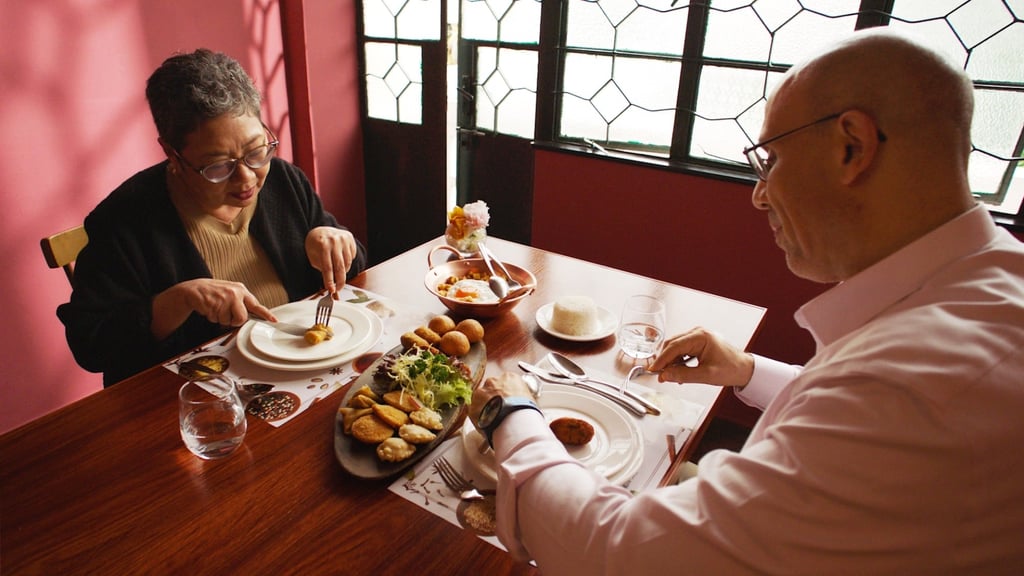
Marina de Senna Fernandes (left) and Ahmed Abdel Fattah feast on popular Macanese dishes at La Famiglia restaurant in Taipa Village, Macau.

Abdel Fattah and de Senna Fernandes share their insights into Macanese cuisine and how to safeguard its heritage while enjoying traditional dishes of Moorish chicken rice – cooked by de Senna Fernandes – minchi served at La Famiglia restaurant in Taipa Village, and bacalhau (dried, salted cod) and sardine tarts at Cafe Sab 8, close to the city’s iconic Ruins of St Paul’s landmark.

Both agree that a key step is to educate local people more about true Macanese cuisine, and encourage them to promote the dishes that are part of what makes Macau special.

“We can introduce food education in elementary, secondary and high school,” Abdel Fattah says. “We bring our local chefs, the authentic local chefs, the local voices, and train our younger generation to preserve our cooking methods.”

La Famiglia is run by Florita Morais Alves, who is a renowned chef of Macanese cuisine, while Cafe Sab 8 is run by Sandra Barros and her mother Ana Liza, who both want to promote Macanese cuisine by modernising it and, in the process, make it more appealing to the younger generation.

“Personally, I feel happy that there are younger generations that are making and trying to keep this cuisine alive and bringing creativity to some,” de Senna Fernandes says. “I don’t want to say reinventing Macanese food, because we don’t need that, but making another taste, since cuisine is always an evolving art.”

Watch the video of the discussion between Ahmed Abdel Fattah and Marina de Senna Fernandes on the relationship between Macau’s gastronomy and its heritage.


Read Full Article At Source