Amazfit T-Rex Ultra 2: Rugged Smartwatch Debuts

Amazfit T-Rex Ultra 2: Rugged Smartwatch Debuts


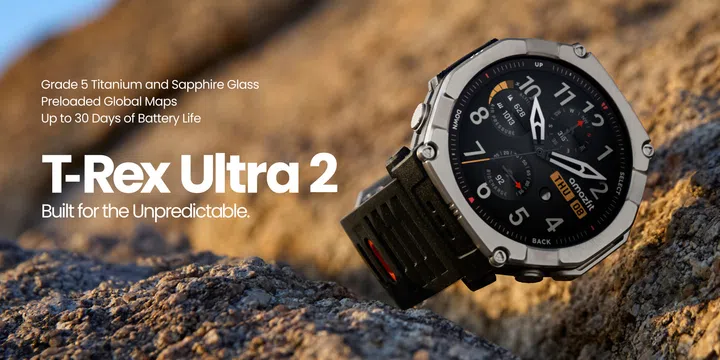
The Amazfit T-Rex Ultra 2 is a rugged GPS smartwatch that’s built to be durable. It has a strong case construction, a high-visibility display, and its battery is supposed to last up to 30 days. It also comes with comprehensive outdoor navigational features.

The hardware and specs
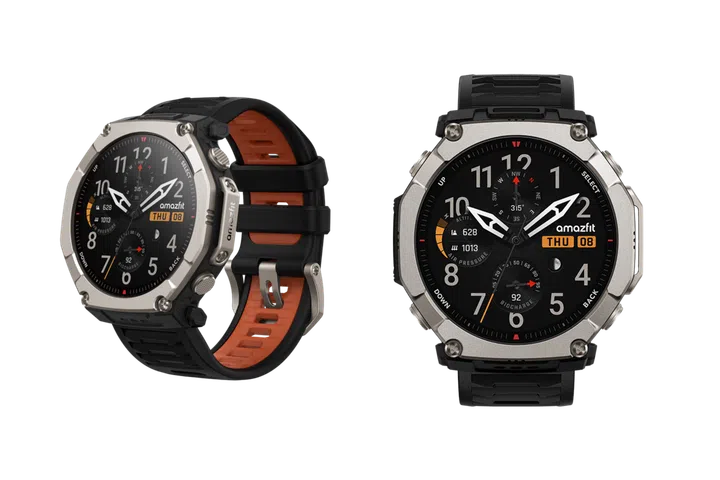
Image of the front and side view of the T-Rex Ultra 2

The front and side view of the T-Rex Ultra 2

Photo: Amazfit

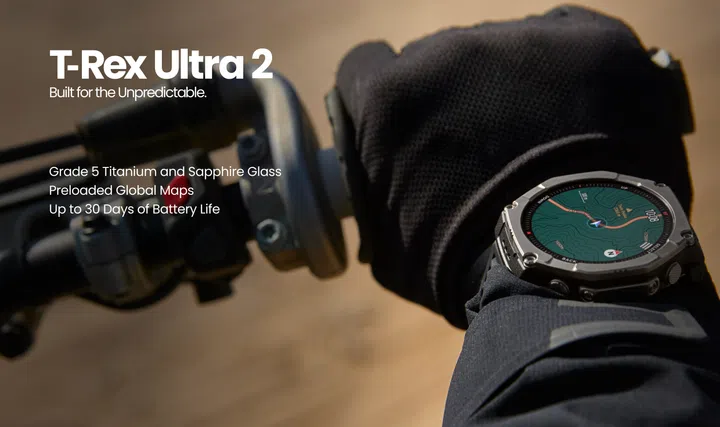
The watch measures 51mm x 51mm x 14.3mm and weighs 89.2g with a strap. Its construction combines a fibre-reinforced polymer case with Grade 5 titanium components. The bezel, buttons, and case back are all titanium. And as for the display, it’s protected by sapphire glass.

The unit carries a 100m water-resistance rating, making it suitable for water-based activities. Four physical buttons are included for use in environments where touch input may not be ideal.

The Ultra 2 has a 1.5-inch AMOLED display, which has a resolution of 480 x 480 pixels and a pixel density count of 322 PPI. Peak brightness is up to 3,000 nits, and the screen supports touch input and is designed to remain readable in direct sunlight.

Battery capacity is rated at 870mAh. Under typical usage, Amazfit claims the battery life can last up to 30 days. The watch also purports to support up to 50 hours of continuous GPS operation in GNSS mode.

Health features and tracking
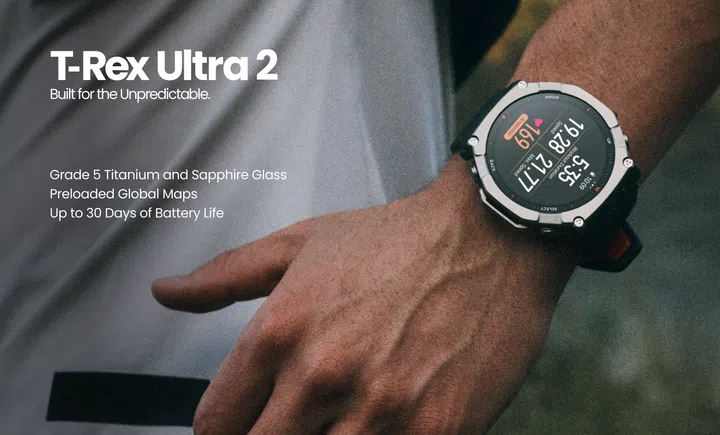
Image of the Amazfit T-Rex Ultra 2 on someone’s hand

The Amazfit T-Rex Ultra 2 has over 180 workout modes for outdoor and indoor use.
The smartwatch supports over 180 workout modes, including hiking, trail running, strength training, and recreational diving. While in strength training mode, the watch can automatically detect up to 25 exercise types and track repetitions, sets, and rest periods.

Health and recovery tracking are handled by the BioTracker 6.0 PPG biometric sensor. The system supports 24-hour heart rate monitoring, blood oxygen measurement, stress tracking, energy monitoring, and advanced sleep tracking, including sleep stages and heart rate variability. Additional onboard sensors include an accelerometer, gyroscope, geomagnetic sensor, barometric altimeter, ambient light sensor, and temperature sensor.

Image of the T-Rex Ultra 2’s navigation in action

The T-Rex Ultra 2’s navigation in action

Photo: Amazfit

GPS positioning is supported by dual-band GNSS, which connects to six satellite systems, and is paired with a circularly polarised GPS antenna for improved signal acquisition and stability.

Navigational features include turn-by-turn directions, point-to-point route planning, checkpoint information, reminders, nearby points of interest, and rerouting. The watch also has a boost mode that enables temporary higher-intensity output, and an SOS signal mode for emergency scenarios.

Offline mapping is also supported, with preloaded maps and additional downloadable maps. The watch offers 64GB of storage, with 30GB being allocated for user-downloaded content.

In addition, the watch comes with a built-in dual-mode flashlight that provides white or green illumination with adjustable brightness levels, a built-in speaker and microphone, which also allow Bluetooth voice calls when connected to a smartphone and includes a linear motor for haptic feedback.

Connectivity

Image of the T-Rex Ultra 2 on rocks

T-Rex Ultra 2 can connect to the free-to-use Zepp app for extra features

Photo: Amazfit

The Ultra 2 can connect to Bluetooth 5.2 and 2.4GHz Wi-Fi. Voice control and instant message voice replies are supported when paired with compatible Android devices. Compatibility extends to Android 7.0 and above, and iOS 15.0 and above.

The device integrates with the free-to-use Zepp App, available on both the Google Play Store and Apple App Store, which provides fitness tracking, nutrition logging, sleep and recovery analysis, long-term trend monitoring, and personalised health insights.

Availability

The Amazfit T-Rex Ultra 2 is available now on Amazfit’s official online store at S$749.


Read Full Article At Source