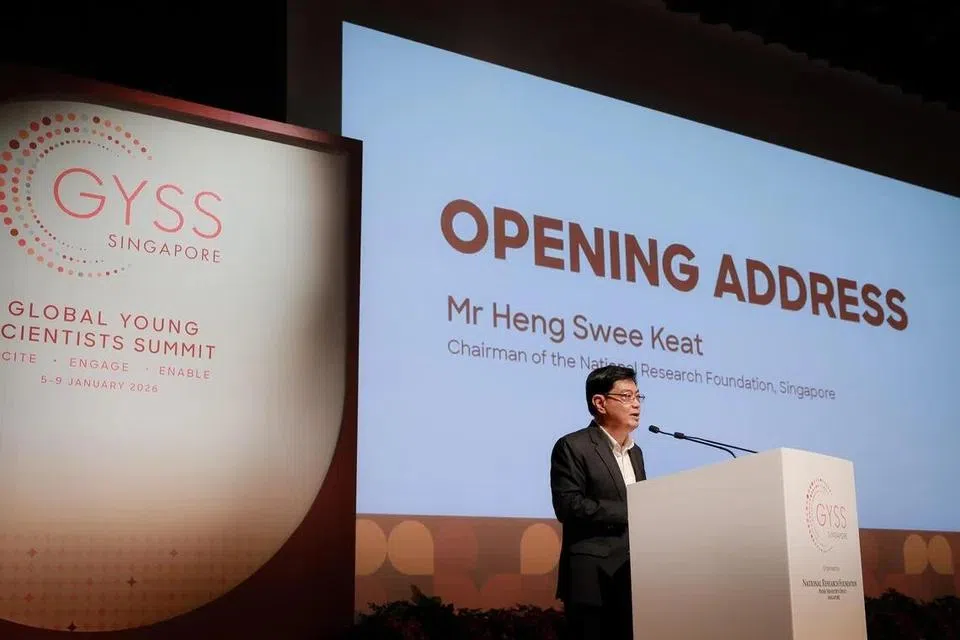
As the world is in the midst of a revolution in artificial intelligence (AI) and machine learning capabilities, the research and innovation field will also be impacted in fundamental ways, said National Research Foundation (NRF) chairman Heng Swee Keat.
Speaking at the opening ceremony of the 14th Global Young Scientists Summit on Jan 6, he outlined the three key trends that are set to shape the future of science.
The first is AI, which provides scientists with techniques and tools of immense sophistication that can be applied to increasingly complex and difficult scientific problems, he said.
However, these developments would also raise concerns about ethics, accountability and misuse.
“Scientists and innovators must work with policymakers all over the world to develop and apply AI systems ethically and responsibly,” said Mr Heng.
The second trend, he noted, is the advancement of quantum computing.
It is similar to traditional computing but operates in ultra-cold temperatures near absolute zero or minus 273.15 deg C. At such temperatures, quantum objects such as electrons or particles of light are manipulated to execute complex mathematical calculations beyond the reach of traditional computers.
“Quantum computing is advancing swiftly and is on the brink of solving what are once-unsolvable computational problems – from simulating complex biological systems to optimising supply chains,” Mr Heng said.
“Yet, much work remains to be done to build scalable, reliable fault-tolerant quantum systems.”
The third trend, he highlighted, is interdisciplinary research becoming more important as challenges facing humanity get increasingly complex and require expertise from multiple fields. For example, climate change requires a combination of environmental science, engineering, data science and policy analysis.