Nvidia DLSS 4.5: Super Resolution & Multi Frame Generation

Nvidia DLSS 4.5: Super Resolution & Multi Frame Generation


At CES 2026, one of the highlights from Nvidia’s showcase was the announcement of DLSS 4.5, the next (half) step in the company’s upscaling tech in its RTX cards. And one of the main upgrades is an updated, second generation transformer model.

If you recall, Nvidia previously made the shift to a transformer neural network model in DLSS 4 last year for Super Resolution, Ray Reconstruction and DLAA features. Compared to the convolutional models in previous DLSS versions, the transformer architecture allowed for more stable images, with less ghosting and smearing.
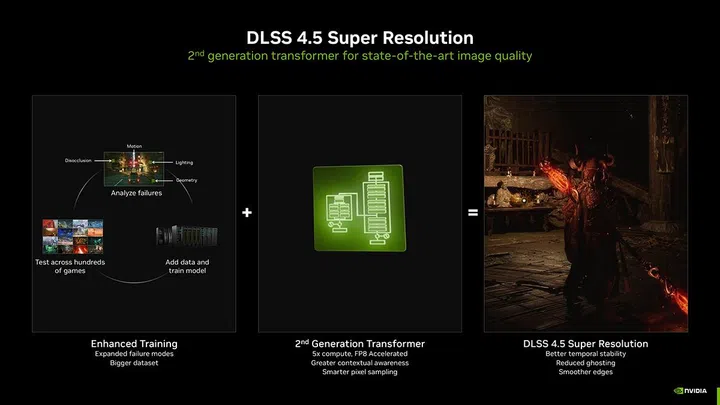
DLSS 4.5’s transformer model is also based on an expanded training data set.

DLSS 4.5’s transformer model is also based on an expanded training data set.

Image: Nvidia.
Nvidia promises that the new transformer model, which for now is applied to Super Resolution, has greater context awareness of each scene – a feature of DLSS 4 was that it could better scenes by identifying the importance of each pixel – and is trained on a larger data set, utilising five times more compute power than DLSS 4’s transformer model. 

Practically, some of the visual improvements Nvidia showed off include better anti-aliasing, better clarity for fast-moving objects. DLSS 4.5 is also able to dampen flicker while retaining a greater range and depth of colour, as well as lighting accuracy.

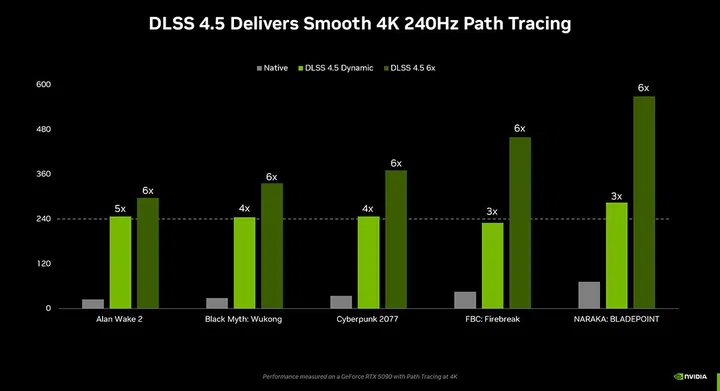
Nvidia claims that 6X and Dynamic Multi Frame Generation enable true 240Hz gaming at 4K.

Nvidia claims that 6X and Dynamic Multi Frame Generation enable true 240Hz gaming at 4K.

Image: Nvidia.

The second generation transformer also affects DLSS 4.5’s new 6X Multi Frame Generation by providing more stable input. Paired with improved frame pacing, the cap for Multi Frame Generation is now up to five additional frames per every frame rendered, up from the previous three (hence the 6X moniker).

DLSS 4.5 also introduces Dynamic Multi Frame Generation. As the name suggests, it can now determine how many more frames need to be generated depending on how demanding a scene is, based on monitoring the gap between GPU performance and the display’s maximum refresh rate. In essence, DLSS 4.5 will generate more frames for more demanding scenes, and scale back the amount of generated frames for less demanding ones.

DLSS 4.5 Super Resolution is available now for all RTX GPUs in the DLSS Override settings on the Nvidia app, via a beta update (with a full release coming on 13 January). Dynamic and 6X Multi Frame Generation, however, will only be available on RTX 50 series cards later in the spring.


Read Full Article At Source