Over a third of Lower Seletar Reservoir would be covered by floating solar panels by 2027

Over a third of Lower Seletar Reservoir would be covered by floating solar panels by 2027


A new floating solar farm occupying an area larger than Gardens by the Bay will soon cover 36 per cent of Lower Seletar Reservoir. 

Construction is slated to begin in 2027. 

When completed two years later, the facility will generate at least 130 megawatt-peak of electricity, contributing 6.5 per cent of Singapore’s solar capacity target of 2 gigawatt-peak by 2030.

National water agency PUB disclosed these details on Dec 23 in reports of an environmental impact assessment for the project spanning some 115ha of the water body’s surface.

The assessment had been called for the site as a key corridor facilitating the travel of wildlife between Singapore’s largest nature reserve, the Central Catchment Nature Reserve, to the northern shoreline habitats of Simpang-Khatib Bongsu and Coney Island.

The 384-page report, prepared by consultant EnviroSolutions & Consulting, recommends adjusting the floating solar panels’ layout to minimise disruption to wildlife using the site, as well as to limit erosion of the reservoir’s shoreline.

Surveys conducted between August 2023 and May 2024 recorded 218 animal species in the area. Nineteen considered significant for conservation were found to use the reservoir and its shoreline.

These included raptors and insect-eating bats that hunt above the reservoir waters, as well as the little grebe and the cotton pygmy goose – both of which are nationally critically endangered waterbirds – that rely on open water for landing and flight.

The report noted that most observations of rare waterbirds during the field surveys were one-off sightings, which suggested that the animals were passing through the reservoir and its surroundings.
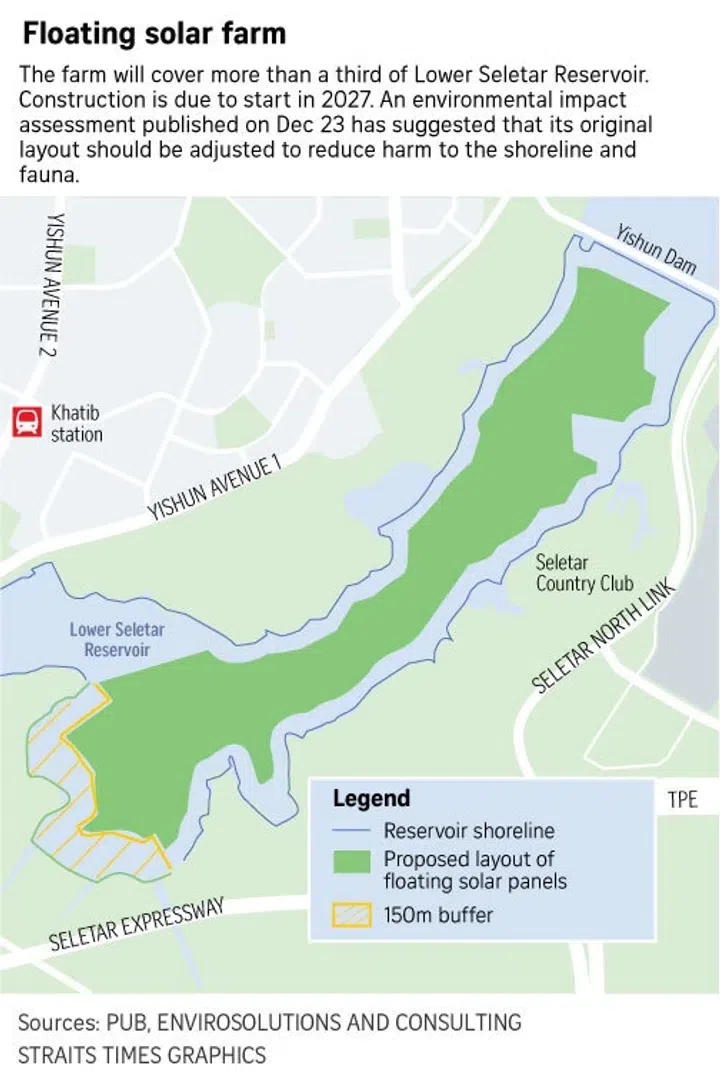
Map showing the proposed location of the solar farm in Lower Seletar Reservoir.


Map showing the proposed location of the solar farm in Lower Seletar Reservoir.

It proposes that the floating solar panels be placed at least 70m away from the nearest shoreline. In the south-west corner of the reservoir, a buffer zone of up to 150m is advised.

The re-orientated layout suggested by the report also avoids areas of high sensitivity and high bird usage.

While the critically endangered Sunda pangolin and long-tailed macaque were spotted in the nearby forests, they were not observed in the 100m-long strip of vegetation that will be cleared for the land-based portion of the farm.

Meanwhile, the aquatic flora and fauna were determined to be of low conservation importance,with most of the fish species and the waterthyme on nearly all of the reservoir’s surface assessed to be non-native. 

Nature Society Singapore president Leong Kwok Peng, who was among those consulted on the report, welcomed the proposed buffer zones.

“That is good because it gives enough space for birds and animals to forage on the river bank and reservoir bank,” he said.

Mr Leong also called for PUB to adopt the report’s recommendation of designing the solar panel edges to serve as perches for birds such as herons and bitterns.

“It will be a win-win situation, so at least some birds will benefit from the solar panels,” he added. 

While acknowledging the project’s impact on the area’s aesthetics, Mr Leong noted that Lower Seletar is less ecologically sensitive than reservoirs like Kranji or MacRitchie, and that options for green energy space in Singapore are limited.

The report noted that floating solar panels will reduce the need to clear land and allow for the efficient generation of solar energy, as water keeps the panels cool.

While the farm is expected to raise the temperature of the water by about 0.2 deg C by 2060 compared with a scenario without the farm, the overall impact on water quality has been deemed to be minor. 

Other measures to limit environmental impact include the installation of temporary noise barriers and slowing down of works if signs of water quality deterioration are detected. 

The report noted that its impact evaluation was based on the preliminary engineering design by the project’s design consultant Aurecon, an engineering company.

When completed, the solar farm will steer clear of the Lower Seletar Reservoir Park water recreational area, where activities such as sailing, kayaking and dragon-boating have been permitted since 2004, according to the report.

The panels will be broken up into smaller islands with corridors for vessels and access by the Singapore Civil Defence Force. 

The public can view and provide feedback on the report at PUB’s website until Jan 19, after which the agency will seek final approval from the Government.

This is the fifth environmental study report to be released in December.

Note: This article was written by Ang Qing and first appeared in The Straits Times on 24 December 2025.

Source: The Straits Times


Read Full Article At Source