SYNOPSIS
Although Singaporeans exhibit high levels of generosity, there appears to be a weaker sense of civic-mindedness, revealing a paradox between generosity of giving and underlying attitudes toward taking responsibility for others. While the government shapes much of civic life in Singapore, institutionalised and incentivised giving may unintentionally “crowd out” civic-mindedness. What the city-state now needs is to cultivate a “crowd in” mindset by deepening the meaning of giving so that a “We-First” society is not just a vision but a lived reality.
COMMENTARY
In his first National Day Rally speech, Prime Minister Lawrence Wong highlighted the importance of cultivating a “We-First” society, where individuals look beyond their own self-interest to care for the wider community. In his view, investing in social capital and strengthening bonds within society is crucial for navigating future challenges, just as the Singapore Spirit carried the nation through the COVID-19 pandemic.
According to the 2024 World Giving Index (WGI), Singapore ranks third globally in giving behaviour, behind Indonesia (1st) and ahead of regional peers such as Thailand (14th) and Malaysia (20th). Based on data from the National Giving Study (NGS), volunteering rates rose from 22 per cent in 2021 to 30 per cent in 2023, while donation rates remained stable at 62 per cent.
Despite these positive trends in giving and the government’s emphasis on strengthening social cohesion, questions remain about how Singaporeans will translate the “We-First” vision into everyday civic action. For instance, while volunteering rates had risen, the National Giving Study also found a decline in the number of hours volunteered and the amount of donations to charity, suggesting time and financial constraints as possible reasons.
Besides practical barriers to giving, the Southeast Asian Social Cohesion Radar – a 2025 study assessing social cohesion across ten ASEAN states – found that civic-mindedness is relatively weaker. As shown in Figure 1, “Focus on the Common Good” scored the lowest at 67.9 per cent – a sub-domain measuring perceptions and behaviours reflecting responsibility for others – compared to “Social Relations” (79.0 per cent), which measures the quality of sectarian relations, and “Connectedness” (71.7 per cent), which assesses the degree of public confidence and trust in the state.
Figure 1: Scores on Social Cohesion Domains and Dimensions for Singapore
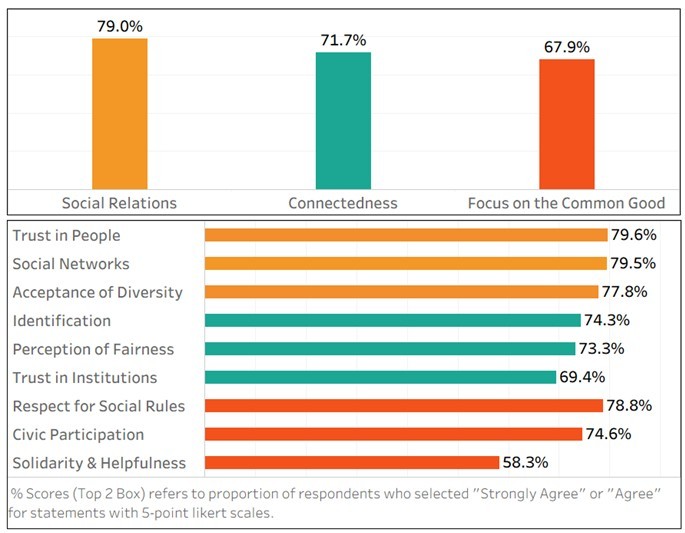
Upon closer examination of the “Solidarity and Helpfulness” dimension, support and care for others are rated significantly lower than in other dimensions. For instance, one in two agreed that Singaporeans think it is important to do community work (48.9 per cent) or to donate to the poor (52.5 per cent). To realise the “We-First” society, it is crucial to nurture an intrinsic sense of responsibility.
Crowding Out of Responsibility? – Disproportionate Roles Between Government and Civil Society
What explains the lacklustre culture of giving among Singaporeans in general? One possible explanation lies in the disproportionate roles between the government and civil society in organising and institutionalising giving. While the “Many Helping Hands” (MHH) approach – adopted as government policy to support vulnerable communities – was intended to involve a broad network of actors, such as Voluntary Welfare Organisations (VWOs), donors, funders and volunteers, its implementation in practice may continue to skew heavily toward the government.