AUCKLAND – Singapore and New Zealand have agreed to upgrade their bilateral relationship and have laid out a road map to cooperate more closely in wide-ranging areas such as trade, security, innovation and supply chain resilience.
The upgrading of links to a comprehensive strategic partnership (CSP) on Oct 10 came as the countries marked 60 years of diplomatic ties and a quarter-century since they signed a free trade agreement (FTA).
That FTA, Singapore’s first, paved the way for even more ambitious ventures between the two island nations, Prime Minister Lawrence Wong said on Oct 10. These included the Pacific-4 (P4) agreement, which grew into the Comprehensive and Progressive Agreement for Trans-Pacific Partnership, a free trade agreement between 12 countries.
Noting that the two countries had completed more than 40 initiatives since ties were last upgraded in 2019, PM Wong said the CSP will see Singapore and New Zealand pursue even more ambitious and innovative projects together.
This includes establishing an annual leaders’ meeting to guide the nations’ cooperation, deepening investment and capital markets collaboration and forging a strategic partnership to bolster food security, he said at a joint press conference with New Zealand Prime Minister Christopher Luxon.
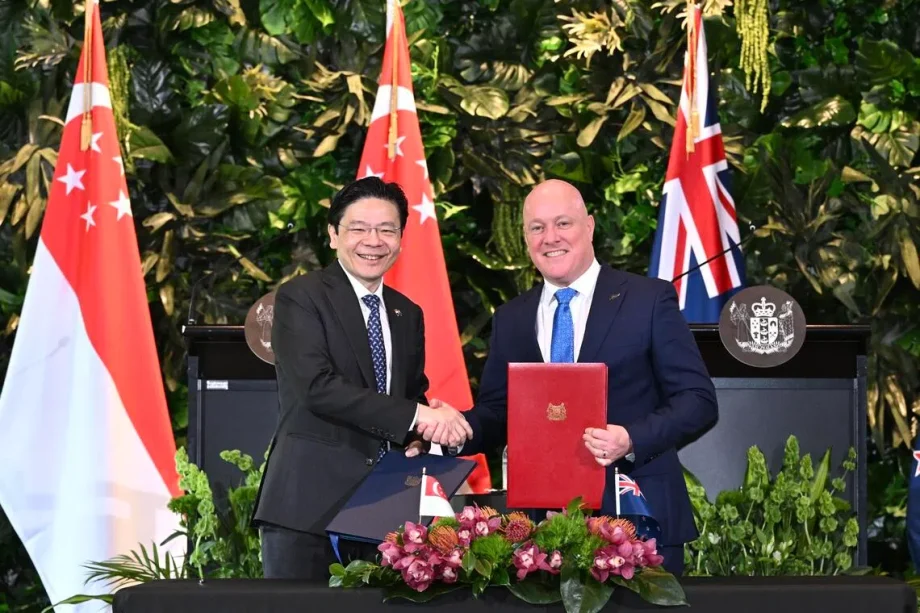
The press conference at Government House in Auckland followed the signing of a joint vision statement by both leaders that sets out the direction of cooperation for the next decade across 72 initiatives.
A key aspect of the CSP is to advance shared strategic priorities, including supporting the wider region by jointly delivering capacity-building programmes to Pacific countries, PM Wong said.
The countries are also discussing proposals for a new multi-country green economy partnership, drawing on their experience working together on the Digital Economy Partnership Agreement, or Depa, founded by Singapore, New Zealand and Chile in 2020.
South Korea joined Depa in 2024, while Canada, China, Costa Rica, El Salvador, Peru, Ukraine and the United Arab Emirates have applied to join, according to the Ministry of Trade and Industry.
By integrating trade and climate action, the green deal under consideration aims to have growth and sustainability reinforce each other, PM Wong said.
Under the CSP, Singapore and New Zealand also agreed to a deal on trade in essential supplies, which will legally bind the two countries to actions that minimise the impact of supply chain disruptions, ensuring that goods such as food, fuels and medicines continue to flow even during crises.
Mr Luxon said the agreement is a great example of how the two countries have the same instincts and intentions in finding mutually beneficial outcomes, given that Singapore imports most of its food while New Zealand imports a large amount of its fuel and pharmaceuticals.
“It speaks to the huge amount of trust that we have between our two countries – this is a frictionless arrangement and relationship,” he said.