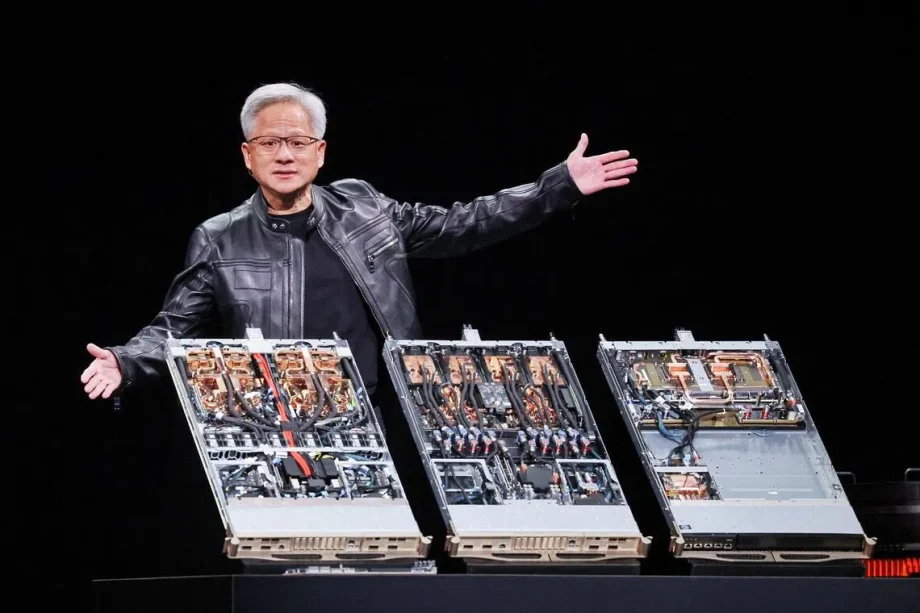
The man who transformed gaming and AI
If you’ve been following the PC gaming and technology industry for the past two decades or so, then Jensen Huang is a name that hardly needs an introduction. The man in his trademark black leather jacket has become almost synonymous with NVIDIA, a company he co-founded in 1993 and helped transform from a small graphics chipmaker on the brink of bankruptcy into one of the world’s most valuable companies.
And for those of us at HardwareZone, NVIDIA’s story is also very much a part of our own history. We’ve been covering its graphics cards for as long as I can remember, from the early GeForce GPUs that helped define PC gaming to today’s RTX graphics cards that can produce visuals we could only dream of 20 years ago. Every new generation of GeForce graphics cards was something to look forward to, whether it was to see how much faster our favourite games could run, what new graphical effects were possible, or simply whether NVIDIA had finally managed to get one over ATI (and later AMD).
Those were exciting times, particularly during the early years of PC gaming when graphics technology was advancing at an incredible pace. I still remember when getting a new graphics card could completely transform the way a game looked and played. And while we spent countless hours testing GPUs, comparing benchmarks and arguing over which NVIDIA or ATI graphics card offered better value, Jensen was quietly building something much bigger behind the scenes.
For much of NVIDIA’s early history, Jensen wasn’t quite the technology celebrity we’ve come to know today. He was the company’s co-founder and CEO, someone whose name appeared regularly in press releases and product announcements, but who wasn’t necessarily the reason gamers were buying GeForce graphics cards. Back then, it was the GPUs themselves that commanded our attention. But as NVIDIA grew, so did Jensen’s ambitions, and it gradually became clear that he saw the graphics processor as something far more important than a component that made video games look prettier.
What I find particularly remarkable about Jensen’s career is how he managed to steer NVIDIA through several technological shifts, often placing bets on technologies that would take years to pay off. CUDA (Compute Unified Device Architecture), for instance, was introduced in 2006, long before the current obsession with generative AI. At the time, most of us were more interested about how well a new GeForce card could run our favourite games than what GPUs could do for scientific computing or artificial intelligence. Yet that investment would eventually become one of the foundations of NVIDIA’s dominance in AI computing.
Looking back, I think that’s what makes Jensen’s career particularly fascinating. He wasn’t content with simply dominating the PC graphics market. Under his leadership, NVIDIA expanded into professional visualisation, scientific computing, autonomous vehicles and eventually artificial intelligence. Some of those ventures were more successful than others, and not every decision he made was universally welcomed. But his conviction that GPUs could fundamentally change computing would eventually transform NVIDIA into something that even its early supporters might never have imagined.
And then came the AI boom.
Almost overnight, it seemed, NVIDIA went from being a company primarily associated with graphics cards to one that everyone, from Wall Street investors to world leaders, suddenly wanted a piece of. Jensen became an unlikely technology superstar, his trademark black leather jacket as recognisable as the NVIDIA logo itself. His GTC keynotes attracted enormous audiences, his Computex appearances in Taiwan became the equivalent of a rockstar visiting, and his announcements could influence the share prices of companies across the technology industry.
For someone like me who remembers NVIDIA’s earlier days, watching that transformation has been quite remarkable. Here was a company whose graphics cards we had been reviewing for years, now helping power some of the most important developments in computing. By October 2025, NVIDIA had become the first publicly traded company to reach a market valuation of US$5 trillion. Jensen had spent more than three decades building the company, and by almost any measure, his achievements were extraordinary.
Which makes his very sudden fall from grace all the more surreal.
The revelations surrounding Jensen’s extramarital affair and the allegations involving a suspected Chinese intelligence operative have raised serious questions that go well beyond his private life. There are concerns about national security, corporate governance and whether his personal conduct could have compromised the company he spent 33 years building. The intelligence allegations have not been publicly proven, and NVIDIA has said it has no reason to believe that national security or company secrets were compromised. Nevertheless, the controversy has already resulted in something that would have been almost unthinkable just a few months ago: Jensen Huang is no longer NVIDIA’s CEO.
And I think there’s something very heartbreaking about how this chapter of his career has ended. Not because Jensen should be excused from scrutiny or accountability, but because it’s difficult to separate his name from the company he helped create. NVIDIA is what it is today largely because of the decisions he made, the risks he took and his conviction that GPUs could fundamentally change computing. It would be unfair to let the circumstances of his departure erase those achievements, just as it would be wrong to ignore the seriousness of the allegations simply because of what he accomplished.
And perhaps that’s why I wanted to write this feature here. We’ve followed NVIDIA’s products, technologies and progress for much of its history, and in many ways, Jensen’s journey has unfolded alongside the evolution of the PC industry we’ve spent decades covering.
So rather than simply revisit the scandal that ended his tenure, I thought it would be worth looking back at some of the moments that defined Jensen’s career. From NVIDIA’s emergence as a force in PC gaming to its extraordinary rise during the AI boom, and ultimately the controversy that brought his tenure to an abrupt end, this is how one of the technology industry’s most influential executives rose to prominence and fell from grace.
Read Full Article At Source
