Eric Berger, the co-developer of viral hit Queen’s Domain, doesn’t exactly adore the video game industry, despite having worked in it for more than two decades. He got his start as a teenager creating maps and mods for Unreal Tournament before landing his first professional level design contract with Gearbox at just 19 years old. From there, he helped bring Advent Rising to life at GlyphX, worked on an unreleased project at Mad Doc Software, and spent years at Airtight Games honing his level design and environment art skills on games like Dark Void. After a stint at Final Strike Games working on Rocket Arena, Berger decided it was time to make a game he really wanted to play.
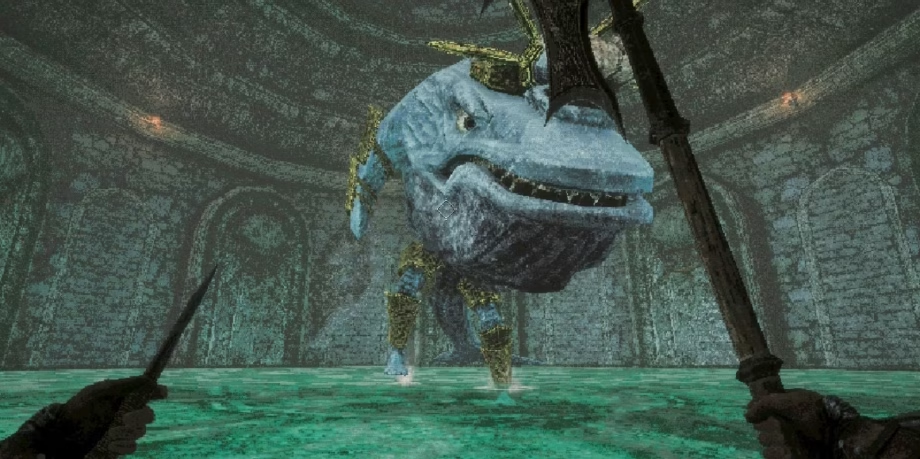
At Final Strike Games, Berger met Bradley Boothe, a technical artist and former software engineer who shared a frustration with what could get done at a traditional studio. Together, they struck out on their own, founding the two-person indie studio Freshly Baked Games and trading the security of industry jobs for the creative freedom — and financial uncertainty — of building something entirely theirs. Many years later, the result was a prototype for a game… that was way too ambitious (but they fully intend to return to). So they went back to a different concept, a stripped-down first-person fantasy inspired by FromSoftware’s cult-classic King’s Field. That was supposed to take a year to build. Three years later, the game, Queen’s Domain, is an ambitious torrent of weaponry, monster encounters, and Berger’s patented 3D level design, all spread across an low-poly open-world map.
Speaking for the first time since unleashing Queen’s Domain on the unsuspecting retro RPG sickos, Berger got into it with Polygon on building a vast interconnected fantasy world, making a game that rewards exploration, and why allowing players to grind their way to overpowered levels doesn’t have to be a bad thing.
This interview has been edited and condensed for clarity.
Polygon: What did you set out to accomplish with Queen’s Domain? Was it born out of pure nostalgia for King’s Field?
Berger: I think our view on game design, why we’re making games, is partly to get away from the idea that everything has to have a hook. What we both really enjoy when we play games, and what we want more of, is games that just go deep on exploring a good foundation. Like you were saying, I want another one of these, I want it to be good. I don’t wanna spend a lot of time figuring out how to make it special and different. I just wanna make every aspect of it as good as we can figure out how to make it.
So focusing on getting the level design to be really tight, really interesting to explore. If we have anything like a hook, obviously it’s the sword dash, but I’m not gonna say I think there’s anything revolutionary about multiple air dashes. Making good use of things versus getting a unique idea out and then going there. Going deeper on mechanics.
Was there a risk in going independent?
A little bit. The way the industry has turned since we left makes it feel like less of a bad decision. Tons of layoffs going on, really hard to find work from everyone I’ve talked to and heard about. At least we don’t have to worry about that part of it.
Bradley is married and has a very supportive partner, so he was given the go-ahead to give it a really good shot for a couple of years and see if it can work. And I did the old sacrifice at the ripe old age of 41. Like, “Hey mom, can I live in your basement?” So I’ve been here for like five or six years.

What makes a great level? What philosophy did you bring to Queen’s Domain?
The high-level things that are important to me in any game are really understanding and making use of what the game is about. Not just things that are always correct, but making sure that each place you make reflects what the person playing this is gonna be wanting to do. What would they be thinking about? It’s an RPG, so they’re gonna be thinking about finding items, finding unique enemies, getting into new areas, “Where can I save?”
Then things like making sure you can understand where you are in a space. Obvious things like landmarking, but making sure the lighting is just right so that when you look around, the things that are important are called out. Paths look like a path you should go on. Don’t put a bunch of torches over on the side of a cliff if that’s not a place you’re supposed to make your way to.
But the biggest one for me is creating interest in moving through a space, making it evident that it’s not a video game box. I try to avoid creating too many facades of buildings. When I’m playing a video game and I see a building, I wanna go in there, and if the game keeps showing me you can’t go in there, it starts to feel fake. So I try to keep the reality of the space very grounded.
In building the map out, I might realize you could get on top of this other thing over here, and that’s not what I wanted you to do. But instead of trying to fix it, I’m gonna make sure the way you get up there at some point in the game becomes clear, and I’m gonna put a suitable reward up there. That way, if you get up there, you’re not just disappointed.
The really easy example: On top of the shrine where you get the main sword, Endu, there’s one of the silver skull collectibles. The first thing I would think of playing a game is: Is there anything on top of that? I can get on top of that. So if you jump off of anywhere high up and have enough dashes, you can get over there.

Do you have a pantheon of great video game levels?
Maybe not so much of a pantheon. I think the big ones are gonna be the same for a lot of game designers, but for me it’s definitely Ico. The castle in that game is just incredible. It’s such a real place that I love to just be there. Not particularly an inspiration for this game in the most direct ways, but Shadow of the Colossus as well, while we’re on that topic of Ueda’s stuff. And the most obvious possible thing, Dark Souls and King’s Field 4 for me are huge, just because I love the way they feel like you’re exploring a place and you could find things there. It’s not just a level you’re playing.
The reverse of that is putting a hole to hell right in the beginning of the game. I made the mistake of going down the well. I was not prepared.
For me that’s creating the reality of the space, the sense that it’s a world for you to explore, not video game levels. I trust you when you play the game to know that area’s bad and maybe you don’t wanna be there. But I’m not gonna stop you from pushing into it a little bit. Maybe you can get some loot out of there, or maybe you can manage to kill one guy and get a lot of XP.


Read Full Article At Source
