SINGAPORE – When the male cryptic painted frog (Nyctixalus crypticus) serenades potential mates, it does so with a soft, musical chuckle echoing from the tree hollows.
Volunteers tracking this unique call have found that calling activity strongly correlates with egg count, suggesting its potential as an indicator for reproductive activity and establishing that sound tracking is an effective, non-invasive indicator of breeding.
The nocturnal amphibian has successfully established a breeding population on Pulau Ubin since its introduction in 2024.
“I thought conservation had to be done in academia, that it required so much experience. Having this opportunity made me realise conservation is actually far more accessible than I expected.” said student volunteer Lim Hui En, 22, an undergraduate in the Asian School of the Environment who was part of the project.
Bioacoustics, the study of animal sounds, is an important tool for biologists to locate and differentiate one species from another. Sound can be the best way of taking stock of shy and elusive creatures like frogs.
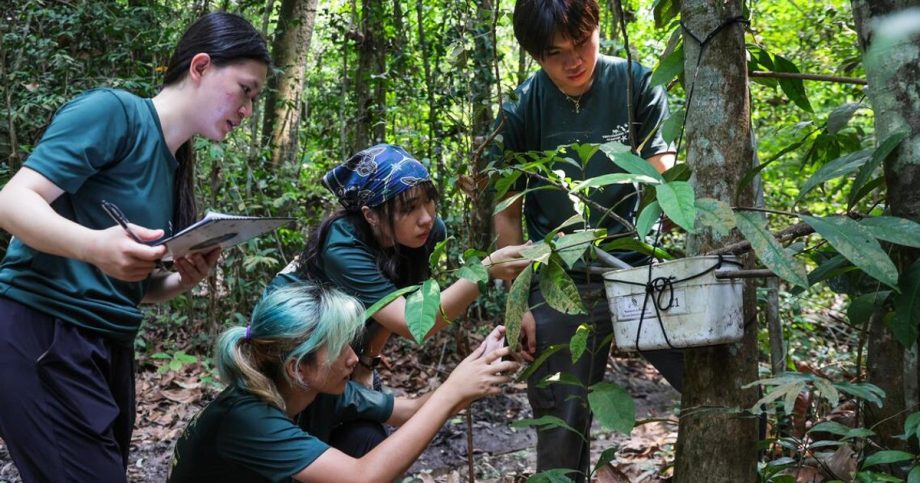
In Singapore, five youth volunteers did a six-month monitoring project to track the breeding patterns of the frog on Pulau Ubin. They placed 21 artificial breeding containers across the site alongside audio recorders and motion-detection cameras to observe the species’ calling activity and egg counts.

(From left) Keon Lim, Lim Hui En, Rachel Tan and Mila Natalia Swyny did a six-month monitoring project to track the breeding patterns of the frog on Pulau Ubin.
ST PHOTO: GIN TAY
Apart from Lim, the project, conducted under the Youth Stewards for Nature (YSN) programme, was carried out by student researchers Mila Natalia Swyny, Keon Lim, Rachel Tan and Shiyang Zhao.
Passionate about wildlife conservation, they worked alongside National Parks Board (NParks) conservation manager Leroy Alphonso to deploy non-invasive acoustic equipment to assess how the species is doing in its new habitat.
Formerly known as the cinnamon bush frog, the cryptic painted frog is native to Singapore and was historically confined to mainland primary rainforests within the Bukit Timah and Central Catchment Nature reserves.
It is listed as “Vulnerable” in the Singapore Red Data Book and “Near Threatened” on the International Union for Conservation of Nature (IUCN) Red List. Adults grow to about 4cm in length, featuring bright orange or reddish-brown colouration with small white spots.
The frog is an arboreal species found in the low vegetation of primary forests, mostly feeding on small insects and arthropods.


Read Full Article At Source