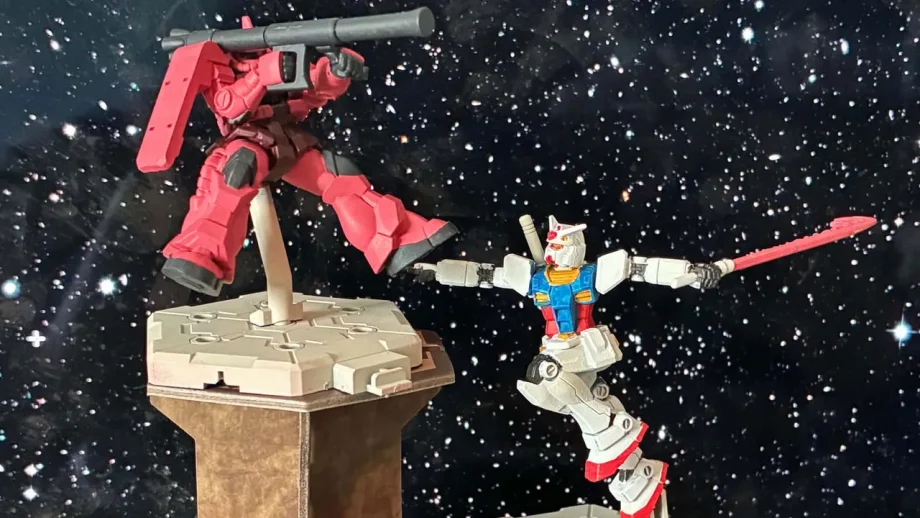
The storied Mobile Suit Gundam series makes another venture into the tabletop world with Gundam Assemble, a new miniatures game experience. In fact, this new game was revealed alongside the Gundam Card Game as a visual companion, so fans got hit with a fun one-two punch of new game teases. Gundam Assemble is available for the first time this fall, with more expansion packs and sets already prepared to release into early next year. After a good chunk of time with the starter set, this game is shaping up to be a fun bite-size brawl compared to some of the other miniature games out there right now.
Arguably one of the biggest barriers of entry to miniature wargames is the building and painting aspect. If building is your biggest concern, have no fear with Gundam Assemble. Just like the gunpla that the series is known for, Gundam Assemble features pieces that you cut out and snap into place. Granted, the pieces are a lot smaller in comparison to regular gunpla, but it’s simplified, needing only a handful of parts to complete a mini Gundam unit. I suggest using proper cutting tools since these are miniatures and there’s less room for error. They look good though, showcasing a decent amount of detail for miniature versions of what fans are familiar with. Like other modern miniatures, assembly has been made a lot easier by simply snapping parts together as instructed, but it loses the customization that players may prefer with particular sets of miniature games. Instead, we see different variants or poses of Gundam units across the different releases. For instance, the RX-78-2 Gundam in the starter set features a beam saber attack, but the variant in the Paint Pack has the mech unit brandishing a beam rifle. Although not ideal for those that want a little bit of personal touch to their creations, it does make it easier for beginners (or even impatient players like myself) to jump right into painting and the gameplay soon after.
Painting miniatures is not for the faint of heart, and Gundam Assemble isn’t any easier with all the tiny details, from the weapons to the mech head pieces. And if you’re a perfectionist, you’ll be spending more time painting than even playing the game. With that said, the mech units in the Gundam universe are fairly straightforward to paint with the mostly monochrome looks with embellishments littered about. Thankfully, there’s no skin or flesh color to deal with while painting Gundam units, which can be difficult to do properly. As long as you start off with a primer, you can save a bit of time, especially with units like the RX-78-2 or the Wing Gundam Zero. For me, I like to keep painting fairly simple because I just don’t have as much free time nowadays. And I care more about the gameplay than the arts and crafts of it all anyway. With that said, I do still want to make things look somewhat cool and clean compared to what I did as a 12-year-old painting Black Templar Space Marines because it was one of the easier chapters to paint. On the flip side, I’d prefer to skip painting altogether if possible, and that’s how I got into other miniature games like HeroClix and Star Wars X-Wing – where the minis were already painted. You can also just not paint the minis, but the extra effort does make for a better experience. The starter set even has a painting guide section in its instruction manual if you’re new to the hobby. Other than having some specific paints available like the Gundam Assemble Paint Pack, it’s also fine to use any water-based acrylic model paint and mix colors as need be. That’s how Char’s Zaku’s colors turned out when some friends and I had a dedicated paint day for some of these minis. Overall, painting is much easier now and it saves a ton of time if you do a bit of research before getting started.
As I mentioned, I care mostly about the gameplay when it comes to miniature games, and Gundam Assemble’s matches are surprisingly a smooth experience. I’m not in the miniatures tabletop scene constantly, but I dabble with some casual games every now and then like Marvel United. The hardest part is finding a buddy or group willing to learn the complex game mechanics and dedicating time and space to matches. It’s been kind of a sore spot for me and my friends lately, always talking about wanting to play Warhammer 40K Kill Team, but never fully committing because we still want to properly build and paint. With Gundam Assemble, it’s easier to get games going because you only really need six mech units versus a multitude of grunts to fill up a squad or army on either side. Although there are still a lot of tokens for various effects and objectives, the most important feature that makes turn-taking smooth is the Gundam Assemble timeline. It consists of ten rounds equaling one phase. On the timeline, players have their mech units’ tokens slotted into specific spots to help track each unit’s turn. For example, the Gundam Vidar has a timeline start number of one compared to RX-78-2’s timeline start number two. This means that Gundam Vidar places its token on round one of the timeline at setup, signifying that it takes its turn first before moving to round two, where RX-78-2’s token sits. As units make certain actions, their unit token moves down the timeline. So depending on what your mech unit does, they could be waiting a long time to act again. Seeing which mech is next in line does give an extra layer of strategy similar to turn-based tactics video games like XCOM or Star Wars Zero Company. It’s nice to have the timeline set to the side of the map and away from the battlefield where token placements can get out of hand.

Read Full Article At Source