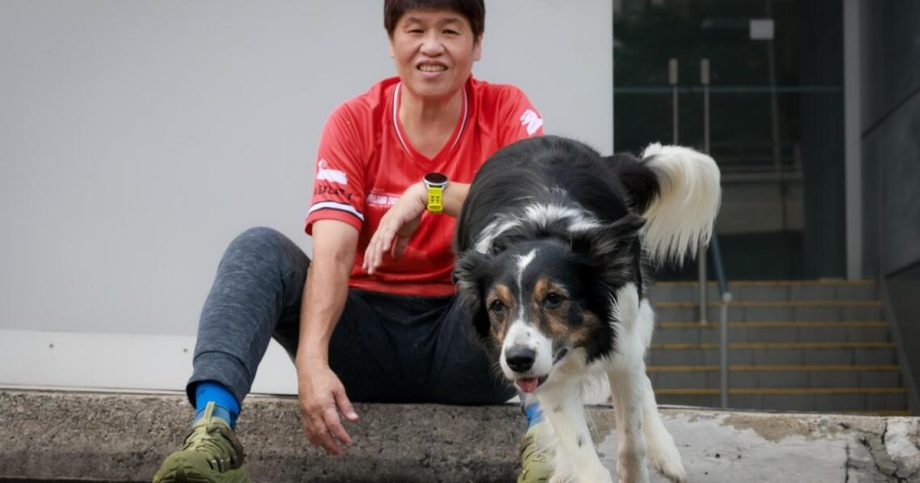
SINGAPORE – It is not just the dog that has to be fast in canine agility competitions. The handler has to sprint along, too, to guide the animal through the timed obstacle course.
But for Elsa Soo, a longstanding knee injury meant that when it came to navigating a course, other competitors left her in the dust. So rather than outrun them, she chose to outwit them.
She came up with her own version of verbal cues to guide her 9½-year-old border collie Venus through the course.
Soo trained Venus to listen to verbal commands and independently search, recognise and commit to an obstacle, such as tight weave poles or sharp tunnel entries, without the 60-year-old having to physically nudge Venus into it.
She would also stand back or remain in a centralised area of the ring while her dog tackled complex sequences some distance ahead of her.
“Venus learnt to listen calmly to my voice and worked things out systematically. Then I would pray that I do not fail her as she tried her best on the world stage,” Soo said, laughing.
According to Agility Divertidog’s results, the senior duo secured a very respectable fifth place at the prestigious FCI Agility World Championship (AWC) 2026 held in Turku, Finland, in September.
“I am 60. I have bad knees. Of course, I could not run as fast as a 25-year-old handler. So, I had to find another way. I did not want to fail my dog,” the former prison officer told The Straits Times.
Now a dog agility trainer, she has a job quite different from the one she held during her 28 years with the Singapore Prison Service. But her passion for dogs has been a constant. Soo had worked with other dogs throughout her adult life.
She joined the prison service in 1991 after helping her mother wind up her second-hand hardware business, as Soo had no intention of taking it over.
“Since (I was in) school, I always wanted to be part of a uniform group because I believed in discipline and structure. Besides that, the Singapore Prison Service also helped offenders turn over a new leaf and gave them a chance to rebuild their lives. That was something I have always believed in – giving people a second chance,” she said.
Soo was given the opportunity to work in the Singapore Prisons Emergency Action Response Force, but went on to break new ground when she became the first woman to undergo narcotics detection dog training with the Singapore Prison Service Dog Unit.
Canine partners that never went off the clock
She expanded her tactical expertise in protection work when she was seconded to the Police Dog Unit for a year, where she was deployed to the airport and customs checkpoints at the borders.
“My canine partner and I were part of the relocation of the patients from Woodbridge Hospital to the current Institute of Mental Health (in 1993). The prisoners, who were ordered by the courts to stay at Woodbridge Hospital then, had to be handled differently during the move,” she said.
“We were also part of the team that made sure the refugees from Vietnam were properly repatriated out of Singapore when the Hawkins Road Refugee Camp officially closed in 1996. We had guard dogs with us to maintain order as the refugees were quite emotional then.
“It was after that that the dog unit was transferred to the police, and I went back to working with inmates in the Women’s Prison, the Drug Rehabilitation Centres and the work release camps,” Soo added.

Soo with a four-legged colleague during her days as a prison officer.
PHOTO: COURTESY OF ELSA SOO
The camps are structured Community-Based Programmes designed to prepare inmates for work and reintegration into society.


Read Full Article At Source