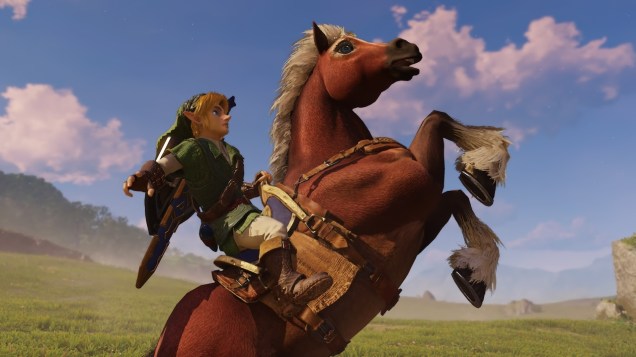
The Legend of Zelda: Ocarina of Time is one of Nintendo’s most revered games of all time, even by the lofty standards of a company known for making influential, groundbreaking video games. That legacy means extra care and consideration put into remaking the game for modern audiences on the Nintendo Switch 2, with a remake that is receiving a glowing reception both in our GameSpot review and across the industry. It is now the top-ranked game of 2026 on GameSpot sister site Metacritic.
It’s a titanic achievement, but to hear producers Eiji Aonuma and Hidemaro Fujibayashi, it was also intended as a learning experience for both the new generation, and for themselves. In a wide-ranging interview just hours ahead of the release of the game, the two repeatedly came back to how younger staff, some of whom had never played the original game, were both discovering the craft of classic Zelda design and introducing their own bold new ideas. They talked about what needed to be modernized, and what was important to preserve, in creating what I called “definitive way to experience this all-time classic.”
The interview below was conducted via interpreters. It has been edited for length and clarity.
GameSpot: In your Ask the Developer QA you said you remember the feeling of nervousness and anticipation leading up to the original launch of Ocarina. So I have to ask: How are you feeling today?
Eiji Aonuma: How am I feeling today? Well, since we’ve arrived in New York, we’ve had these really good opportunities to talk to media. These are folks who, of course, got early copies of the game for the purpose of reviews. And I got to hear about their experiences playing, and some of them talked about being moved to tears while playing, which was amazing for me to hear. And now knowing that with the official release, many more people will be able to play and share their experiences with us. So, yes, I would say that my nerves have calmed quite a bit, and I’m feeling very happy right now.
It’s a very faithful remake, but it also makes some pretty notable changes. How did you decide what needed updating, what needed to stay the same–especially in regards to the jump button, which is a very big change for fans?
Hidemaro Fujibayashi: So, the staff and the directors that worked on this game are all younger, at Nintendo. And in one of the first discussions we had leading up to the full-blown development of the title was really clearly establishing what it is we were going to change and what it is that we weren’t going to change. And starting with the stuff that we wanted to change was really focused on leveraging the capabilities of the Nintendo Switch 2 hardware because it’s going to be developed for that hardware. So really leveraging all that capability so that we can remove any stress from the gameplay experience, so that people can enjoy the game fully. And so that leads to things like changes in how the game controls, or the graphics. Another example is the sound. All of the background music is on 5.1-channel surround sound. So all of that is an evolution of what it was from the Nintendo 64 version.

And when it comes to what we weren’t going to change, we thought what was the experience that the original Ocarina of Time developers wanted to convey through the game? And that experience was what we didn’t want to change. And within that, there was a lot of heavy discussion, as you mentioned, about the jump button. You might say, “a jump button wasn’t there, are we going to change it?” There was a lot of discussion around that, but ultimately, we ended up in the conclusion that being able to allow players to jump anywhere will make the gameplay experience a lot smoother and allow, again, players to be really able to fully enjoy the experience that this game is trying to provide.
When you’re choosing things to update, were there ambitious ideas that didn’t work out? I know you referenced in the Q&A warp points as something that you tried, but then thought, “This actually just doesn’t feel like Ocarina anymore.”
Fujibayashi: So another thing that I can mention was ReDeads. With this remake, the graphics are a lot improved, and so the ReDead–the sound, the graphics, and the movement–ended up being very, very scary. And the staff wanted to make this in service of making a good gameplay experience. But from our perspective, taking a step back, we felt like, let’s remember the experience that we don’t want to change, and taking that into consideration, maybe we’ve gone a step too far, so let’s dial it back.

Breath of the Wild marked a new era of Zelda. If you think of Zelda in three eras, like I do, it’s 2D, 3D, Breath of the Wild onward. So how did it feel going back to this previous era, and probably the most famous example from the previous era, of Zelda games, now that we’re in the Breath of the Wild era?
Aonuma: So I think when you’re contrasting the the different styles of game design and gameplay, and you’re thinking about the perhaps higher level of freedom that you have in the open-air style of games, and comparing that to the more classical feel of earlier games, what stands out for me is, how do we, underline what is good about the the classical-feel gameplay in the Zelda series?


