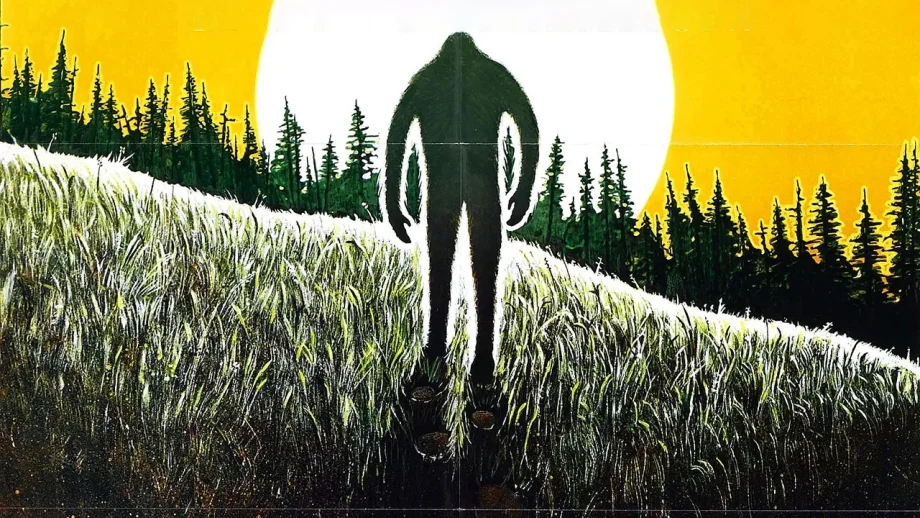
“Scientists representing the world’s foremost research centers took part in the examination of the evidence. The facts that will be presented are true. This may be the most startling film you’ll ever see.” -Peter Graves, The Mysterious Monsters (1975)
During the turbulent era of Vietnam and Watergate, the happy veneer of America in the 1950s and ‘60s gave way to the conspiracy-minded ‘70s. Dark revelations about the government, justice system, military, and police made the public begin to rethink their perceptions about a great many things. This led to renewed interest in occult matters like ESP, UFOs, and cryptozoology. These subjects, along with other pseudoscientific phenomena like near-death experiences or the Bermuda Triangle, became the bread and butter of a Utah-based production house called Sunn Classic Pictures. The company made a fortune releasing partially-dramatized “documentaries” that tantalized viewers with possibilities of what could be out there beyond the veil.
“I think it was people just questioning what the norm was… what is real, what isn’t real,” James L. Conway, who worked as a writer/producer/director at Sunn Classic, tells IGN. “There were very few outlets back then to experience these things, very few TV channels. Through a theatrical window, we were able to make movies about these subjects. They were incredibly popular because there was no other place for people to get knowledge about this… no YouTube, no Wikipedia, no social media. If you wanted to see something that was on the unusual side, it was a theatrical motion picture.”

Conway was a college senior at the University of Denver around 1971 when he was in the Mass Communications Department and the phone rang. It was Charles E. Sellier Jr., who ran an industrial film and commercial company in Denver.
Continues Conway, “Chuck was looking for cheap labor to edit his industrial films. I said, ‘I’m your guy.’ While I finished college I worked for Chuck, and after about three months I said to him, ‘You know, I can direct these shows better than the people you’re hiring.’ Total chutzpah. He gave me a shot, I did really well, and that began our relationship.”
After producing a western comedy called The Brothers O’Toole, Sellier connected with Sunn Classic Pictures, which at that point was a distribution outfit in Utah and a newly-founded division of the Schick razor company. They had made several well-attended hunting pictures like The Life and Times of Grizzly Adams, and decided their next avenue would be a series of pseudoscience documentaries kicked off by a re-edited and English dubbed version of the 1970 German doc Chariots of the Gods. Based on Erich von Däniken’s popular claptrap supposing celestial beings who seeded early humanity, in 1973 it grossed over $25M and was nominated for an Oscar.
Noted film scholar Dr. Gary D. Rhodes recently published a book titled Weirdumentary all about this era of strange docs throughout the ‘70s, of which he claims Chariots of the Gods is the urtext: “The fact that it was nominated for an Academy Award suggests how many more people were taking these ideas seriously. I hesitate to think a documentary on that subject now would get an Academy Award nomination. From the late ‘60s we see a rise in interest in everything from occultism and psychic phenomena, new age philosophies, magic, astrology, paganism, life after death, anti-materialism, holistic medicine, reincarnation… there’s a desire to find alternate ways of examining our experiences that is unique to that era, including academia. You would not find many parapsychology departments in today’s world.”
Once they found the winning formula, Sunn Classic released a wave of documentaries including 1975’s The Mysterious Monsters, where Mission: Impossible actor Peter Graves hosts a Whitman’s Sampler of cryptids.
“For me as a little kid, I certainly loved Mysterious Monsters the most of any of them because it was the era of fascination with Bigfoot, widespread belief that there might be such a creature,” says Rhodes. “There was equal interest in the Loch Ness monster and the Yeti. There were documentary films individually about all of those monsters, but here it was like the Universal monster rally films where you were getting all of them at once.”
The film was actually an amalgam of a few previously-released TV documentaries including CBS’ Monsters! Mystery or Myth, which helped popularize the supposed veracity of the Roger Patterson/Robert Gimlin footage of Bigfoot strolling through the woods. Narrates Graves, “If this film is legitimate, then there can no longer be any question about Bigfoot’s existence.”
Because Sunn Classic was a Mormon-run company, Rhodes says they “wanted to tap into films where everybody from a little kid to the grandparents could go and not feel out of place or offended.” Sellier himself called this demographic “the lost audience” who felt left behind by both the kiddie fare of Disney and the blood-and-nudity-soaked visions of New Hollywood auteurs (Taxi Driver, The Exorcist, etc.). Sunn’s product even included a few movies which attempted to present scientific evidence for aspects of the Christian faith. The most successful was In Search of Noah’s Ark, co-written and directed by Conway based on a book by Sellier and David W. Balsiger. It posits that (conveniently inaccessible) evidence exists that the remains of Noah’s Ark lay on Turkey’s Mount Ararat. It includes several non-Russell Crowe re-enactments, as well as a supposed photograph that became the lynchpin for “proof.”
Read Full Article At Source