SINGAPORE – Singapore will be proposing changes to its Transboundary Haze Pollution Act (THPA) to give it more teeth when Parliament sits next week, said Senior Minister K. Shanmugam on Oct 28.
Under the amendments, firms linked to the haze must give appointed investigators full access to information, corporate documents and business premises.
Currently, the THPA does not give the National Environment Agency (NEA) – the agency administering the law – the powers to request firms to appoint investigators to study a firm’s operations, corporate relationships or supply chains.
This resulted in practical challenges in obtaining information, to investigate and to enforce against transboundary offences.
NEA will be given the authority to do so once the proposed changes take effect, and failing to comply will be considered an offence, Shanmugam said.
The next parliamentary sitting begins on Nov 3.
His remarks were directed to executives from 10 Singapore-based companies that were issued notices under the THPA on Oct 23.
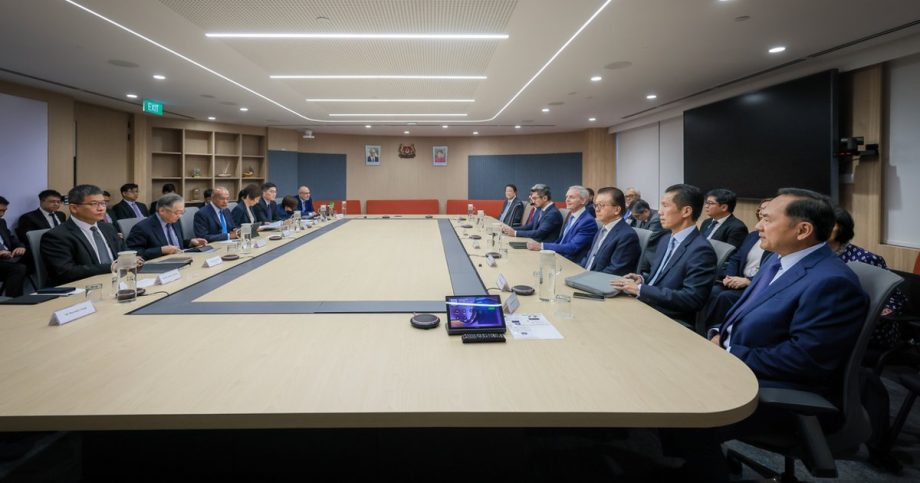
They had been summoned for a closed-door meeting at the Treasury building with Shanmugam, Deputy Prime Minister Gan Kim Yong and Minister for Sustainability and the Environment Grace Fu.
Also in attendance was Senior Counsel Davinder Singh, whose law firm will advise the Government and oversee the coordination of the panel of experts appointed to look into the transboundary problem.
All 10 Singapore companies were represented at the meeting.
-
Bumitama Agri was represented by its chief executive and executive chairman Lim Gunawan Hariyanto
-
Asia Pulp & Paper (APP) Company, APP Company (China) and Golden Agri International were represented by Franky Oesman Widjaja. The Widjaja family owns Sinar Mas, an Indonesian conglomerate that owns the APP companies and Golden Agri International. Also present at the meeting was Bernard Tan, senior adviser of Sinar Mas Group.
-
First Resources was represented by Ciliandra Fangiono, its chief executive and executive director
-
Indofood Agri Resources was represented by Mark Wakeford, its chief executive and executive director
-
Kencana Agri was represented by its chief executive and executive director Albert Maknawi
The meeting with the company representatives came five days after the NEA first issued notices to the 10 Singapore-based firms under Section 10 of the Republic’s haze law on Oct 23.
Under this section of the law, firms are required to furnish information about their links to companies in Indonesia contributing to the haze.
Failing to comply could result in a fine of up to $5,000, a jail term of up to one month, or both, for representatives of uncooperative firms.
According to the transcript, Shanmugam told the firms: “I will say this plainly, non-compliance with Section 10 is an offence. They are not routine requests for information. We expect your companies to respond fully, accurately, and promptly.”
He also told them that the Singapore Government expects “substantive cooperation and transparency, not merely technical compliance or lawyered responses which don’t deal with the substance.”
Shanmugam was speaking in his capacity as the chairman of the Homefront Crisis Ministerial Committee, which is comprised of political leaders charged with setting the direction and providing strategic guidance for the overall governmental response to major crises.
The Government had also announced on Oct 23 that it will be convening a specialist panel of experts to identify and hold accountable firms that may be responsible for, or have contributed to the haze-causing fires in Indonesia.
Comprising firms in the legal, audit and investigation fields, the panel’s work will be coordinated by Davinder Singh Chambers, which the Government said has extensive experience in cross-border inquiries and complex legal structures.
Those firms that had been identified by the Government as being linked to the haze will have to engage professionals from the panel to conduct thorough inquiries into their operations, corporate relationships and supply chains. Audits will have to be submitted to the authorities.
Fu said the list of firms selected to be on the panel will be published by the Ministry of Law, and the 10 companies issued notices will have to engage those firms at their own expense.
“Singaporeans should not have to bear the health and environmental costs of irresponsible business conduct. Even as the haze condition improves, we will not relent,” she told the media.
During the meeting, Shanmugam had also said that third-party information or experts may also be tapped, such as geospatial analysts being called in to examine data from satellite images of hotspots.
Shanmugam told the media afterwards that the Government made clear to them Singapore’s position on the matter.
“We told them the intention of this exercise is not to find scapegoats. The Singapore Government will do what is right. We need to make sure that the companies here conduct their operations in a manner that doesn’t affect Singapore or the region,” he said.
“I told them we are determined to act, and that we are giving full attention to this issue, and that we will pursue all available legal and regulatory avenues, and we will use all the powers we have to establish responsibility where there is responsibility, and we will hold those responsible to account.”
He added that if the facts show no wrongdoing, “we will proceed on that basis as well”.
“I told them we expect full cooperation from their companies, and in the meeting, the companies said they will cooperate fully.”
Shanmugam had said on Oct 19 that the Government would use “every legal and regulatory lever” at Singapore’s disposal to confront companies linked to the haze.
He also said then that the Monetary Authority of Singapore (MAS), which regulates banks, will have supervisory jurisdiction over banks to ensure they manage risks properly.
To that end, the authority on Oct 28 said that banks should take steps to mitigate environmental risks.
For starters, they should engage their customers and obtain information if they are linked to activities contributing to the haze, including details on measures to prevent, detect and stop fires.
They can also impose conditions, review financing terms and limit any additional exposure.
“Clear breaches of environmental laws would warrant stronger measures, including limiting exposures or exiting the relationship,” MAS said.

Read Full Article At Source