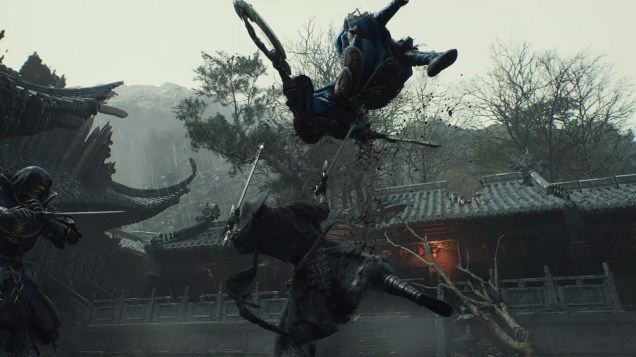
S-Game, the Chinese studio behind Phantom Blade Zero, clearly understands the core tenets of character-action games. If your melee combat isn’t tight, responsive, and oozing cool, then what’s the point? Some games might have better combat, but few can match Phantom Blade Zero’s style.
Every moment feels like you’re in the middle of a Chinese martial-arts movie, pulling off moves that shouldn’t be feasible–moves that go against what we expect from third-person action games–yet are baked into the mechanics. The game is not without issues, and they do hold it back from reaching the genre’s upper echelons, but the highs are stratospheric.
Character-action games aren’t typically known for telling riveting stories, and Phantom Blade Zero is no different. You play as Soul, a stoic assassin who dies in the game’s opening moments when a sword tears through his heart. Soon after, a mysterious figure gives him a chance to come back from the dead, forcing him to choose between two artificial hearts. One will allow him to live but strip away all of his emotions, while the other will let him retain those emotions but only give him 66 days left on this mortal coil. Soul chooses the latter, setting up a 66-day quest to find a cure, unravel a conspiracy, and prove that he was framed for his master’s murder.
It’s a fairly ridiculous opening, but one that doesn’t reflect the rest of the game. Much of Phantom Blade Zero’s narrative unfolds through background machinations: in clandestine conversations, hidden notes, and secondhand information. Multiple organizations, people, and malicious schemes are in play, but it doesn’t do a particularly good job of filling you in, so I found it tough to keep track of who’s who and what’s what. Some aspects eventually come into sharper focus toward the end of the game, but this feels like too little, too late.
You’re essentially dropped into an established world where even the protagonist knows more than you do, referencing past events and showing familiarity with characters new to you. All you can do is attempt to piece together some kind of understanding through the notes and loading-screen tooltips, but even then you’ll still be in the dark for a good chunk of the game’s dialogue.
There are some cool storytelling moments here and there, such as the way it uses hand-drawn watercolor animation whenever it flashes back to Soul’s childhood. One sequence also features traditional Chinese shadow puppets (or Piyingxi) to explore a character’s backstory. Repeating or explaining plot points during loading screens feels like a concession to its failures elsewhere, though, and ultimately, I found it difficult to latch onto anything that would make me care about the story.
Unsurprisingly, combat is Phantom Blade Zero’s bread and butter. It’s also unlike anything else I’ve played, essentially translating the choreographed action of films like Hero and Crouching Tiger, Hidden Dragon to a playable medium. Both movies are known as Wuxia, a Chinese genre of fiction and low fantasy that blends martial arts with fantastical elements. Wuxia fight scenes are known to be incredibly fluid and dynamic: half combat, half choreographed dance, with both sides attacking and defending at the same time, creating a calculated but frenetic spectacle of clashing steel.


The choreography isn’t something you can replicate in video games without resorting to quick-time events, but Phantom Blade Zero still makes it look and feel like you’re engaged in a cinematic, free-flowing dance to the death. You have light and heavy attacks at your disposal, with combos alternating between the two. The key is that these attacks require no commitment.
There’s never a point where an attack begins and locks you into an animation until it ends. Switching to defense–either to block or parry–is instantaneous, even if you’re mid-combo. Some attacks will even deflect incoming strikes automatically, recreating the back-and-forth, simultaneous attack-and-defend action Wuxia is known for. The whole thing is antithetical to the call-and-response philosophy of so many other action games, but it works when enemies test your abilities.