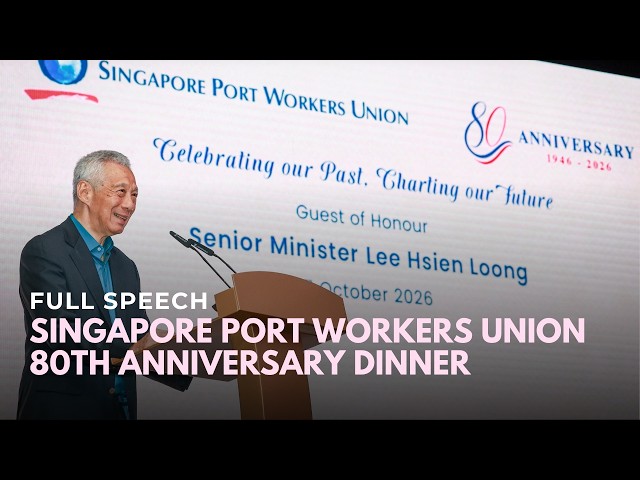
President of the Singapore Port Workers Union (SPWU), Arasu Duraisamy, SPWU Executive Council Members, brothers and sisters from NTUC, Members of PSA’s Board and management, friends, a very good evening to everybody.
Congratulations to SPWU on reaching your 80th anniversary!
I am pleased to celebrate the occasion with you, and especially touched and moved by the honour that you have conferred on me. I have had many dealings with SPWU, stretching over many years. I have greatly respected your determination to fight for the welfare of port workers. And your commitment to work with PSA’s management and the government to make ours one of the best container ports in the world. I am proud to have become an honorary member of the SPWU.
The origins
The sea has always been Singapore’s open passage to the world; our port – the gateway.
Our maritime story is well-known. For centuries, Singapore functioned as a regional trading post on an ancient maritime silk route between China, India and Europe. Two hundred years ago, the British arrived and built a free port in Singapore, and we became a major entrepot. After independence, the entrepot trade model was reaching its limits, but we did not give up on our port. We pivoted to container cargo, invested in modern port infrastructure, and made ourselves a major node in the global maritime trade.
But a port is not just ships and cargo. At the heart of the port is people. A hardworking and adaptable workforce has long been the backbone of Singapore’s maritime industry. This is what ultimately makes our port tick.
Decade after decade, as Singapore advanced from third world to first, we steadily upgraded our port operations. Dock labour experienced great transformations. Generations of port workers participated in the rapid changes.
In the early colonial days, dock labour was fragmented across different contractor networks and stevedore coolie lines. Working conditions were harsh. Hard physical labour was the norm. Workers received unpredictable daily-rated wages.
After the Second World War, the British began to register and regulate organised labour, and harbour workers seized the opportunity to establish legal collective bargaining rights. In 1946, the Singapore Harbour Board Staff Association (SHBSA) became the first union to be officially registered under the Trade Unions Ordinance. Since then, the union has played an important role helping port workers secure better wages and working conditions.
During the turbulent 1950s, the port became a battleground for worker rights and anti-colonial agitation. There were strikes and go-slows, as the militant union tussled with the Singapore Harbour Board (SHB). Mr Lee Kuan Yew was the SHBSA’s legal advisor. He recommended that the various port labour unions merge to strengthen their bargaining power. And eventually they did, and SHBSA became the sole union representing all daily- and monthly-rated workers.
In 1968, the Singapore Harbour Board was reconstituted into the Port of Singapore Authority (PSA). And the SHBSA changed its name to the Singapore Port Workers Union (SPWU).
Post-independence
After independence, with the advent of tripartism, SPWU abandoned the adversarial approach of strikes and confrontation, and embraced the cooperative relationship that defines labour management relations in Singapore today. On their part, PSA’s management reciprocated this change in approach. That turned a new page in our port development story.
Read Full Article At Source