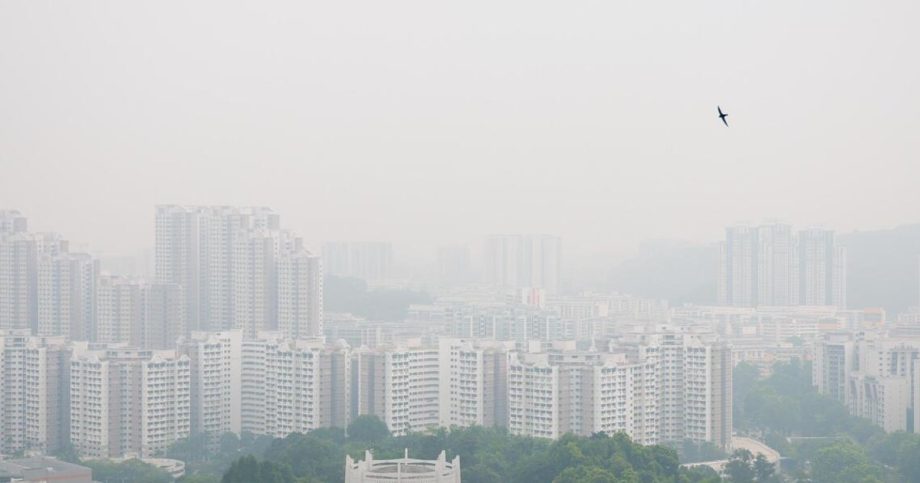
SINGAPORE – Singapore is currently experiencing its longest stretch of unhealthy air quality since September, with the Pollutant Standards Index (PSI) here recording readings above 101 since Oct 5.
The authorities also warned on Oct 9 that air quality may worsen and breach “very unhealthy” levels if hot, hazy conditions continue.
The Straits Times talks to experts on what can bring reprieve.
Will turning on the air-conditioner alone help to filter out haze particles?
Experts say that while air-conditioning helps to cool a room to make it more comfortable, its filters are designed to capture large dust particles, and not tiny haze pollutant particles.
The dominant pollutants during periods of transboundary haze are PM2.5 – tiny particles measuring 2.5 microns in diameter, 30 times smaller than the width of a strand of hair. These particles can get lodged deep in the lungs and enter the bloodstream.
Liu Zheng from NTU’s School of Materials Science and Engineering said a home air-conditioner mostly cools the same air that is already in the room. Its filter is only meant to catch dust instead of haze particles, which are far too small.
“So it makes the room cooler, but not much cleaner,” he said. Turning on the air-conditioner, however, does help in an indirect way as the closed doors and windows help to keep much of the haze out, he added.
Rajasekhar Balasubramanian from the NUS College of Design and Engineering said that while air-conditioning systems contain filters, those commonly used at homes are generally not efficient at removing fine particulate matter.
Upgrading air-conditioners to include filters of Minimum Efficiency Reporting Values (MERVs) of 13 and above can also improve the removal of airborne fine particles, said Balasubramanian. MERVs indicate the ability of an air filter to capture airborne particles.
Otherwise, experts said that using an air purifier with a High-Efficiency Particulate Air filter, or HEPA filter – which is designed to catch the tiny haze particles – in an enclosed room can help improve indoor air quality.
However, the air purifier must have enough capacity to match the size of the room and should not be confused with humidifiers and dehumidifiers, said Philip Eng, a senior consultant respiratory physician at Mount Elizabeth Hospital.
Will indoor plants help to improve air quality?
Singapore Environment Council executive director Cheang Kok Chung said that while indoor plants can absorb small amounts of gaseous pollutants, such as volatile organic compounds, which are toxic gaseous compounds, plants are unable to filter out fine particular matter like the haze particles.
NUS’ Balasubramanian said plants can capture some airborne particles on their leaves.


Read Full Article At Source