I’ve spent years judging games on things like combat, story, graphics, or how satisfying their open worlds are. But something occurred to me recently–I’ve not put enough thought into where exactly I would live if I had to move into one of these games.
Sure, legendary weapons are nice, and okay, fine, maybe I should be concerned about the fate of the world. If there’s an ancient evil force trying to destroy civilization, I guess I could take a look at it. But I’m an adult, and so I have adult concerns. When retiring to my quarters among all of the chaos, do I have enough storage? Is the bathroom a reasonable enough distance from where I sleep? Is there enough natural light?
For this highly specific and scientific experiment, I’ve decided to judge games based purely on how nice–or how practical–it would be to live there. There are no additional points for graphics, narrative, or combat. A lovely house in a terrible location still counts as a terrible house. A vast mansion with a shitty kitchen is just going to rack up my Uber Eats bill.
I’ve judged each property on its layout, facilities, location, storage, outdoor space, and a mysterious parameter that I’m just going to refer to as “the vibe.” Of course, considering each house is from a game, I’ll also have to focus on how likely it is that I’ll be murdered in my sleep, whether supernatural interference is likely, and signs of an impending apocalypse. I’m also assuming that I can afford these places without question.

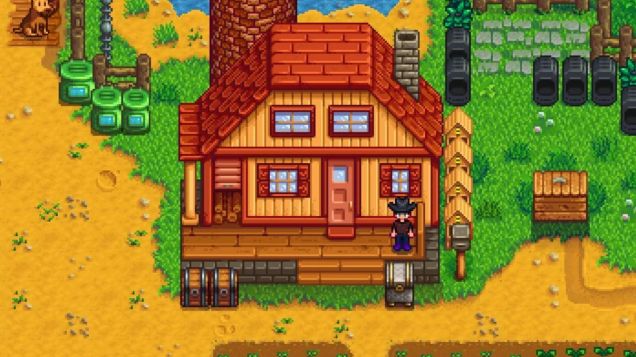
Stardew Valley’s Farmhouse
Stardew Valley’s farmhouse has everything you could reasonably want from a rural property–a comfortable living space, room to customize the interior, and even a patch of land to grow your own food. The real selling point is the garden. Imagine having enough space to keep a variety of animals, grow your own vegetables, and potter around blissfully without having to share an allotment with anyone else.
The simplicity is appealing, since you can expand and improve your property over time, making it feel like a home you’ve actually developed yourself instead of a huge, soulless new build with the same kitchen island as 30 other people in a two-mile radius.
However, there are some concerns about the local area. The town is small with limited infrastructure and the economy seems to rely on a small handful of people selling produce to one another. The local mine also has monsters but nobody seems bothered about securing the entrance or introducing an emergency protocol.
Overall, I’ll give Stardew Valley’s farmhouse a strong 9/10. I deducted a point for isolation, dangerous monsters, and a questionable local economy.

The Lake House in Alan Wake 2.
I love being beside the water, so I was pretty excited to get acquainted with the lake house in Alan Wake 2’s expansion of the same name. The views are spot on, it’s nice and tranquil, there’s plenty of fresh air, what’s not to love?
Unfortunately, Alan Wake 2 taught me that an isolated property in a heavily wooded area is not the peaceful escape I was looking for. The architecture is beautiful, and the landscape is spectacular, but survivability prospects are poor.
Given the plethora of supernatural horrors, I’d like to know whether there’s a hospital within a reasonable distance, whether delivery drivers know my house exists, and whether my insurance company covers mysterious shadow creatures.
Sadly, I’ve had to give the lake house a disappointing 4/10. While the views are stunning, I don’t want to live anywhere with such a high density of “strange” occurrences.

Animal Crossing: New Horizons’ Player’s House
The joy of Animal Crossing is that you can make the space entirely your own. You can customize your rooms, rearrange furniture, experiment with different styles, and express yourself entirely through your home. The abundance of space outdoors also allows you to create an outdoor space that you want, no matter what that is.


