He says new institutions will also be necessary amid loud calls for AI safety from top AI tech leaders, safety researchers and lawmakers
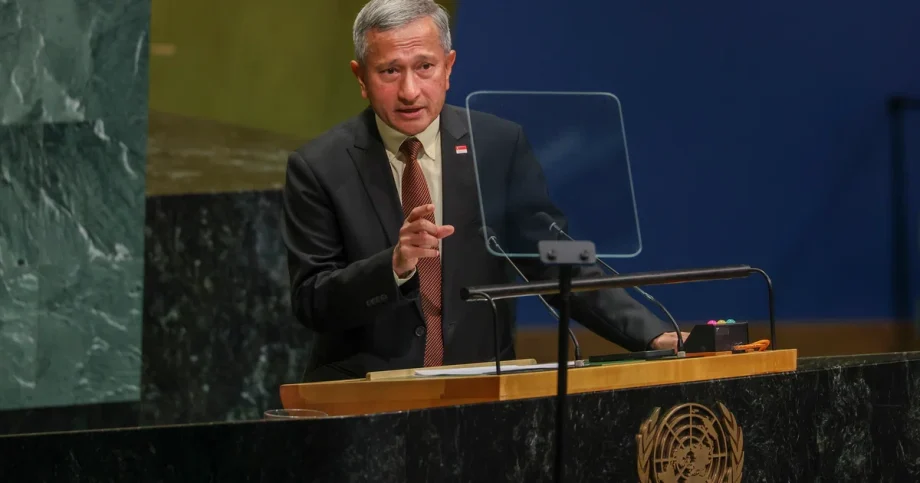
[PHILADELPHIA] As the US and China accelerate their artificial intelligence push, it is too late to ask for a safety pause, but what would help is the creation of institutions that can set safeguards and standards, Singapore Foreign Minister Vivian Balakrishnan told the United Nations in a speech on Saturday (Sep 26).
“We must collectively formulate new rules and be prepared to create new institutions, if necessary, for new technologies,” Balakrishnan said while delivering Singapore’s national statement at the General Debate of the UN General Assembly (UNGA) in New York.
“We must explore all options, including the idea of a UN Framework Convention on AI Safeguards,” he said in a 20-minute speech that advocated revitalising multilateralism to tackle acute geopolitical challenges.
A framework convention, like the one adopted by the UN on climate change, could be in the form of a broad international treaty that establishes foundational principles and cooperative institutions and provides the architecture for international action.
A similar call was made by Turkish President Recep Erdogan who used his address at the UN to stress the need for a common international legal framework for AI.
Balakrishnan said new institutions would also be necessary amid loud calls for AI safety from top AI tech leaders, safety researchers and lawmakers who warn that AI capabilities are advancing faster than the human ability to safely manage them.
“We may also need an international institution that can perform for AI some of the functions that currently exist for institutions that perform this function of setting common technical standards,” the minister said, citing the examples of the International Telecommunications Union (ITU), which manages global telecommunications and digital networks and the International Atomic Energy Agency (IAEA) which oversees the peaceful and safe use of nuclear technology.
Balakrishnan said the risks arose from three possibilities – the loss of control of autonomous systems; the misuse by rogue actors to create bio weapons or other weapons of mass destruction, and pervasive political and socio-economic disruption.
“But the genie is already out of the bottle,” he added, in a reference to the clamour for safety as well as the nascent efforts between the US and China to set up a dialogue on the issue.
SEE ALSO

“It is too late to call for a halt, especially given the superpower rivalry and the huge financial incentives for companies who already have frontier models,” he said.
He used the analogy of a car and traffic lights to bring the point home.
“To drive a high-performance car quickly and safely, you need a powerful engine, but equally, you need good brakes,” he said.
“And especially if you are going to go beyond your neighbourhood or cross boundaries, you need effective shared rules, traffic lights, insurance, norms of behaviour, and seat belts,” he added.
“Our safeguards must keep pace,” he said, calling for rigorous testing and evaluation before deployment.
Read Full Article At Source