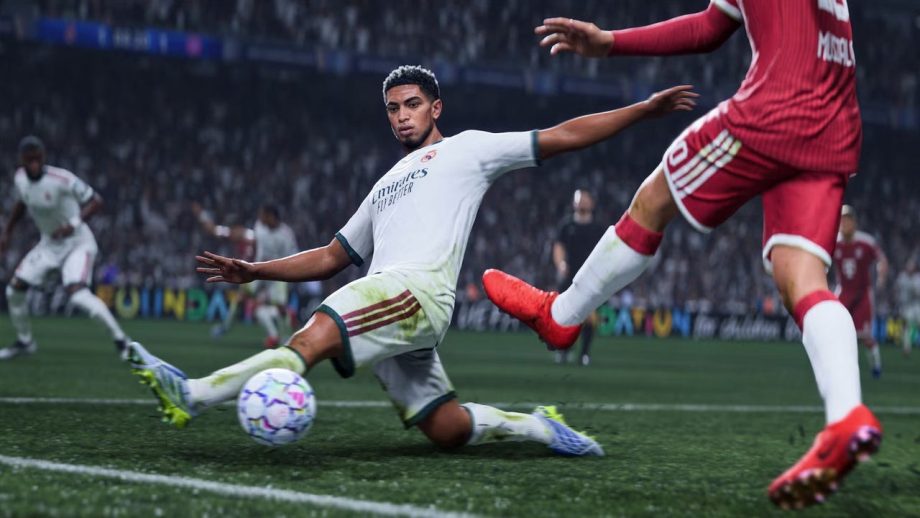
I find myself in a weird place with EA Sports FC 27. On one hand, worthwhile strategic elements have finally been added that reflect real-world tactics in a concise, intuitive way. On the other hand, the promised improvements to the behavior and pathing of computer-controlled players on the field still ring hollow, carrying over many of the same issues the series has had for over a decade. Couple this with the dreaded introduction of open-world elements via The Grounds, and the result is yet another year where nearly positive change is balanced out by a negative one.Ever since NBA 2K14 introduced MyPark, which eventually evolved into The Neighborhood in NBA 2K18 and The City in NBA 2K21, I figured it was only a matter of time before EA brought a similar open world full of activities to its other sports franchises. While The Grounds isn’t without merit, it often feels like EA is trying to solve a problem that didn’t really exist.
After hours of exploring The Grounds, it’s clear FC 27 didn’t need to have an open-world environment to deliver a more communal online mode. I don’t need to run through a visually saturated, low-resolution city populated by lifeless NPCs just to find a game mode to start up when simple menus devoted to the same function can do that in a more efficient manner. Sure, it works well as an active lobby for matchmaking and makes it easier to find other players and move between activities, but between the framerate drops and unnatural character animations, nothing is immersiveness enough about this hub to justify its existence.
The issues above are only compounded by the myriad of unskippable cutscenes and NBA 2K15-level voice acting that make up The Grounds. The irony is that I was initially excited by the new hub world because it brings back one of my favorite FIFA characters from The Journey story mode: Alex Hunter, who first appeared in FIFA 17 and FIFA 18, once again voiced by Adetomiwa Edun. That enthusiasm disappeared quickly once Hunter began speaking, as his delivery feels noticeably more rigid and detached than it did during his original story.
Edun’s performance nearly a decade ago was passionate and natural, whereas The Grounds’ version of Hunter sounds like he would rather be anywhere else. Things get even more painful when Kylian Mbappe appears shortly afterward, delivering his lines with such a stiff, mechanical cadence that it was clear he read them directly from the script all in one take. I honestly found myself grateful that my created character doesn’t speak to avoid adding even more uncomfortable interactions.
The frustration is only compounded by the constant connection issues and errors that still plague the multiplayer community. From disconnects to server lag, I got kicked from or had to leave more games than I can count in my first full week with FC 27. At one point, I even had a match where my opponent had a goal kick, but instead of kicking the ball, his keeper started floating up the pitch with it. This didn’t end until the poor player was sent back to his home planet like Poochie in The Simpsons. After a few hilarious, confusing seconds, the netminder was able to take his place back between the posts, but I was given a corner kick as a result.
I also played every new minigame, from Mario Kart-like Balloon Ball to Football Tennis. While I had some fun, it wasn’t enough to buck the notion that these elements belong in FIFA Street more than they do FC 27. Combine that with the fact that progression in The Ground is tied to coins and XP that can also be purchased with real money, and it only compounds my worry that the series keeps moving away from the beautiful game I know and love to further push microtransactions.
When it comes to gameplay, FC 27’s expanded Tactics system and its effect on gameplay is easily the best addition, wonderfully complementing the playstyles and roles introduced over the past few years by improving strategy, movement, passing, and crossing in numerous ways. Now more than ever, you have more control over how teams behave in different phases of play, going beyond basic formations and instructions by explaining the purpose, strengths, and weaknesses of different tactical approaches.
This becomes particularly useful when building around individual player attributes. As a Manchester United fan, I found that a deeper defensive approach worked especially well for Noussair Mazraoui, whose patient style lets him maintain his position and disrupt attacks without constantly stepping out of shape, while a short-passing buildup gives him chances to use his technical ability without abandoning that defensive structure.