DUNHUANG – On the lawn of the Asian Civilisations Museum (ACM), a 6m inflatable jostles for height with nearby trees.
This illuminated cartoon figure with a cherubic smile, draped in a gravity-defying sash, is an avatar of the apsaras, the “cheerleaders” of Buddhism. Where they are, it is said, there is music and flowers, a nirvana saturated with fragrance.
These celestial beings have become synonymous with the north-western Chinese desert city of Dunhuang – a tourist hot spot for China’s domestic travellers.
A slice of this arid city now sits at the ACM’s blockbuster exhibition, Sacred Caves: Dunhuang, Buddhism, And The Silk Road, created in partnership with China’s state-run Dunhuang Academy.
From Sept 25, visitors can step into 1,000-year-old grottoes filled with monumental sculptures and floor-to-ceiling murals from the renowned UNESCO World Heritage site Mogao Caves, so named for its “peerless” status.
Comprising four full replica caves, 22 paintings and 47 original artefacts, it is the biggest show of Dunhuang treasures in South-east Asia and is on till March 7.
The Mogao Caves, a hive of 500 ornately decorated chambers chipped into the soft gravel facade of the Mingsha mountains, is still relatively little-known outside China. But in culture and history circles, it has long been famous as a repository of some of the world’s most eloquent Buddhist art.
Think the Sistine Chapel in Vatican City, but multiplied hundredfold.
The man-made caves are diverse in size and are illustrative of the prayers of humble workers and the demonstrative vanity of the rich, their efforts at accumulating merit spanning the fourth to 14th centuries.

An inflatable apsara stands tall on the Empress Lawn in front of the ACM.
ST PHOTO: JASON QUAH
The images they contain are a portal into humanity’s reverential imaginings, from a human-faced bird in Chinese mythology to Hindu elephant-faced Ganesha to suggestions of Greek sun god Apollo.
ACM curator Louise Lui says: “Even though ancient Dunhuang and contemporary Singapore are very far apart in time and space, they share many traits. One is on the Overland Silk Road, the other is on the Maritime Silk Road.

ACM curator Louise Lui in front of a replica of a Mogao Caves mural in Dunhuang, China.
PHOTO: LIANHE ZAOBAO
“Both cities were shaped by trade movement, and cultural encounter and exchange, which is not something that is modern, but something that’s been happening for thousands of years.”
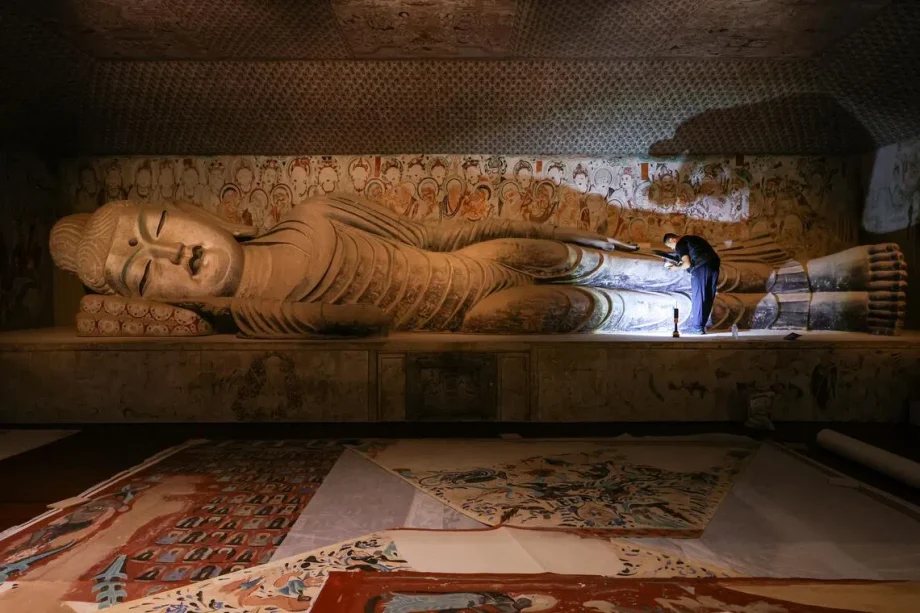
In the ACM foyer, a 13m-long reclining Buddha greets visitors, a shrunken replica as the original at 15.6m was simply too long for the space. Assembled in parts, its head alone weighs some 200kg and required 12 full-grown men to manoeuvre up the heritage building’s stairs.
Bringing history out of China
It is patently impossible to capture in ACM the mystique of the Mogao Caves, around which an entire tourist industry has blossomed, catering to nearly 20 million visitors annually.
Apsara sculptures tower in hotel lobbies. Two elaborate immersive theatre shows with purpose-built arenas are powered by state-of-the-art light equipment, with hundreds of actors popping out from niches to tell the Mogao Caves story, given a nationalistic spin.
One is directed by Wang Chaoge, co-director of the opening and closing ceremonies of the 2008 Beijing Olympics. Actresses playing goddesses wail from behind gauzy sheets: “After so much time, tell me, am I still pretty?”

Elaborate immersive shows tell the stories of the Mogao Caves in Dunhuang, digging into the endless possibilities of its pantheon.
PHOTO: LIANHE ZAOBAO
A chorus bemoans the traitorous 20th-century sales of precious manuscripts found in the caves to Western archaeologists.
Chinese domestic tourists still make up the bulk of visitors. For those committed to seeing them in person, the Mogao Caves is a 12-hour flight from Singapore via a Beijing transfer, and then a one-hour car ride from the airport.
Securing entry requires fast fingers: Ticket sales are limited to 6,000 a day, tied to identity card numbers to prevent multiple bookings and price gouging, with extra “emergency tickets” during peak seasons.


Read Full Article At Source